 Wenzhou Kaixin Kaixin Metal Co.,LTD
Comparing Inconel 718 with Other Alloys
When strength, heat, corrosion, and fit-for-purpose sourcing all matter, Inconel 718 is often shortlisted beside stainless steel, Inconel 625, Inconel 600, titanium, and high-performance alloy steels. This page helps buyers, engineers, and purchasing teams compare Inconel 718 properties against common alternatives, then request the right product form, including Inconel 718 tube, Inconel 718 pipe, Inconel 718 tubing, and Inconel 718 seamless tube. If you already know your size, specification, or operating conditions, use those details to get a focused quote instead of a generic material suggestion.
Which alloy is right for your application?
The right alloy is the one that performs reliably in the actual environment: load, temperature, corrosion exposure, fabrication method, inspection standard, and budget all matter. Inconel 718 is usually considered when a project needs high strength with good oxidation and corrosion resistance, especially where ordinary stainless steel may not provide enough high-temperature performance. Other alloys can still be the better choice when the application prioritizes easier forming, lower cost, lighter weight, or a different corrosion profile.
A practical comparison starts with the failure risk you are trying to avoid. If the part may deform under heat and stress, 718 deserves attention. If chemical corrosion is the dominant concern, Inconel 625 may be worth comparing closely. If the application is moderate-duty and cost-sensitive, stainless steel or alloy steel may meet the requirement without moving into a nickel alloy.
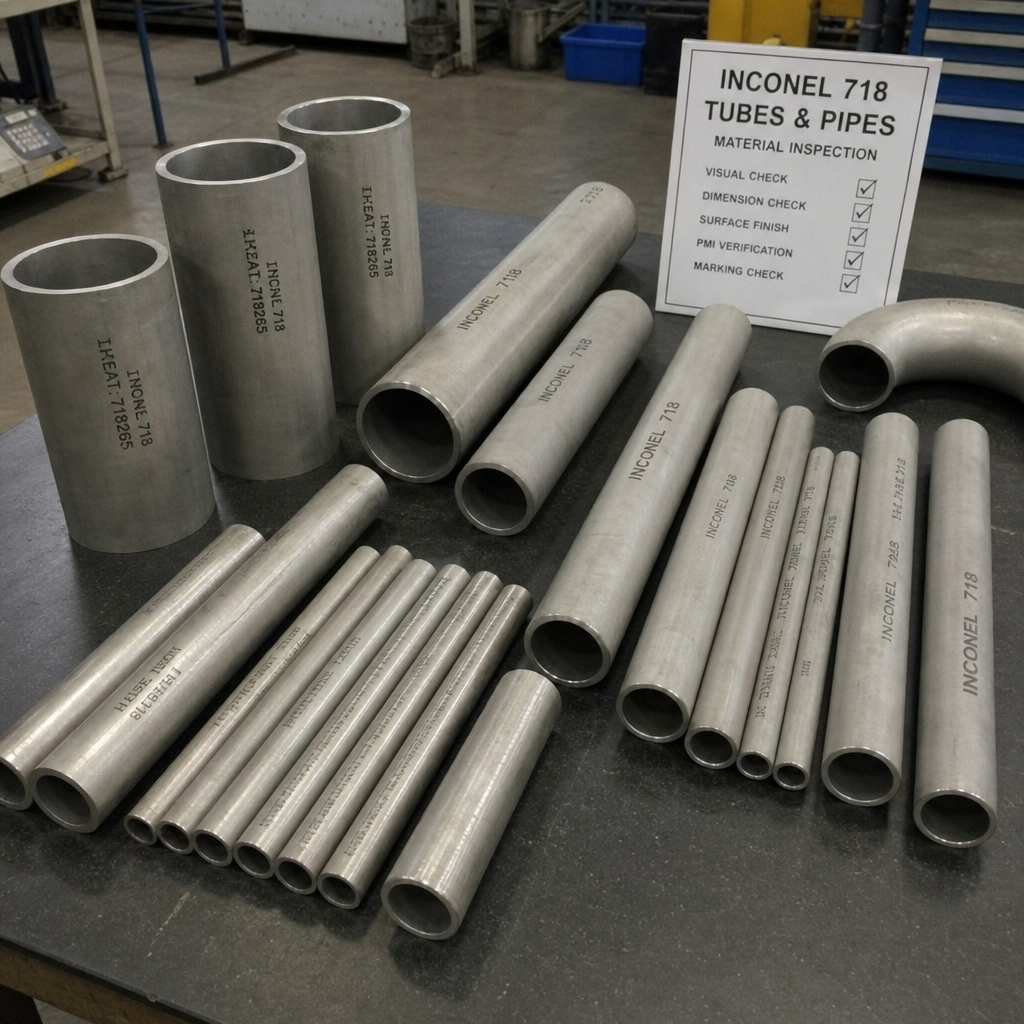
Inconel 718 tubes and pipe products arranged for industrial inspection
Inconel 718 delivers strength where standard materials reach their limit
Inconel 718 is a nickel-chromium-based superalloy valued for its combination of strength, heat resistance, oxidation resistance, and general corrosion resistance. Its precipitation-hardenable nature allows it to maintain mechanical performance in demanding environments where many conventional alloys lose capability. That makes it a serious candidate for aerospace, power generation, oil and gas, chemical processing, marine, and high-performance industrial equipment.
For buyers, the advantage is not simply that 718 is “strong.” The real benefit is confidence in parts that must keep their shape, tolerate stress, and resist aggressive service conditions. In tube and pipe applications, that can mean more dependable flow paths, structural support, instrumentation lines, or process components where material failure would be expensive or unsafe.
Common reasons teams specify Inconel 718 include:
- High strength in demanding temperature ranges
- Good resistance to oxidation and many corrosive environments
- Strong fatigue and creep resistance compared with many standard alloys
- Suitability for critical components where consistency matters
- Availability in practical product forms, including bar, sheet, plate, tube, pipe, and fittings depending on supply route
Product forms for tube, pipe, and tubing requirements
Choosing the alloy is only half the decision. The product form, dimensional tolerance, manufacturing route, and documentation requirements determine whether the material will work in production. Inconel 718 tube and Inconel 718 pipe may sound interchangeable in casual sourcing conversations, but buyers should confirm outside diameter, wall thickness, schedule, length, end finish, and applicable specification before ordering.
Inconel 718 tubing is often used where dimensional control, routing, or assembly fit matters. Inconel 718 seamless tube is commonly requested when the application requires a continuous structure without a welded seam. Pipe is typically selected for pressure, process, or transfer applications where nominal pipe size and schedule are part of the design language.
When requesting a quote, prepare the following details:
- Product form: tube, tubing, seamless tube, pipe, bar, sheet, or plate
- Size requirements: outside diameter, inside diameter, wall thickness, schedule, or cut length
- Quantity: total length, number of pieces, or project volume
- Specification or standard: ASTM, AMS, ASME, or project-specific requirement if applicable
- Condition: annealed, age-hardened, solution treated, or other required condition
- Testing and documents: material test reports, traceability, PMI, or inspection needs
- Delivery requirements: target lead time, destination, and packaging expectations
How Inconel 718 compares with other alloy choices
Compared with stainless steel, Inconel 718 is typically chosen for more demanding heat and strength requirements. Stainless steel can be easier to source and more economical for general corrosion resistance, but it may not provide the same performance margin under elevated temperature and sustained stress. For non-critical service, stainless can be the practical choice; for high-duty environments, 718 may justify the higher material investment.
Compared with Inconel 625, 718 is often selected for strength, while 625 is frequently considered for excellent corrosion resistance and weldability in harsh chemical or marine environments. The best choice depends on whether mechanical load or corrosion exposure is the main design driver. If both are severe, engineering review is essential before purchase.
Compared with Inconel 600, 718 offers a different performance profile, especially where higher mechanical strength is required. Inconel 600 remains useful in heat and corrosion environments, but 718 is the stronger candidate when the application combines load, fatigue, and temperature.
Compared with titanium, Inconel 718 is denser but can offer valuable high-temperature strength and oxidation resistance. Titanium may win where weight reduction is the top priority, while 718 is often preferred when heat, stress, and durability are more important than mass savings.
Inconel 718 price depends on the details of the order
The Inconel 718 price for a project is not determined by alloy name alone. Nickel alloy markets, product form, mill availability, size, tolerance, heat treatment, testing, certification, cut-to-length work, and delivery timing can all affect the final quote. A small custom seamless tube order may price very differently from a larger standard-size pipe requirement.
To get a more useful price response from Inconel 718 suppliers, avoid asking only for “price per foot” or “price per pound” unless the form and condition are already defined. A complete inquiry helps the supplier check realistic availability and avoids delays caused by missing information. If your project allows approved alternates, say so early; a comparable form or nearby size may improve lead time or cost.
Sourcing support from qualified Inconel 718 suppliers
A strong supplier does more than accept a part number. The right sourcing partner helps confirm whether the requested alloy, form, and documentation match the application and purchasing standard. This is especially important for Inconel 718 pipe, tubing, and seamless tube, where tolerance, traceability, and test documentation can be just as important as base material selection.
Look for support in these areas:
- Material identification and grade confirmation before quoting
- Clear communication on availability, lead time, and minimum order quantity
- Help comparing 718 with alternate nickel alloys or stainless options
- Documentation support for quality, traceability, and compliance needs
- Cutting, packaging, or logistics coordination when required
- Responsive quoting when project timelines are tight
A practical buying path for your application
Start with the service environment, then work backward to the product. Define the temperature range, load, corrosion exposure, pressure requirements, joining method, inspection standard, and expected service life. From there, compare Inconel 718 properties with the practical advantages of other alloys, including cost, availability, machinability, weldability, and lead time.
For example, a buyer replacing a standard stainless tube in a hotter, higher-stress assembly should not simply move to the most expensive alloy. The better approach is to confirm why the original material is failing, then evaluate whether Inconel 718 tube, Inconel 718 seamless tube, or another nickel alloy solves that specific problem. This keeps the purchasing decision tied to performance instead of guesswork.
Request a focused quote
If you need Inconel 718 tube, Inconel 718 tubing, Inconel 718 seamless tube, or Inconel 718 pipe, send the product form, dimensions, quantity, required specification, condition, documentation needs, and delivery timeline. You can also include the alloy you are comparing against, such as stainless steel, Inconel 625, Inconel 600, titanium, or alloy steel. With those details, your quote can address both material fit and purchasing reality, helping you choose an alloy that performs as expected without overspecifying the job.

 English
 Afrikaans
 Arabic
 Bengali
 Catalan
 Chinese
 French
 Dutch (Belgium)
 Dutch
Dutch German
 Czech
Czech Greek
Greek Hindi
Hindi Japanese
 Italian
 Portuguese
 Spanish (Chile)
 Spanish (Colombia)
 Spanish (Argentina)
 Persian
 Estonian
 Albanian
 Russian
 Spanish (Peru)
 Indonesian
 Thai
Thai Vietnamese
 Georgian
 Korean
 Nepali
 Polish
 Ukrainian
 Malayalam
 Xhosa
Xhosa