 Wenzhou Kaixin Kaixin Metal Co.,LTD
Umahluko wamapayipi angama-32205 xa ethelekiswa neeHastelloy C-276 zokutshintshisana ubushushu
Hastelloy C-276 tubes are high-performance heat exchanger tubes for corrosive process conditions where standard stainless and duplex stainless grades may not give enough protection. If your comparison is between “32205” and Hastelloy C-276, the practical question is usually whether UNS S32205 duplex stainless steel is sufficient, or whether the more corrosion-resistant C-276 alloy is worth the higher purchase cost. This page helps buyers, engineers, and procurement teams choose the right hastelloy tubing for chemical, marine, waste treatment, and industrial heat exchanger service.
Which tube material is better for your heat exchanger?
Hastelloy C-276 is generally the stronger choice for severe corrosion, mixed acids, chloride pitting, crevice corrosion, and aggressive chemical process fluids; UNS S32205 duplex stainless steel is often chosen when the environment is less aggressive and mechanical strength with cost control is the priority. In simple terms, S32205 can be a practical Isitshintshi sobushushu tube material for many chloride-bearing services, while hastelloy c-276 tubes are selected when failure risk, downtime, leakage, or product contamination would cost far more than the initial material upgrade. Hastelloy C-276 alloy is a nickel-chromium-molybdenum material known for high resistance to chloride-induced pitting and crevice attack, while SAF 2205 / UNS S32205 is a duplex stainless steel with good chloride stress corrosion cracking resistance compared with common austenitic stainless steels.
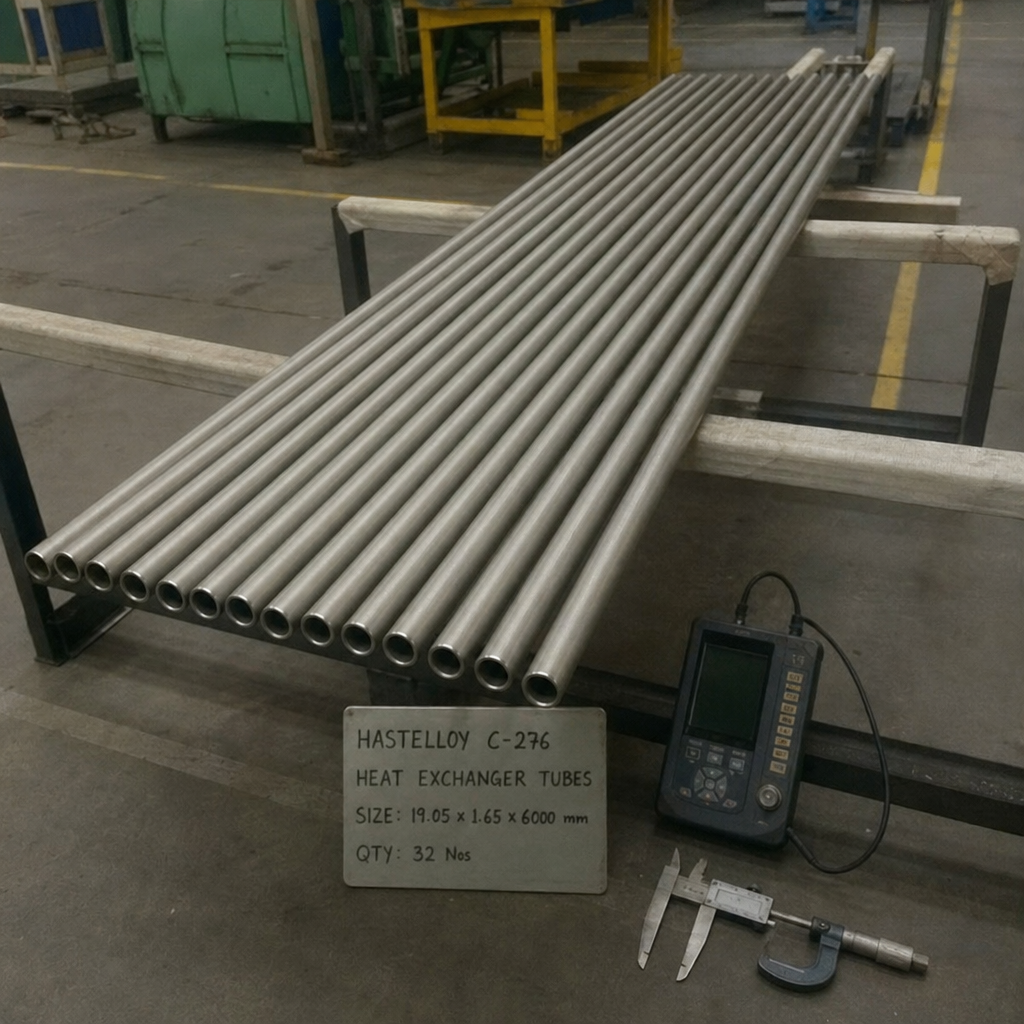
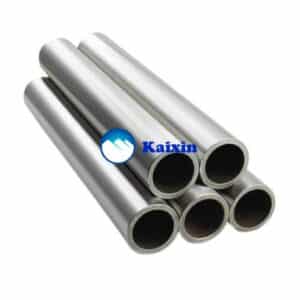
Hastelloy C-276 heat exchanger tubes arranged for industrial inspection
The core difference between S32205 and Hastelloy C-276
S32205, often known as Duplex 2205, is a stainless steel grade with a mixed austenitic-ferritic structure. It offers good strength and improved chloride stress corrosion cracking resistance compared with grades such as 304L and 316L. That makes it attractive for many heat exchanger designs where the operating medium is moderately corrosive and the project needs a balance of performance, availability, and cost.
Hastelloy C-276, also written as hastelloy c 276, hastelloy c-276, C276, or UNS N10276, belongs to a different material class. It is a nickel-based c-276 alloy with chromium, molybdenum, and tungsten additions. Its value is not simply “higher grade metal”; it is better security in harsh media where localized corrosion can start at crevices, deposits, tube sheet joints, weld heat-affected zones, or stagnant areas inside a heat exchanger.
For buyers, the difference becomes clear in three areas:
- Corrosion margin: Hastelloy c-276 tubes are normally selected for harsher chemical duty, especially where acids, chlorides, oxidizing contaminants, or changing process chemistry are present.
- Cost position: S32205 usually has a lower material cost than nickel alloy tubing, while hastelloy c 276 tubes price is higher because of its nickel and molybdenum content and more demanding production route.
- Risk management: If the heat exchanger is easy to access, operates in mild conditions, and downtime is manageable, S32205 may be enough. If leakage would stop production or create safety and environmental risk, C-276 becomes easier to justify.
Product focus: Hastelloy C-276 tubes for demanding heat exchangers
Our offered hastelloy c-276 tubes are intended for heat exchanger projects where chemical resistance is the deciding factor. They are suitable for shell-and-tube exchangers, condensers, evaporators, process coolers, acid service equipment, scrubber systems, and other industrial assemblies that require reliable tubing under corrosive media. The goal is simple: help the heat exchanger last longer in the actual operating environment, not only pass a material checklist.
C-276 is often considered where ordinary hastelloy pipes, stainless tubes, or duplex alternatives may face pitting, crevice attack, or weld-area corrosion. In heat exchangers, those risks matter because tubes are thin, numerous, and difficult to inspect internally once installed. A single leaking tube can force plugging, shutdown, cleaning, or replacement, so material selection should be based on the fluid, temperature, chlorides, deposits, cleaning chemicals, and expected service life.
When sourcing from a china hastelloy c 276 tubes supplier, buyers should focus on traceability and documentation rather than price alone. Correct alloy identity, dimensional control, heat treatment condition, surface quality, and testing records are all part of the product value. A lower quote is not useful if the tubing arrives without documents, has poor surface finish, or cannot meet the heat exchanger fabricator’s specification.
Key benefits of choosing Hastelloy C-276 tubing
Hastelloy C-276 tubing is chosen when the process environment leaves little room for trial and error. It provides a corrosion-resistant tube option for users who need more protection than common stainless steel and many duplex stainless applications can offer. This does not mean C-276 is required for every exchanger; it means the alloy is valuable when corrosion risk is the main design constraint.
Iinzuzo eziphambili ziquka:
- Better protection in severe chemical media: C-276 is widely associated with resistance across many aggressive chemical environments, making it a strong candidate for chemical processing and pollution control applications.
- Resistance to localized attack: Heat exchanger tubes can suffer from pitting and crevice corrosion where deposits, low flow, or tube sheet gaps concentrate corrosive species. C-276 is selected to reduce that vulnerability.
- Useful weldability profile: C-276 was developed with very low carbon and silicon content to help address welding-related corrosion concerns in wrought nickel-chromium-molybdenum materials.
- Long-term equipment confidence: The higher initial cost can be justified where shutdowns, tube plugging, product loss, or emergency replacement would be expensive.
- Broad industrial fit: Hastelloy applications include chemical process equipment, waste treatment, flue gas systems, sour service-related equipment, and other duties where corrosive fluids are handled.
Where S32205 may still be the right choice
A fair comparison should not make S32205 look weak. Duplex 2205 / UNS S32205 is a respected engineering material, and in the correct service it can be efficient and economical. It has good strength, good resistance to chloride stress corrosion cracking compared with 304L and 316L, and a strong track record in many industrial systems.
S32205 may be suitable when:
- The heat exchanger medium is only moderately corrosive.
- Chloride concentration and temperature are controlled.
- The process does not involve severe reducing or mixed acid conditions.
- Cleaning chemicals are compatible with I-duplex engagqwali.
- The equipment can be inspected and maintained without major production loss.
- Budget limits make nickel alloy tubing impractical.
The caution is that heat exchanger service is rarely defined by alloy name alone. Temperature spikes, stagnant zones, deposits, oxygen content, cleaning cycles, and weld quality can change the corrosion picture. Reports on duplex stainless systems also show that hot chloride service can create stress corrosion cracking risks under certain conditions, especially when chlorides, temperature, deposits, and stresses combine.
Recommended selection guide for buyers
Choosing between S32205 and hastelloy c-276 tubes should begin with process data, not only material preference. If your team is replacing failed tubes, upgrading an existing exchanger, or designing new equipment, the best request for quotation should include the service conditions. That allows the tube supplier or manufacturer to recommend a realistic product route.
Sebenzisa olu luhlu lokujonga phambi kokuba ucele ikowuti:
- Identify both fluids. Provide tube-side and shell-side media, including contaminants, chlorides, acids, solvents, or suspended solids.
- Define temperature and pressure. Include normal operating values plus upset, cleaning, start-up, and shutdown conditions.
- Review corrosion history. Note any previous pitting, leaks, scale, crevice attack, stress corrosion cracking, or tube plugging.
- Confirm fabrication method. State whether the heat exchanger requires seamless tubes, welded tubes, U-bent tubes, straight lengths, or cut-to-size pieces.
- Specify documents. Ask for mill test certificates, chemical composition records, mechanical test reports, dimensional inspection, and any required NDT.
- Check applicable standards. Confirm the ASTM, ASME, EN, or project-specific requirements before production.
- Compare total cost. Include expected service life, downtime risk, cleaning frequency, and replacement cost, not just the tube purchase price.
This approach helps prevent a common mistake: selecting S32205 because it is cheaper, then discovering the real operating environment needed hastelloy c 276 tubes from the start. It also prevents the opposite mistake: specifying C-276 for a mild service where a duplex or stainless grade would have been adequate.
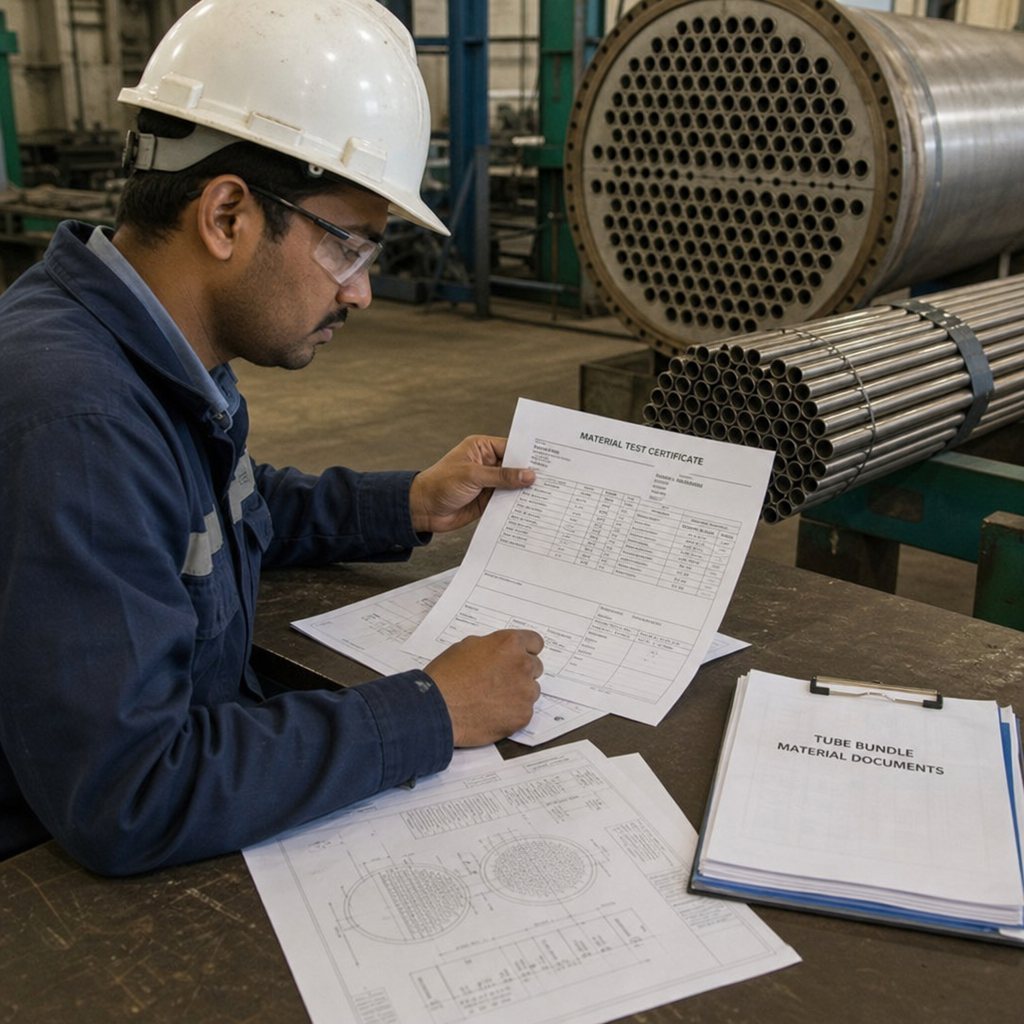
Engineer checking tube bundle material documents for heat exchanger fabrication
Inkxaso yezinto onokukhetha kuzo kunye neenkcukacha zemveliso
Hastelloy c-276 tubes can be supplied for different heat exchanger fabrication needs, depending on project requirements and production capability. Because exact sizes, wall thicknesses, tolerances, surface condition, and testing requirements vary by order, the correct specification should be confirmed before quotation. This is especially important for buyers comparing international offers from a china hastelloy c 276 tubes manufacturer or exporter.
Common purchasing details to prepare include:
- Material name: Hastelloy C-276 / Alloy C-276 / UNS N10276.
- Uhlobo lwemveliso: Heat exchanger tube, condenser tube, process tube, or general hastelloy tubing.
- Indlela yokuvelisa: Seamless or welded, depending on design and standard.
- Tube condition: Annealed or project-specified condition.
- Dimensions: Outside diameter, wall thickness, length, and tolerance.
- End use: Chemical exchanger, condenser, evaporator, scrubber, waste treatment, or other equipment.
- Testing needs: Hydrostatic test, eddy current test, ultrasonic test, PMI, visual inspection, and dimensional inspection where required.
- Amaxwebhu: MTC, heat number traceability, packing list, certificate requirements, and third-party inspection if needed.
For heat exchanger manufacturers, consistent dimensions and clean surfaces are not minor details. Tube rolling, expansion, welding, and tube sheet sealing all depend on stable geometry and surface quality. A strong hastelloy c 276 tubes manufacturer should be able to discuss these requirements clearly before production.
Price factors for Hastelloy C-276 tubes
Hastelloy c 276 tubes price changes with alloy cost, size, quantity, manufacturing route, testing level, delivery schedule, and documentation requirements. Nickel alloy tubing is normally quoted project by project because small changes in wall thickness, length, tolerance, or inspection requirements can affect production cost. For this reason, a generic per-kilogram price is rarely enough for heat exchanger procurement.
The main price drivers are:
- Nickel alloy raw material cost: C-276 contains high-value alloying elements, so market movement can affect quotations.
- Umbhobho Ubungakanani and wall thickness: Thin-wall heat exchanger tubes require careful production and inspection.
- Seamless versus welded supply: Manufacturing route influences cost, availability, and lead time.
- Order quantity: Larger quantities may improve unit pricing, while small urgent orders can cost more.
- Testing requirements: Additional NDT, PMI, corrosion testing, or third-party inspection can increase cost but reduce project risk.
- Packing and export needs: Wooden cases, seaworthy packing, marking, and document legalization may affect final price.
- Delivery time: Stock items, new production, and urgent shipment all price differently.
If you are comparing C-276 with S32205, do not stop at the first purchase price. A cheaper tube that fails early can become the most expensive option once labor, shutdown, emergency freight, cleaning, and lost production are included.
Heat exchanger scenarios where C-276 is the safer upgrade
A practical example is a chemical plant replacing tubes after repeated leakage near tube sheet areas. The previous material may have looked acceptable on paper, but deposits and low-flow zones created crevice conditions during operation. In that situation, upgrading to hastelloy c-276 tubes can provide extra corrosion margin where inspection is difficult and failure is disruptive.
Another common scenario is process variation. If the heat exchanger sees changing acid concentration, chloride contamination, oxidizing impurities, or periodic chemical cleaning, a material that survives only the “normal” condition may not be enough. C-276 is considered when the plant wants more tolerance against real-world changes rather than perfect laboratory conditions.
C-276 may be especially worth evaluating for:
- Acid coolers and condensers.
- Chloride-containing chemical process streams.
- Scrubber and pollution control systems.
- Waste treatment and recovery equipment.
- Heat exchangers exposed to aggressive cleaning chemicals.
- Tube bundles where access and replacement are difficult.
How to request the right quote
To receive an accurate quotation for hastelloy c 276 tubes, share your drawings, tube schedule, material standard, quantity, inspection requirements, and delivery destination. If you are still choosing between S32205 and C-276, also share service conditions so the offer can be aligned with the actual duty. The more complete the information, the easier it is to compare suppliers on the same basis.
Send your inquiry with the required Ubungakanani bethubhu, wall thickness, length, quantity, standard, and application. Ask for current availability, production lead time, documentation, inspection options, and packing details. Whether you are sourcing hastelloy pipes, heat exchanger tubes, or custom hastelloy tubing, a clear specification helps secure the right alloy, the right quality level, and the right price for your project.


 English
 Afrikaans
 Arabic
 Bengali
 Catalan
 Chinese
 French
 Dutch (Belgium)
 Dutch
Dutch German
 Czech
Czech Greek
Greek Hindi
Hindi Japanese
 Italian
 Portuguese
 Spanish (Chile)
 Spanish (Colombia)
 Spanish (Argentina)
 Persian
 Estonian
 Albanian
 Russian
 Spanish (Peru)
 Indonesian
 Thai
Thai Vietnamese
 Georgian
 Korean
 Nepali
 Polish
 Ukrainian
 Malayalam
 Xhosa
Xhosa