 Вэньчжоу Кайсинь Кайсинь Металл ЛТД

Сравнение фланцев с приварной шейкой и насадочных фланцев
Choosing between a weld neck flange and a slip-on flange affects installation time, welding requirements, long-term reliability, and how well a piping connection handles pressure, temperature, and movement. Both are common pipe flanges used across industrial systems, but they are built for different service conditions. This guide explains how each design works, what flange dimensions matter, and how to compare weld neck flange vs slip on options for practical applications.
What is the difference between a weld neck flange and a slip-on flange?
A weld neck flange has a long tapered hub that is butt-welded to the pipe, creating a smooth transition from pipe to flange and helping distribute stress through the connection. A slip-on flange slides over the outside of the pipe and is typically fillet-welded at the hub and inside the bore, making it simpler to fit and often faster to install. In short, weld neck flanges are usually selected for more demanding service, while slip-on flanges are often chosen where ease of alignment and installation efficiency are priorities.
That difference in geometry drives most of the comparison. The weld neck design becomes more integrated with the pipe wall, which can make it suitable for systems where pressure, thermal cycling, vibration, or mechanical loading are concerns. The slip-on design is less complex and easier to position before welding, but it does not provide the same tapered reinforcement or butt-welded transition.
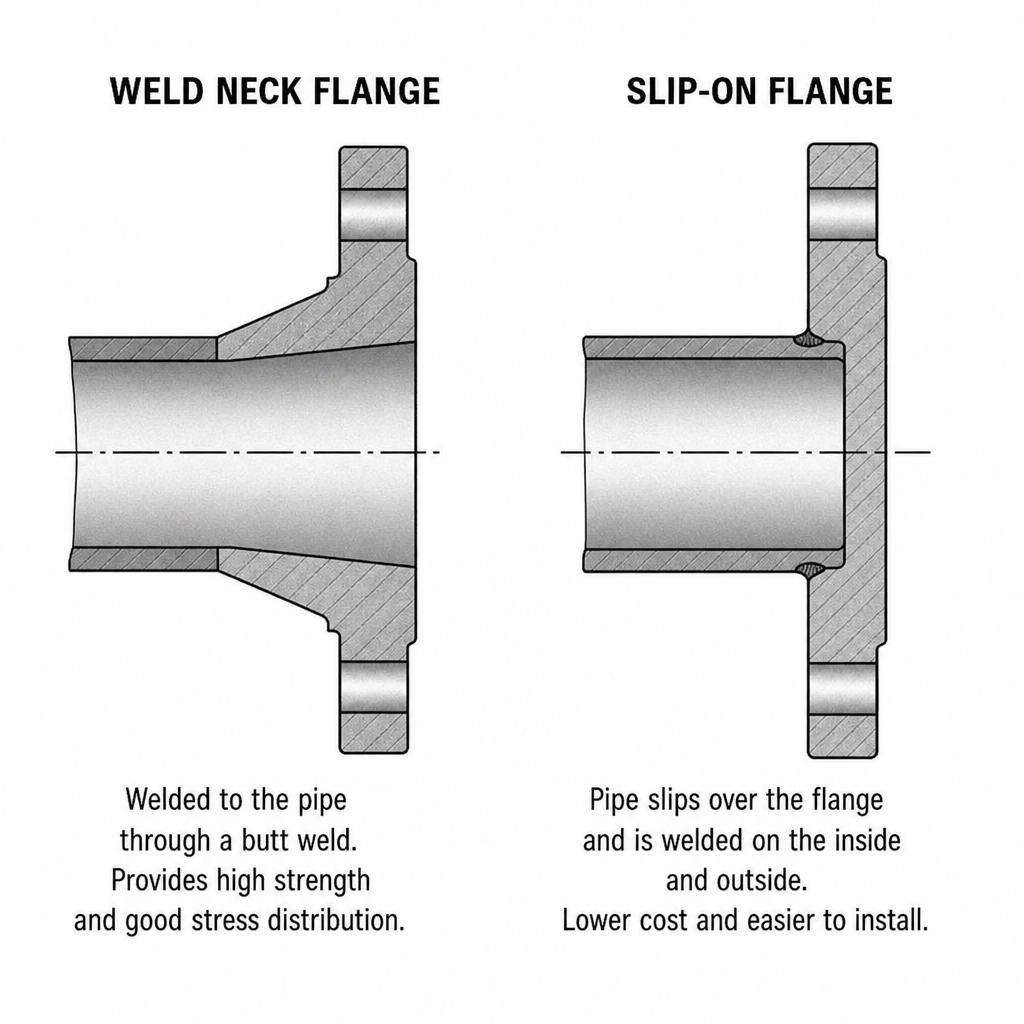
weld neck and slip-on flange side-by-side diagram
Flanges create bolted access points in piping systems
Industrial flanges are used to connect pipe to pipe, pipe to valves, pipe to equipment, and pipe to specialty components such as strainers, meters, or expansion joints. Unlike a permanent welded joint, a flanged joint can be disassembled when maintenance, inspection, cleaning, or replacement is needed. That serviceability is one reason flange types are so widely used in технологические трубопроводы, water systems, oil and gas facilities, power plants, chemical service, and general industrial construction.
A typical flanged connection includes two matching flanges, a gasket, bolts or studs, nuts, and a controlled tightening process. The gasket seals between the flange faces, while the bolting creates the compressive load needed to maintain the seal. Because all of these parts work together, flange selection should not be based on flange style alone. Material, pressure class, face type, gasket compatibility, bolt pattern, bore size, and project standard all matter.
Weld neck flange fundamentals
A weld neck flange is recognized by its extended neck or hub. The pipe end is beveled and butt-welded to the flange neck, forming a full-penetration-style connection when specified and executed according to the applicable procedure. This design helps create a more gradual path for stress rather than concentrating load abruptly at the flange body.
The hub is the main feature that separates this flange from simpler designs. In demanding systems, that hub can help the joint tolerate pressure loads, bending forces, temperature changes, and vibration more effectively than a flat or compact flange geometry. This is why a weld neck flange is commonly associated with critical piping, high-pressure lines, high-temperature service, hazardous media, or locations where failure would be costly.
A carbon steel weld neck flange is a common choice for many industrial piping systems where carbon steel pipe is also used. The benefit is compatibility with common pipe materials and welding practices, but the final selection still depends on the fluid, temperature, corrosion allowance, wall thickness, coating requirements, and governing specification.
Slip-on flange fundamentals
A slip-on flange is designed with a bore slightly larger than the pipe outside diameter, allowing the pipe to slip into the flange before welding. Installers can adjust the flange position more easily during fit-up, which can be helpful when lining up bolt holes, correcting minor layout issues, or working in less complex piping runs. The flange is then secured with fillet welds, typically at the outside hub area and at the inside connection point.
The practical appeal of a slip-on flange is straightforward: it is comparatively easy to handle, align, and weld. For lower-demand services, utility piping, and general industrial applications, that simplicity can make the slip-on style attractive. It can also reduce fit-up complexity where a butt-welded neck is not required by the design.
However, easier installation does not automatically mean the best long-term choice. A slip-on flange introduces different stress behavior because the pipe is not butt-welded to a tapered neck. In systems with high loads, significant vibration, frequent thermal cycling, or strict inspection requirements, the design engineer may prefer a weld neck flange.
Flange dimensions that matter in both designs
Flange dimensions are not just catalog details. They determine whether the flange fits the pipe, mates with the opposing flange, accepts the correct gasket, and provides the intended sealing performance. Even small mismatches can create field delays, leakage risk, or rework.
Important dimensions and fit details include:
- Номинальный размер трубы The flange must match the pipe size and the connecting component. Nominal size is not always the same as measured outside diameter, so selection should follow the relevant standard or project specification.
- Pressure class or rating The class affects thickness, bolt pattern, and pressure-temperature suitability. A flange should not be chosen by size alone.
- Bore diameter The bore must match the pipe schedule or wall thickness requirements. This is especially important for a weld neck flange because the bore transition should suit the pipe’s internal diameter.
- Outside diameter and thickness These dimensions affect strength, clearance, weight, and compatibility with adjacent equipment or supports.
- Bolt circle and bolt holes Matching bolt patterns are essential. If the bolt circle, hole size, or number of holes differs, the flanges will not assemble correctly.
- Face type and gasket surface Raised face, flat face, and other facing styles must be compatible with the gasket and mating flange. Surface finish may also be specified for sealing performance.
- Hub dimensions On a weld neck flange, hub length and taper are central to the design. On a slip-on flange, hub geometry still affects welding access and connection strength.
Weld neck flange vs slip on performance comparison
When comparing weld neck flange vs slip on choices, the best answer depends on the system’s operating conditions rather than a single universal rule. A weld neck flange generally offers a stronger, more continuous connection to the pipe, while a slip-on flange generally offers easier installation and alignment. Each can be the right choice when applied in the correct context.
Strength and stress distribution
The weld neck flange has the advantage when stress distribution is a major concern. Its tapered hub helps transfer load between pipe and flange more gradually. This can be valuable in systems exposed to pressure surges, temperature changes, vibration, or external loads from connected equipment.
A slip-on flange relies on fillet welds and does not have the same butt-welded neck transition. For less severe service, that may be acceptable. For critical applications, the design team should evaluate whether the connection provides enough mechanical integrity.
Installation and alignment
The slip-on flange is often easier to position because it slides over the pipe. Installers can rotate it to align bolt holes before welding, which can simplify fabrication. This advantage can matter when many flanged joints are being installed or when the line is not subject to severe service.
A weld neck flange requires more precise pipe preparation and fit-up. The pipe end and flange neck need proper alignment for the butt weld, and welding quality is more central to the finished joint. The added effort can be justified when service demands are higher.
Inspection and maintenance implications
Inspection requirements depend on the project, code, and service. Weld neck flanges may be preferred where butt weld inspection is required or where the weld configuration aligns with established quality procedures. Slip-on flanges may involve fillet weld inspection practices that are suitable for many non-critical services.
Maintenance crews usually care about reliable sealing, bolt access, and repeatable gasket replacement. Both flange types can support maintainable joints when installed correctly. Problems tend to arise when the flange type, gasket, bolts, or tightening practice does not match the service.
How do you choose the right flange type?
Choose the flange type by matching the design to pressure, temperature, fluid hazard, pipe material, inspection requirements, installation conditions, and maintenance expectations. A weld neck flange is often the more conservative choice for demanding service, while a slip-on flange may be appropriate for lower-risk systems where fit-up speed and simplicity matter. The final decision should follow the governing piping code, project specification, and engineering review.
Use this practical checklist before selecting between slip on flange vs weld neck flange options:
- Define the service conditions: Identify operating pressure, temperature, cycling, fluid type, and whether the service is hazardous, corrosive, or difficult to shut down.
- Confirm the pipe specification: Match material grade, wall thickness, schedule, and corrosion requirements.
- Review the applicable standard: Use the specified flange standard for dimensions, pressure class, facing, tolerances, and marking requirements.
- Check mating components: Make sure valves, equipment nozzles, gaskets, and existing pipe flanges use compatible dimensions and face types.
- Evaluate fabrication capability: Consider whether the shop or field team is prepared for butt welding, fillet welding, inspection, and any heat treatment requirements.
- Plan for maintenance access: Confirm that bolts can be removed, gaskets can be replaced, and the flange locati0n is serviceable.
- Avoid mixing assumptions: Do not assume two flanges match because they share a nominal size. Verify class, face, bore, bolt pattern, and material.
Common application patterns
Weld neck flanges are frequently associated with process lines, high-pressure piping, high-temperature service, rotating equipment connections, and other locations where durability and stress management are important. They are also useful when the pipe-to-flange connection needs to be treated as part of a more rigorous welded piping system.
Slip-on flanges are commonly used in general utility service, lower-pressure process support lines, water systems, and fabricated assemblies where installation convenience is valuable. Their ability to slide into position can make them practical for layouts that require easier adjustment before final welding.
These patterns are not substitutes for engineering judgment. A slip-on flange may be unsuitable in one plant but acceptable in another because the operating conditions, standards, inspection plan, and risk tolerance differ. Likewise, a weld neck flange may be more robust than necessary for a simple low-demand line.
Material selection and compatibility
Flange material should be compatible with the pipe, the process fluid, the environment, and the welding procedure. Carbon steel is widely used, including in carbon steel weld neck flange applications, but it is not automatically right for every service. Stainless steel, alloy steel, low-temperature carbon steel, and other materials may be required depending on corrosion, temperature, toughness, or cleanliness needs.
Material compatibility also affects gasket and bolt selection. A flange connection is only as reliable as the complete assembly. If the flange body, fasteners, gasket, and pipe are not selected together, the joint may fail to seal properly or may degrade faster than expected.
Best practices for specifying pipe flanges
Good flange specification reduces field problems. Instead of ordering by shorthand, include enough information for the supplier, fabricator, and installer to identify the correct component.
A clear flange description should usually include:
- Flange type, such as weld neck flange or slip-on flange
- Номинальный размер трубы
- Pressure class or rating
- Material grade or specification
- Facing type
- Bore or pipe schedule requirement
- Applicable standard
- Any special requirements, such as coating, testing, marking, or documentation
It is also wise to confirm flange dimensions before fabrication begins. Drawings, datasheets, and purchase descriptions should agree with the piping isometric and the mating equipment. Catching a mismatch early is far less expensive than discovering it after welding or during installation.
The practical takeaway
The comparison between weld neck and slip-on flanges comes down to service severity, installation needs, and the level of connection integrity required. A weld neck flange provides a reinforced butt-welded transition suited to demanding industrial systems. A slip-on flange offers simpler fit-up and can be an efficient choice for less severe service.
For any project involving industrial flanges, treat the flange as part of a complete pressure-containing joint rather than a standalone part. Verify flange dimensions, material compatibility, pressure class, facing, gasket selection, and welding requirements before ordering or installing. When the application is critical, the safest path is to follow the project specification and involve qualified engineering, fabrication, and inspection personnel before making the final selection.
 English
 Afrikaans
 Arabic
 Bengali
 Catalan
 Chinese
 French
 Dutch (Belgium)
 Dutch
Dutch German
 Czech
Czech Greek
Greek Hindi
Hindi Japanese
 Italian
 Portuguese
 Spanish (Chile)
 Spanish (Colombia)
 Spanish (Argentina)
 Persian
 Estonian
 Albanian
 Russian
 Spanish (Peru)
 Indonesian
 Thai
Thai Vietnamese
 Georgian
 Korean
 Nepali
 Polish
 Ukrainian
 Malayalam
 Xhosa
Xhosa