 Вэньчжоу Кайсинь Кайсинь Металл ЛТД

If you work with instruments, medical devices, or any system that moves fluid or signal through a very small space, you have probably met the капиллярная трубка из нержавеющей стали. It is a slender, high-precision member of the бесшовная труба из нержавеющей стали family — typically with an outside diameter under about 25 mm and a wall thickness measured in fractions of a millimetre. Get the grade or tolerance wrong and your assembly leaks, corrodes, or simply will not fit. Get it right and it quietly does its job for years.
This guide walks you through what these tubes are, the types and materials you can choose from, where they actually get used, and how to specify one with confidence. We have spent years supplying precision stainless steel tubing to buyers in more than 130 countries, so the advice below comes from the shop floor as much as the spec sheet.
Not sure which grade fits your application?
Send us your drawing or required dimensions and our engineers will recommend a grade, tolerance, and finish — usually within one business day.
What a Stainless Steel Capillary Tube Actually Is
At its core, a capillary tube is a small-bore, thin-wall tube built for controlled flow and precise geometry rather than for carrying large volumes. The word “capillary” points to the tiny internal diameter — often from a fraction of a millimetre up to several millimetres — that gives the product its signature behaviour: it resists kinking, holds a tight dimensional tolerance, and lets you route fluid or wire through spaces where a standard pipe will not go.
You will usually see two construction routes. Seamless versions are cold-drawn from a solid billet, so there is no weld line to fail under pressure. Welded (laser-welded then redrawn) versions start from strip and are often more economical for larger diameters. For most critical jobs — sensors, medical lines, analytical instruments — seamless is the safe default.
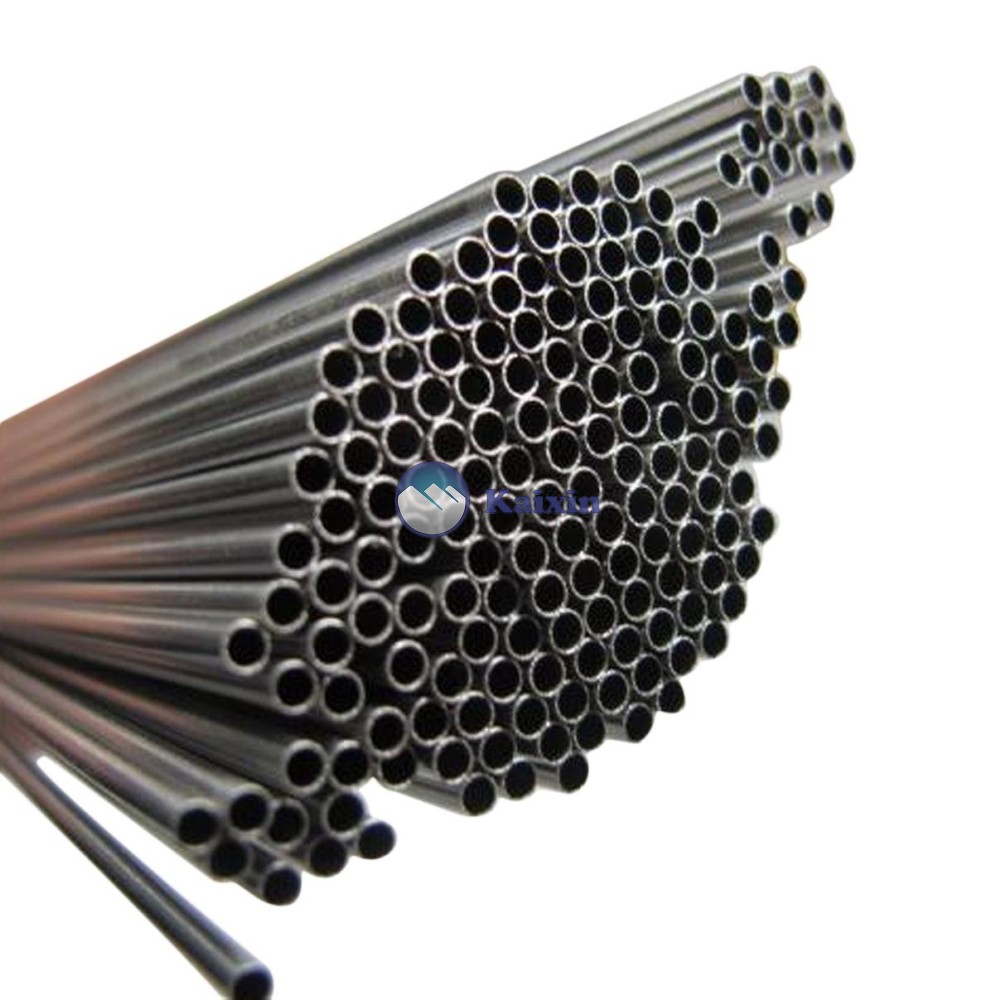
Polished stainless steel capillary tubes — small outside diameter, tightly controlled wall.
Common Types You Will Encounter
When you shop for precision stainless steel tubing, the catalogue usually splits into a few practical families:
- Seamless capillary tube — drawn without a weld, preferred where pressure, purity, or fatigue matter.
- Welded (redrawn) capillary tube — cost-effective for less critical lines and larger bores.
- Coiled capillary tube — supplied on a spool for long instrument runs, remote sensing, and bundled assemblies.
- Square or rectangular micro tubing — used where a flat face or nesting matters more than round flow.
- Stainless steel micro tubing — the finest-bore end of the range, often for catheters, micro-fluidics, and lab devices.
The right shape depends less on the catalogue and more on what your downstream process demands — a point we return to in the specification section.
Materials and Grades — and How to Pick
Stainless is not one material. The grade you choose decides corrosion resistance, weldability, and price. Here is the short list you will actually meet:
| Класс | Why you might choose it | Typical use |
|---|---|---|
| 304 / 304L | Good all-round corrosion resistance, easy to form, economical | General instrumentation, food and sanitary lines |
| 316 / 316L | Molybdenum added for pitting resistance in chloride and marine settings | Medical, marine, chemical sampling |
| 321 / 347 | Stabilised against sensitisation at high temperature | Exhaust, high-heat sensor lines |
| Duplex (2205, 2507) | Very high strength and resistance to harsh, chloride-rich media | Offshore, desalination, aggressive process |
| Nickel alloy (254SMO, alloy 20) | Extreme corrosion and high-temperature service | Specialty chemical, seawater systems |
For a 304 stainless steel capillary tube, 304L (low carbon) is the common pick when you need to weld without post-annealing. Step up to 316L when your line sees salt, sweat, or process chemicals. If the environment is genuinely hostile, a SAF2507 duplex steel tube or a 254SMO stainless steel pipe earns its premium by lasting where 316L would thin out. For truly corrosive or high-purity duty, our труба из нержавеющей стали с никелевым сплавом range covers the grades standard 300-series cannot.
Where They Go to Work: Real Applications
The reason capillary tubing keeps showing up in advanced products is simple: as devices get smaller and more precise, the channels inside them have to shrink too. A few places you will find them:
- Medical and life science — catheter components, surgical instruments, and diagnostic carts. The move toward minimally invasive procedures has pushed tolerances and surface finish to new levels, because even a micron of burr can matter inside the body.
- Analytical and scientific instruments — chromatography, mass spectrometry, and sample lines where contamination is the enemy. Here, electropolished 316L is often the baseline.
- Semiconductor and clean utility — ultra-clean gas and chemical delivery. As fabs pack more steps onto a wafer, the demand for particle-free, leak-tight micro tubing keeps climbing.
- Automotive and mobility — fuel and brake sensing, turbo actuator lines, and EV thermal management, where vibration and temperature swing test every joint.
- Energy and process — downhole sensing, heat-exchanger instrumentation, and offshore measurement, increasingly specified in duplex and nickel alloys as fields move into harsher ground.

Dimensional checks on small-diameter medical-grade tubing before release.
Looking for a specific size or grade?
Browse our full stainless steel capillary tube range, including 304/304L, 316/316L, and custom drawn sizes with mill test certificates.
Sizes, Tolerances, and Standards You Should Know
Sizing a stainless steel capillary tube is mostly about three numbers: outside diameter (OD), wall thickness, and the tolerance on each. Common small-bore sizes run from roughly 0.2 mm OD up to about 25 mm, with wall thicknesses from 0.05 mm upward. The tighter your tolerance, the more drawing passes and the higher the cost — so specify only as tightly as the job requires.
| OD range (typical) | Wall thickness | Common tolerance |
|---|---|---|
| 0.2 – 3 mm | 0.05 – 0.30 mm | ±0.01 – ±0.02 mm |
| 3 – 10 mm | 0.10 – 0.50 mm | ±0.02 – ±0.05 mm |
| 10 – 25 mm | 0.20 – 1.00 mm | ±0.05 – ±0.10 mm |
The standards that govern these tubes are worth knowing when you write a purchase order:
- ASTM A269 / A632 — the workhorses for small-diameter austenitic tubing in general and precision service.
- ISO 1127 — dimensions and tolerances for stainless tubes, handy when your plant is metric.
- EN 10216-5 — European pressure-tube standard, widely cited for instrument lines.
- GB/T 13296 / GB/T 14976 — Chinese standards covering boiler, heat-exchanger, and fluid-conveying capillary tubing, relevant for Asian supply chains.
Naming the right standard on your RFQ saves you a round of clarification and makes it far easier to compare stainless steel capillary tube suppliers on equal terms.
How Precision Capillary Tubes Are Made
Understanding the process helps you judge a quote. The typical route is:
- Cold drawing — the tube is pulled through a die (and often a mandrel) to shrink OD and wall while improving surface.
- Bright annealing — heated in a protective (often hydrogen) atmosphere so the surface stays bright and oxide-free; this also restores ductility.
- Sizing and straightening — multiple passes bring the tube to final tolerance.
- Cleaning and finishing — electropolishing or passivation for hygienic and medical grades.
- Inspection — dimensional scans, leak tests, and surface checks before release.
At Kaixin’s Wenzhou plant we run hydraulic forming, drawing, and imported shearing equipment under ISO 9001, and we back critical lines with helium leak testing and laser-micrometer dimensional verification. When you ask a supplier “how do you know this tube is good?”, those are the answers you want to hear.
Ready to specify your tubes?
Share your grade, OD, wall, length, and finish. We will return a quote with lead time and a sample option where available.
How to Specify the Right Tube for Your Project
If you remember nothing else, remember this short checklist before you send an RFQ:
- Medium — what flows inside? Water, gas, chemical, or blood each point to a different grade and finish.
- Pressure and temperature — these set wall thickness and whether you need 316L, duplex, or nickel.
- Cleanliness — medical or semiconductor duty calls for electropolish and documented cleanliness.
- Tolerance — only tighten what your assembly needs; it drives cost directly.
- Paperwork — ask for a mill test certificate (EN 10204 3.1) and, where relevant, positive material identification (PMI).
Getting these five points onto your drawing is the difference between a tube that “probably fits” and one you can install with confidence.
Часто задаваемые вопросы
Should you choose seamless or welded capillary tubing?
For pressure-bearing, high-purity, or fatigue-prone lines, seamless is the safer choice because there is no longitudinal weld to be the weak point. Welded-and-redrawn tubing can be perfectly good for lower-pressure or larger-bore runs and usually costs less. If you are unsure, default to seamless and let price drive you toward welded only where the application clearly allows it.
What surface finish (Ra) do you need for medical or sanitary use?
Sanitary and medical lines are usually specified by roughness average (Ra). A mechanically polished tube might sit around Ra ≤ 0.5 µm, while electropolishing can take you to Ra ≤ 0.25 µm or better for the cleanest flow paths. Tighter Ra means more processing, so match the finish to your cleanability and validation requirements rather than always asking for the mirror finish.
How do you read a capillary tube spec sheet — OD, ID, wall, and tolerance?
OD (outside diameter) and wall thickness define almost everything; ID (inside diameter) is then OD minus twice the wall. A spec like “3.0 × 0.3 mm, ±0.02 mm” means 3.0 mm OD, 0.3 mm wall, with ±0.02 mm tolerance on the dimensions called out. Always confirm which dimensions the tolerance applies to — OD, wall, or both — because that changes how the tube behaves in your fitting.
What quality documents should you request from a supplier?
At minimum ask for a mill test certificate (often EN 10204 3.1) covering chemistry and mechanical properties, and request positive material identification (PMI) for critical grades. For medical or semiconductor lines, add cleanliness validation and a traceable lot number. Reputable stainless steel capillary tube suppliers will hand these over without hesitation; hesitation is itself a signal.
Can capillary tubes be supplied coiled or cut-to-length, and what affects lead time?
Yes. Long instrument runs are often supplied coiled on a spool, while assembled parts usually arrive cut-to-length with deburred ends. Lead time depends on whether the size is in stock, how tight the tolerance is, and whether special alloy or finish is needed — standard 304/316L sizes can ship fast, while custom duplex or nickel draws take longer. Ask for a sample before a large order to confirm fit.
How should you store and handle stainless capillary tubes to avoid contamination?
Keep tubes in their sealed packaging until use, store in a clean, dry area away from carbon steel to prevent cross-contamination and rust staining, and cap the ends after cutting. For sterile or semiconductor duty, handle with clean gloves and avoid dragging ends across shop surfaces — iron particles embedded in the surface are the most common avoidable cause of later corrosion.
Связанные ресурсы
If you want to go deeper on grades and standards, these posts on the same site are a useful next step:
- Бесшовная труба из нержавеющей стали ASTM A270 — hygienic tubing for clean fluid systems.
- Difference Between TP316L and TP316Ti Steel Pipe — pick the right 316 variant.
- Difference of UNS32750 and UNS32760 — super duplex grades explained.
- Key Difference of ASTM TP304, 304H and TP304L — choose the right 304 grade.
 English
 Afrikaans
 Arabic
 Bengali
 Catalan
 Chinese
 French
 Dutch (Belgium)
 Dutch
Dutch German
 Czech
Czech Greek
Greek Hindi
Hindi Japanese
 Italian
 Portuguese
 Spanish (Chile)
 Spanish (Colombia)
 Spanish (Argentina)
 Persian
 Estonian
 Albanian
 Russian
 Spanish (Peru)
 Indonesian
 Thai
Thai Vietnamese
 Georgian
 Korean
 Nepali
 Polish
 Ukrainian
 Malayalam
 Xhosa
Xhosa