 Wenzhou Kaixin Kaixin Metal Co., Ltd.

Selección de tuberías de acero inoxidable mvr
Stainless steel pipe selection for MVR systems is about matching the pipe to vapor, condensate, concentrate, temperature, pressure, corrosion risk, cleanability, fabrication, and long-term maintenance. In mechanical vapor recompression, piping is not just a connection between equipment; it affects pressure drop, heat recovery, reliability, and the service life of the evaporator package. This stainless steel pipe selection guide explains how to compare stainless steel grades, identify the most important design conditions, and choose pipe material options without over- or under-specifying the system.
What does stainless steel pipe selection mean in an MVR system?
Tubo de acero inoxidable selection in an MVR system means choosing a pipe grade, wall thickness, joining method, finish, and layout that can safely handle the process stream while supporting efficient vapor recompression. MVR, or mechanical vapor recompression, recycles vapor by compressing it so recovered heat can be reused in evaporation, concentration, distillation, or waste treatment processes. Because the system depends on stable vapor movement and heat transfer, pipe decisions should be made with both corrosion performance and process efficiency in mind. (en.wikipedia.org)
In many MVR applications, tubos de acero inoxidable are selected because they offer a practical balance of corrosion resistance, mechanical strength, weldability, hygiene, and availability. However, “stainless” does not mean universally resistant. A pipe that performs well in clean condensate may be a poor fit for hot chloride-bearing concentrate, acidic cleaning fluids, or sections exposed to wet-dry cycling.
A good stainless steel pipe selection mvr process starts with the actual service conditions. The same plant may need different tipos de acero inoxidable in the feed line, vapor ducting, condensate return, concentrate discharge, CIP circuit, and drain system. Treating the whole package as one material decision can create weak points where corrosion, fouling, leakage, or maintenance access becomes a problem.
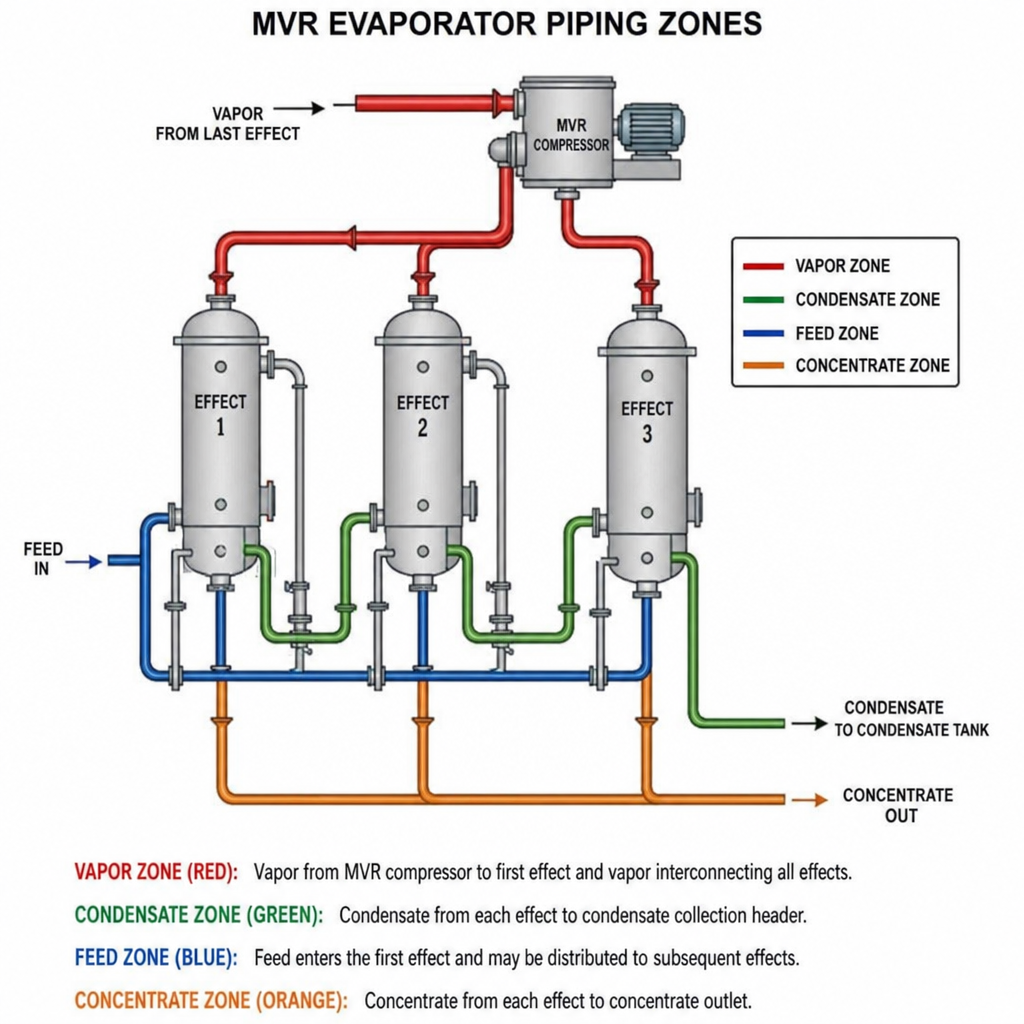
MVR evaporator piping zones with vapor, condensate, feed, and concentrate lines
MVR piping conditions that shape material choice
MVR systems create a mix of thermal, chemical, and mechanical demands. Vapor lines may be large in diameter and sensitive to pressure loss. Liquid lines may carry concentrated salts, organics, cleaning chemicals, suspended solids, or fluctuating pH. Condensate sections may look mild but can still contain volatile compounds, oxygen, or traces of corrosive species depending on the process.
The most important conditions to define before selecting tubos de acero inoxidable incluyen:
- Fluid or vapor composition: Identify chlorides, acids, alkalis, sulfides, organics, dissolved oxygen, and cleaning chemicals.
- Operating and design temperature: Corrosion mechanisms often accelerate with heat, and some tipos de acero inoxidable become more vulnerable under certain hot chloride conditions.
- Operating and design pressure: Pipe schedule, fittings, flanges, gaskets, supports, and testing requirements must be aligned with the pressure envelope.
- Concentration changes: MVR systems often concentrate the process stream, so the outlet may be much more aggressive than the feed.
- Velocity and pressure drop: Undersized vapor piping can reduce system efficiency, while excessive liquid velocity can contribute to erosion, noise, or vibration.
- Cleanability: Food, pharmaceutical, and some specialty chemical systems may require smoother surfaces, drainability, and sanitary connections.
- Método de fabricación: Welded, seamless, orbital-welded, flanged, and mechanically joined systems each have different implications for installation and inspection.
These variables interact. For example, a chloride level that is manageable at lower temperature may become risky when the liquid is hot and concentrated. A pipe grade that resists the process fluid may still fail early if weld heat tint is not removed, if crevices trap deposits, or if dead legs allow stagnant liquid to concentrate.
Stainless steel grades commonly considered
The phrase “stainless steel grades” covers a wide family of alloys. For MVR pipe material options, the most common discussion usually begins with austenitic stainless steels such as 304L and 316L, then moves toward duplex, super duplex, or higher-alloy materials if corrosion risk increases. Types 304 and 316 are widely fabricated stainless steels, while molybdenum-bearing grades such as 316 are often chosen where better pitting and crevice corrosion resistance is needed.
304 and 304L stainless steel
304 and 304L are often considered for relatively mild MVR service, such as non-aggressive condensate, clean water, low-chloride feed, general utility piping, and some non-wetted or external components. The “L” version has lower carbon content, which can help reduce sensitization concerns in welded service. It is commonly available and generally easy to fabricate, making it attractive where the chemistry is well understood and not highly corrosive.
The limitation is chloride exposure. Hot chlorides, stagnant deposits, crevices, and evaporative concentration can make 304L vulnerable to localized corrosion. If the system processes brines, landfill leachate, high-chloride wastewater, seafood waste, fermentation residues, or chemical streams with unknown variability, 304L should be treated cautiously rather than used as a default.
316 and 316L stainless steel
316L is a common step up when the process contains moderate chlorides or when additional resistance to pitting and crevice corrosion is desired. The molybdenum content is a key reason it is often preferred over 304L in more demanding aqueous environments. In MVR systems, 316L may be suitable for many feed, condensate, CIP, and process liquid lines when the chemistry remains within its practical limits.
Still, 316L is not a cure-all. Chloride stress-corrosion cracking and pitting can remain concerns in hot, concentrated, or poorly drained service. This is especially important in MVR because evaporation can increase dissolved solids and create aggressive deposits at elbows, low points, welds, and nozzles.
Duplex stainless steels
Duplex stainless steels, such as 2205 and related grades, combine useful corrosion resistance with higher strength than standard austenitic stainless steels. They are frequently considered where chloride exposure, pressure, wall thickness, or mechanical robustness becomes more demanding. Duplex stainless steels are known for strong resistance to chloride-related corrosion compared with many standard austenitic grades, but they require knowledgeable welding and heat control.
For MVR piping, duplex may be appropriate in concentrate lines, high-chloride feed systems, evaporator circulation loops, or sections exposed to warmer brines. The higher strength can also be useful where mechanical loading matters, though designers should still evaluate code requirements, toughness, fabrication practices, and compatibility with fittings and valves.
Super duplex and higher-alloy options
Super duplex, 6% molybdenum stainless steels, titanium, nickel alloys, or other specialty materials may be considered when the environment exceeds the reliable range of 316L or standard duplex. These options are typically evaluated for highly corrosive brines, acidic chlorides, seawater-like conditions, severe wastewater, or applications where downtime is extremely costly. Some MVR equipment suppliers also reference material options such as stainless steel, duplex stainless steel, titanium, and nickel alloys for vapor-side components, reinforcing the need to match materials to the actual duty.
The tradeoff is cost, availability, fabrication complexity, and procurement lead time. Higher-alloy material should not be selected only because it sounds safer; it should be justified by chemistry, temperature, lifecycle risk, and maintenance expectations.
Selection standards for stainless steel pipes under different chloride ion concentrations
Chloride concentration ≤ 200 ppm:
Use 304 sanitary-grade stainless steel pipe, suitable for food, general light industry, and low-corrosion wastewater scenarios, with a pH tolerance range of 3-12, offering the lowest cost.
Chloride concentration ≤ 1000 ppm (1000 mg/L):
Seleccionar 316L stainless steel pipes, which contain 2-3% molybdenum to effectively prevent intergranular corrosion, suitable for conventional electroplating and low-concentration high-salt wastewater scenarios.
Chloride concentration 2000-20000mg/L:
Use 2205 tubo de acero inoxidable dúplex, with yield strength and stress corrosion resistance far superior to ordinary austenitic stainless steel, making it the mainstream choice for medium to high chloride wastewater, with strong long-term operational stability.
Chloride concentration 20,000-50,000 mg/L:
Select 2507 super duplex stainless steel pipes for stronger resistance to high-concentration chloride corrosion, suitable for high-salt wastewater evaporation conditions with crystallized chlorides.
Chloride concentration > 50,000 mg/L:
Exceeds the tolerance limit of conventional stainless steel. Upgrade to TA2 titanium or Hastelloy. Ordinary stainless steel material is not recommended.
⚠️ Considerations for Selection Under Special Operating Conditions
If the wastewater contains both chloride and ammonium ions simultaneously, even if the chloride concentration does not reach high levels, Acero inoxidable superdúplex 2507 must be directly selected to prevent localized pitting corrosion.
If the fluoride ion concentration in the wastewater exceeds 10 mg/L, the use of titanium materials is strictly prohibited. Prioritize the selection of 2507 duplex stainless steel or Hastelloy to prevent rapid corrosion caused by fluoride ions.
When the pH of acidic wastewater is below 4, the corrosiveness of chloride ions will significantly increase, requiring the material selection to be upgraded by one grade based on the original chloride ion concentration.
When the evaporation temperature remains consistently above 80°C, the corrosion resistance threshold of stainless steel will significantly decrease, necessitating an appropriate reduction in the applicable upper limit of chloride ions for the corresponding material.
How should you compare pipe material options?
Compare pipe material options by ranking the service risk first, then matching the least complicated material that can meet corrosion, pressure, temperature, cleaning, and fabrication requirements. The right choice is not always the most expensive alloy. It is the option that gives adequate service life, predictable fabrication quality, and manageable maintenance under the real operating conditions.
A practical comparison should consider:
- Corrosion risk: Review chlorides, pH, oxidizers, reducing species, cleaning chemicals, and concentration effects.
- Thermal duty: Account for normal operation, startup, shutdown, upset conditions, steam-out, and cleaning cycles.
- Mechanical design: Confirm pressure rating, pipe schedule, supports, thermal expansion, vibration, and nozzle loading.
- Fabrication quality: Specify weld procedure, filler metal, purge requirements, heat tint removal, passivation, and inspection.
- Surface requirements: Decide whether standard industrial pipe, polished pipe, or sanitary tubing is needed.
- Lifecycle cost: Include replacement risk, cleaning frequency, shutdown cost, spare parts, and future process changes.
For industrial process piping, ASME B31.3 is commonly used for piping in facilities such as chemical, pharmaceutical, power, textile, and related process plants. It does not replace engineering judgment, but it provides a recognized framework for pressure piping design, material requirements, examination, and testing. (asme.org)
A practical stainless steel pipe selection guide for MVR projects
A structured selection process helps prevent guesswork. Use the following workflow early in the project, before piping isometrics, equipment nozzles, and procurement specifications are locked.
1. Map the system by service zone
Divide the MVR package into zones: feed, preheated feed, recirculation, vapor outlet, compressor inlet, compressor discharge, heating side, condensate, concentrate, CIP, vents, drains, and utilities. Each zone may need its own material basis. The concentrate line, for example, often deserves more attention than a clean condensate line because dissolved solids and corrosive ions may be much higher.
2. Build a chemistry envelope
Do not rely on a single average sample. Define expected ranges for chlorides, total dissolved solids, pH, organic acids, oxidizers, suspended solids, and cleaning agents. Include startup batches, seasonal variation, upstream process changes, and worst-case concentration. MVR systems can magnify small chemistry assumptions because evaporation changes the fluid composition over time.
3. Match stainless steel grades to corrosion mechanisms
Identify whether the main risk is general corrosion, pitting, crevice corrosion, stress-corrosion cracking, erosion-corrosion, microbiologically influenced corrosion, or contamination. Molybdenum improves resistance to pitting and crevice corrosion, which is why 316L and higher-alloy stainless steels are often evaluated for chloride-bearing service. (nickelinstitute.org) If chlorides are high and temperatures are elevated, duplex or higher-alloy options may need to be reviewed by a corrosion specialist.
4. Size for flow and efficiency, not only connection diameter
MVR performance depends on moving vapor and liquid with controlled pressure loss. Vapor piping that is too restrictive can reduce available temperature difference and increase compressor burden. Liquid piping that is poorly sized may cause high pressure drop, flashing, vibration, erosion at bends, or poor pump operation.
Sizing should consider:
- Vapor density and volume at operating conditions
- Allowable pressure drop between evaporator, compressor, and heating surfaces
- Liquid velocity in recirculation and concentrate lines
- Pump net positive suction head requirements
- Drainability and low-point removal
- Expansion loops or flexible connectors where thermal movement is expected
5. Specify wall thickness and pressure class correctly
Pipe schedule is not selected by grade alone. It depends on design pressure, design temperature, corrosion or erosion allowance, mechanical loads, joining method, code requirements, and available fittings. Stainless steel pipes may have thinner schedules than carbon steel in some services, but thin-wall pipe can be more sensitive to handling damage, weld fit-up, vibration, and external loading.
Flanges, valves, gaskets, expansion joints, instruments, and branch connections should be checked as part of the same pressure boundary. The system is only as reliable as its weakest compatible component.
6. Control welding and post-weld condition
Many stainless steel failures begin at fabrication details rather than in the base metal. Poor purge control can leave oxidized internal weld surfaces. Heat tint, rough weld beads, undercut, crevices, and trapped deposits can undermine corrosion resistance. For MVR service, welding specifications should define acceptable procedures, filler metals, internal purge, inspection, cleaning, and passivation where appropriate.
This is especially important for duplex stainless steels. Duplex grades need controlled welding heat input and suitable filler metals to preserve their intended corrosion and mechanical properties. If the fabricator lacks duplex experience, the material advantage can be lost during installation.
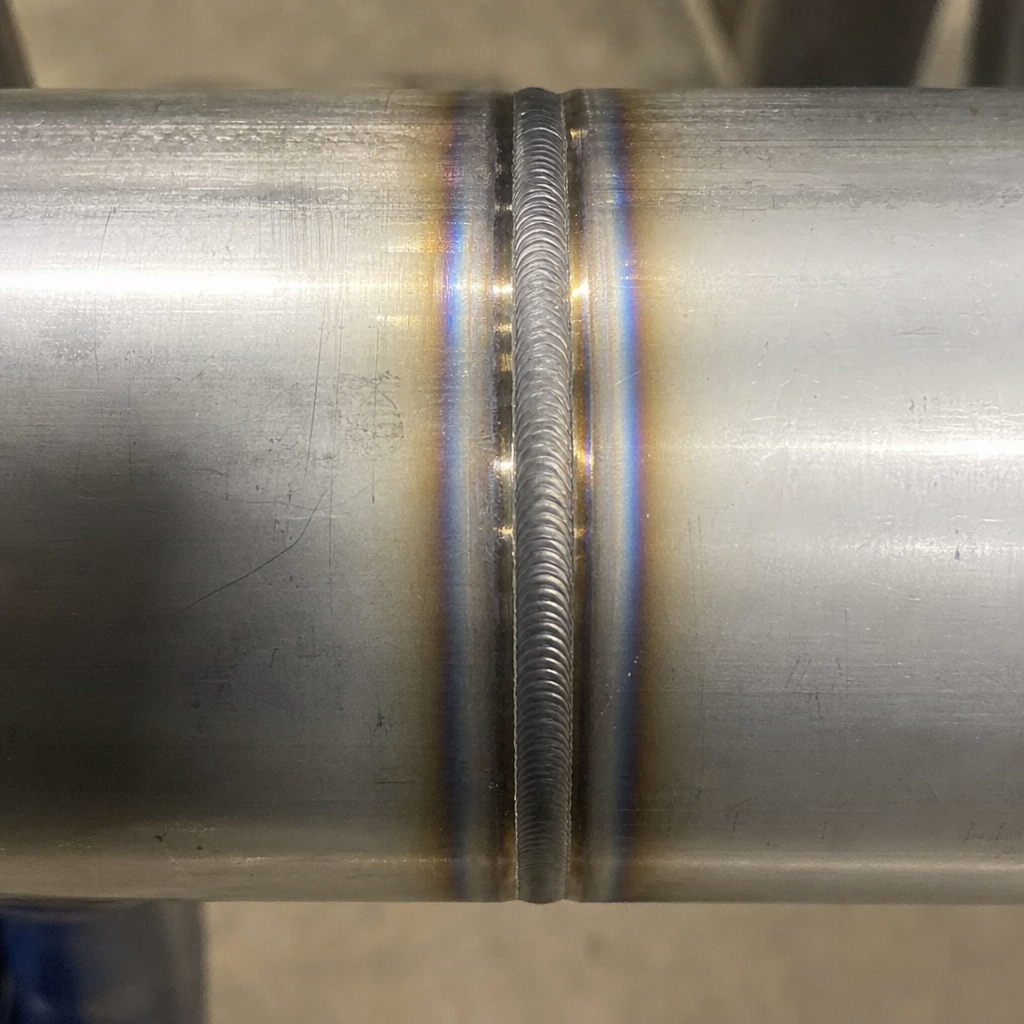
Close-up of properly purged stainless steel pipe weld for process piping
Common selection mistakes to avoid
Even experienced teams can run into trouble when schedule pressure, delivery time, or incomplete process data pushes material selection too quickly. The most common mistakes are not exotic; they are practical oversights.
Avoid these errors:
- Using one grade everywhere: Different zones may need different tipos de acero inoxidable.
- Ignoring concentration effects: The discharge or recirculation loop may be more corrosive than the feed.
- Choosing 304L as a default: It may be suitable for mild service, but not for many hot chloride or concentrated streams.
- Overtrusting 316L: It improves resistance in many environments but can still pit or crack in aggressive chloride service.
- Skipping weld quality requirements: Base metal selection cannot compensate for poor fabrication.
- Creating stagnant areas: Dead legs, flat runs, and poorly drained sections can concentrate contaminants.
- Forgetting cleaning chemicals: CIP solutions may be more aggressive than the normal process fluid.
- Mixing incompatible materials: Dissimilar metals, gasket choices, and fasteners should be reviewed together.
The practical lesson is simple: stainless steel pipe selection is a system decision. Grade, geometry, flow, weld quality, and maintenance access all work together.
When is a higher-grade stainless steel worth it?
A higher-grade stainless steel is worth considering when the cost of corrosion, leakage, contamination, or downtime is greater than the added material and fabrication cost. In MVR systems, this often applies to hot concentrate, high-chloride streams, critical vapor paths, hard-to-access piping, and plants that run continuously. The more difficult the pipe is to inspect or replace, the more important it is to choose conservatively.
However, upgrading every line may not be necessary. A balanced design might use 316L for general wetted service, duplex for concentrate or chloride-rich zones, and a higher alloy only for the most aggressive sections. Non-wetted supports, platforms, or external frames may use different materials if they are properly isolated from corrosive exposure.
A simple decision checklist can help:
- Is the chemistry variable or poorly defined?
- Will evaporation significantly increase chloride or solids concentration?
- Is the line hot, stagnant, cyclic, or difficult to drain?
- Would a leak create safety, environmental, product quality, or downtime problems?
- Is the pipe difficult to inspect, clean, or replace?
- Are cleaning chemicals more aggressive than the process fluid?
- Does the selected fabricator have experience with the chosen grade?
If several answers are yes, a stronger material review is justified.
Documentation that should support the final selection
A stainless steel pipe selection guide is only useful if the final decision is documented clearly. The project file should show why each material was chosen, what assumptions were made, and what limits apply. This helps procurement, fabrication, operations, and future maintenance teams avoid substitutions that weaken the design.
Useful documentation includes:
- Process fluid data and concentration assumptions
- Design and operating pressure and temperature
- Selected tipos de acero inoxidable by service zone
- Pipe schedule, fitting standard, flange class, and gasket type
- Welding, purge, cleaning, and passivation requirements
- Inspection and pressure testing requirements
- Corrosion allowance or rationale for no allowance
- Notes on insulation, heat tracing, supports, and thermal expansion
- Approved alternates and prohibited substitutions
Clear documentation also helps with future troubleshooting. If corrosion appears later, the team can compare actual operating conditions with the original assumptions instead of starting from zero.
Final selection principles for reliable MVR piping
The best stainless steel pipe selection mvr strategy is to begin with process reality, not a preferred grade. Define the chemistry, temperature, pressure, concentration factor, flow behavior, cleaning method, and maintenance expectations. Then select stainless steel pipes and fittings that fit each service zone with enough corrosion resistance, mechanical integrity, and fabrication control.
For mild service, 304L or 316L may be appropriate. For hotter, chloride-bearing, concentrated, or critical areas, duplex or higher-alloy pipe material options may provide better lifecycle value. Most importantly, treat the pipe system as part of the MVR process, not as an afterthought. A well-selected stainless steel piping package supports energy recovery, stable operation, easier maintenance, and longer service life.
 English
 Afrikaans
 Arabic
 Bengali
 Catalan
 Chinese
 French
 Dutch (Belgium)
 Dutch
Dutch German
 Czech
Czech Greek
Greek Hindi
Hindi Japanese
 Italian
 Portuguese
 Spanish (Chile)
 Spanish (Colombia)
 Spanish (Argentina)
 Persian
 Estonian
 Albanian
 Russian
 Spanish (Peru)
 Indonesian
 Thai
Thai Vietnamese
 Georgian
 Korean
 Nepali
 Polish
 Ukrainian
 Malayalam
 Xhosa
Xhosa