 Công ty TNHH Kim loại Kaixin Wenzhou

So sánh các loại thép không gỉ 304 và 316
Choosing between 304 and 316 stainless steel usually comes down to environment, corrosion exposure, appearance needs, and budget. Both are austenitic stainless steel grades with strong formability, clean visual appeal, and reliable everyday performance, but 316 offers added protection in chloride-heavy or chemically aggressive settings. This guide explains how each stainless steel grade performs so you can select the right material for kitchens, fabrication, architectural work, marine use, and sheet metal projects.
What is the main difference between 304 and 316 stainless steel?
The main difference is that 316 stainless steel contains molybdenum, while standard 304 stainless steel does not. That added element improves resistance to pitting and crevice corrosion, especially around salt, coastal air, de-icing chemicals, and some industrial chemicals. In normal indoor or mild outdoor conditions, 304 stainless often performs very well; in harsher environments, 316 is usually the safer long-term choice.
304 stainless steel is often described as an “18/8” stainless steel because it commonly contains around 18% chromium and 8% nickel. 316 stainless steel also contains chromium and nickel, but its molybdenum content gives it a practical advantage where corrosion risk is more severe. That difference may sound small, yet it can determine whether a component stays clean and serviceable or begins to show staining, pitting, or premature surface damage.
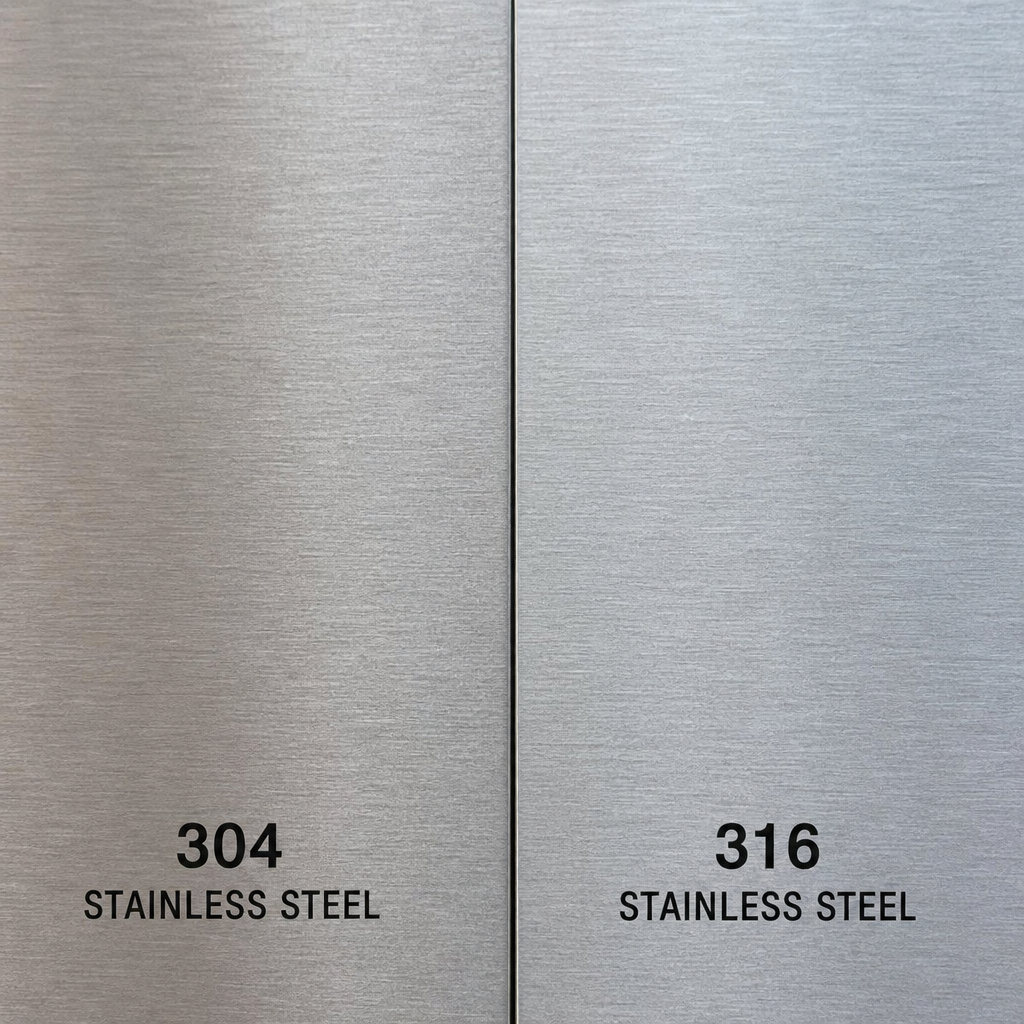
close-up comparison of brushed 304 and 316 stainless steel sheets
Understanding stainless steel properties
Stainless steel gets its corrosion resistance from chromium. When chromium is present in sufficient amounts, it helps form a thin passive oxide layer on the surface. This layer is not paint or coating; it is part of how the metal protects itself. If the surface is scratched in a suitable environment, the passive layer can reform, which is one reason stainless steel is so widely used.
However, “stainless” does not mean stain-proof. Heat, chlorides, harsh cleaners, trapped moisture, and poor surface maintenance can all challenge corrosion resistant steel. The right grade matters because different alloys tolerate different environments.
Key stainless steel properties to consider include:
- Khả năng chống ăn mòn: How well the alloy resists rust, staining, pitting, and crevice corrosion.
- Strength and toughness: How the metal performs under load, impact, and temperature changes.
- Formability: How easily it can be bent, drawn, cut, or fabricated.
- Weldability: How well it joins without creating weak or corrosion-prone areas.
- Khả năng vệ sinh: How easily the surface can be maintained in food, kitchen, medical, or decorative applications.
- Cost and availability: How practical the grade is for sourcing, production, and replacement.
Both 304 and 316 share many of these strengths. The difference is not that one is “good” and the other is “bad.” The difference is whether the extra corrosion resistance of 316 is necessary for the job.
304 stainless steel is the everyday workhorse
304 stainless steel is one of the most widely used stainless steel grades because it balances performance, availability, and cost. It resists corrosion in many indoor environments, forms well, welds well, and provides the clean silver appearance people expect from stainless steel. For many general-purpose applications, 304 is the practical default.
In kitchens, 304 is especially common. A 304 stainless steel kitchen may include sinks, backsplashes, counters, shelves, range hoods, cookware, appliances, and food preparation surfaces. Its smooth, nonporous surface is easy to clean, and it does not need a painted or plated finish to look professional.
Common uses for 304 stainless
304 stainless is often selected for:
- Commercial and residential kitchen surfaces
- Thiết bị chế biến thực phẩm
- Interior architectural panels
- Handrails and trim in mild environments
- Tanks, containers, and light industrial equipment
- Decorative sheet metal and fabrication projects
- General-purpose brackets, covers, and enclosures
A 304 stainless steel sheet is also a popular choice for fabrication because it is available in many thicknesses and finishes. Whether someone searches for stainless steel 304 sheet, stainless steel sheet 304, or 304 stainless steel sheet, they are typically looking for a versatile material that can be cut, formed, polished, or installed in a broad range of settings.
Where 304 may not be enough
304 can struggle when exposed to chlorides. Saltwater, pool environments, coastal air, bleach, and some cleaning chemicals can attack the passive layer and create small pits. These pits may start as cosmetic marks, but in demanding applications they can become a performance concern.
This does not mean 304 should never be used outdoors or near moisture. It means the environment, finish, drainage, cleaning routine, and expected service life should be considered. If stainless steel will be exposed to salt spray, standing water, or harsh chemicals, 316 often deserves serious consideration.
316 stainless steel adds protection for demanding environments
316 stainless steel is designed for tougher corrosion conditions. Its molybdenum content improves resistance to chloride attack, making it a frequent choice for marine, coastal, chemical, pharmaceutical, and some medical applications. It still looks and fabricates much like 304, but it gives extra durability where corrosion risk is higher.
This added resistance is valuable when replacement is difficult, downtime is expensive, or appearance must remain clean in an aggressive setting. A railing in a coastal locati0n, a component on a boat, or a fitting exposed to cleaning chemicals may justify the higher cost of 316 because failure or visible corrosion would be more costly than the initial material upgrade.
Common uses for 316 stainless steel
316 is often used for:
- Marine hardware and boat fittings
- Coastal architectural features
- Thiết bị xử lý hóa chất
- Laboratory and pharmaceutical equipment
- Outdoor fasteners in corrosive settings
- Food and beverage equipment exposed to salts or harsh washdowns
- Poolside components, with proper maintenance and design
Even with 316, good design still matters. Crevices, trapped moisture, rough surfaces, and contamination from carbon steel tools can reduce performance. The grade improves corrosion resistance, but it does not remove the need for proper fabrication and maintenance.
How should you choose between 304 and 316?
Choose 304 when the environment is mild, the application is general-purpose, and cost efficiency matters. Choose 316 when the metal will face salt, coastal exposure, chlorides, aggressive cleaners, or chemical conditions where pitting resistance is important. If the project sits between those categories, look at the cost of failure, not just the cost of the material.
A simple decision process can help:
- Identify the exposure. Will the stainless steel be indoors, outdoors, coastal, marine, industrial, or near pools?
- Check for chlorides. Salt, bleach, brines, and de-icing chemicals are common reasons to move from 304 to 316.
- Consider cleaning methods. Frequent washdowns, harsh chemicals, or trapped residue can increase corrosion risk.
- Think about appearance expectations. Decorative applications may need a grade and finish that resist visible staining.
- Evaluate repair or replacement difficulty. If access is difficult or downtime is costly, a more resistant grade may be worth it.
- Match the sheet to fabrication needs. Thickness, finish, bending, welding, and edge treatment can matter as much as alloy selection.
For example, a stainless steel sheet 304 panel in an indoor kitchen backsplash is usually a sensible choice. A similar panel installed near ocean air, road salt, or chemical washdown may be better specified as 316. The “best” grade is the one that matches the actual environment rather than the most expensive option by default.
Sheet metal considerations for 304 and 316
When buying sheet, grade is only one part of the specification. Finish, thickness, flatness, protective film, and grain direction can affect both appearance and performance. A brushed finish may hide fingerprints and light handling marks better than a mirror-like finish, while smoother finishes can be easier to clean in hygienic applications.
For a 304 stainless steel sheet used in kitchens or interior panels, the installer should consider how edges will be finished and how the sheet will be fastened. Exposed edges may need deburring, polishing, or trim for safety and appearance. Adhesives, fasteners, and backing materials should also be compatible with the environment so moisture does not become trapped behind the sheet.
316 sheet requires the same care, especially in corrosive settings. If the material is chosen for a coastal or chemical environment, fabrication should avoid carbon steel contamination. Tools, grinding media, and work surfaces can transfer iron particles that later rust on the stainless surface, creating the false impression that the stainless itself is failing.
Maintenance keeps stainless steel performing
Both 304 and 316 last longer when cleaned correctly. Routine maintenance removes salts, dirt, grease, and chemical residues before they sit on the surface. This is especially important outdoors, near water, or in food service spaces where cleaners and residues can accumulate.
Use these best practices:
- Clean with mild detergent, warm water, and a soft cloth when possible.
- Rinse thoroughly after using cleaners so residue does not remain on the surface.
- Wipe in the direction of the grain on brushed finishes.
- Avoid steel wool or carbon steel brushes that can contaminate the surface.
- Do not allow bleach or chloride-heavy cleaners to sit on stainless steel.
- Improve drainage and airflow where moisture might be trapped.
- Inspect crevices, fasteners, seams, and underside areas, not just visible faces.
Maintenance does not have to be complicated. The main goal is to keep the passive surface clean and free from concentrated corrosive deposits. Even corrosion resistant steel benefits from regular care.
Practical guidance for final selection
304 thép không gỉ is the right answer for many everyday projects: kitchen surfaces, indoor sheet metal, appliance panels, food prep areas, and general fabrication. It offers the familiar benefits people want from stainless steel without paying for corrosion resistance they may not need.
316 stainless steel is the better investment when conditions are more aggressive. If the application involves salt, coastal exposure, chemical contact, or hard-to-replace parts, its added protection can help preserve appearance and service life. The smartest choice is not based on grade name alone; it comes from matching thép không gỉ properties to the real-world environment, fabrication method, and maintenance plan.
When in doubt, start with the exposure. If the project is clean, dry, and indoors, 304 stainless is usually a strong candidate. If the project is wet, salty, chemical-heavy, or outdoors in a demanding locati0n, 316 deserves a closer look before the material is ordered.
 English
 Afrikaans
 Arabic
 Bengali
 Catalan
 Chinese
 French
 Dutch (Belgium)
 Dutch
Dutch German
 Czech
Czech Greek
Greek Hindi
Hindi Japanese
 Italian
 Portuguese
 Spanish (Chile)
 Spanish (Colombia)
 Spanish (Argentina)
 Persian
 Estonian
 Albanian
 Russian
 Spanish (Peru)
 Indonesian
 Thai
Thai Vietnamese
 Georgian
 Korean
 Nepali
 Polish
 Ukrainian
 Malayalam
 Xhosa
Xhosa