 Công ty TNHH Kim loại Kaixin Wenzhou

Compare 304 304L 316 316L Stainless Steel Pipe
Choosing between 304, 304L, 316, and 316L stainless steel pipe is mostly a question of environment, welding, corrosion risk, and budget. These four stainless steel types are all austenitic grades, so they share many familiar stainless steel features: good formability, clean appearance, and strong general corrosion resistance. The practical differences become clearer when you compare carbon level, molybdenum content, weld exposure, and service conditions.
Which stainless steel pipe grade should you choose?
Chọn 304 for general-purpose, non-marine, low-chloride service; 304L when welding is important; 316 when the pipe needs better resistance to chlorides and localized corrosion; and 316L when you need both improved chloride resistance and low-carbon weld performance. In many real projects, 304L and 316L are preferred because pipe systems are commonly welded, and low-carbon grades reduce the risk of weld-area corrosion associated with sensitization. The Stainless Steel Industry of North America lists 304L and 316L with a maximum carbon content of 0.03%, while 316 and 316L include 2.00–3.00% molybdenum.
A simple stainless steel pipe comparison starts with two dividing lines. First, 304 versus 316 is mainly about molybdenum: 316 contains molybdenum, which improves resistance to pitting and localized corrosion in more aggressive environments. Second, standard versus L grade is mainly about carbon: 304L and 316L have lower carbon limits than 304 and 316, which is especially useful around welds.
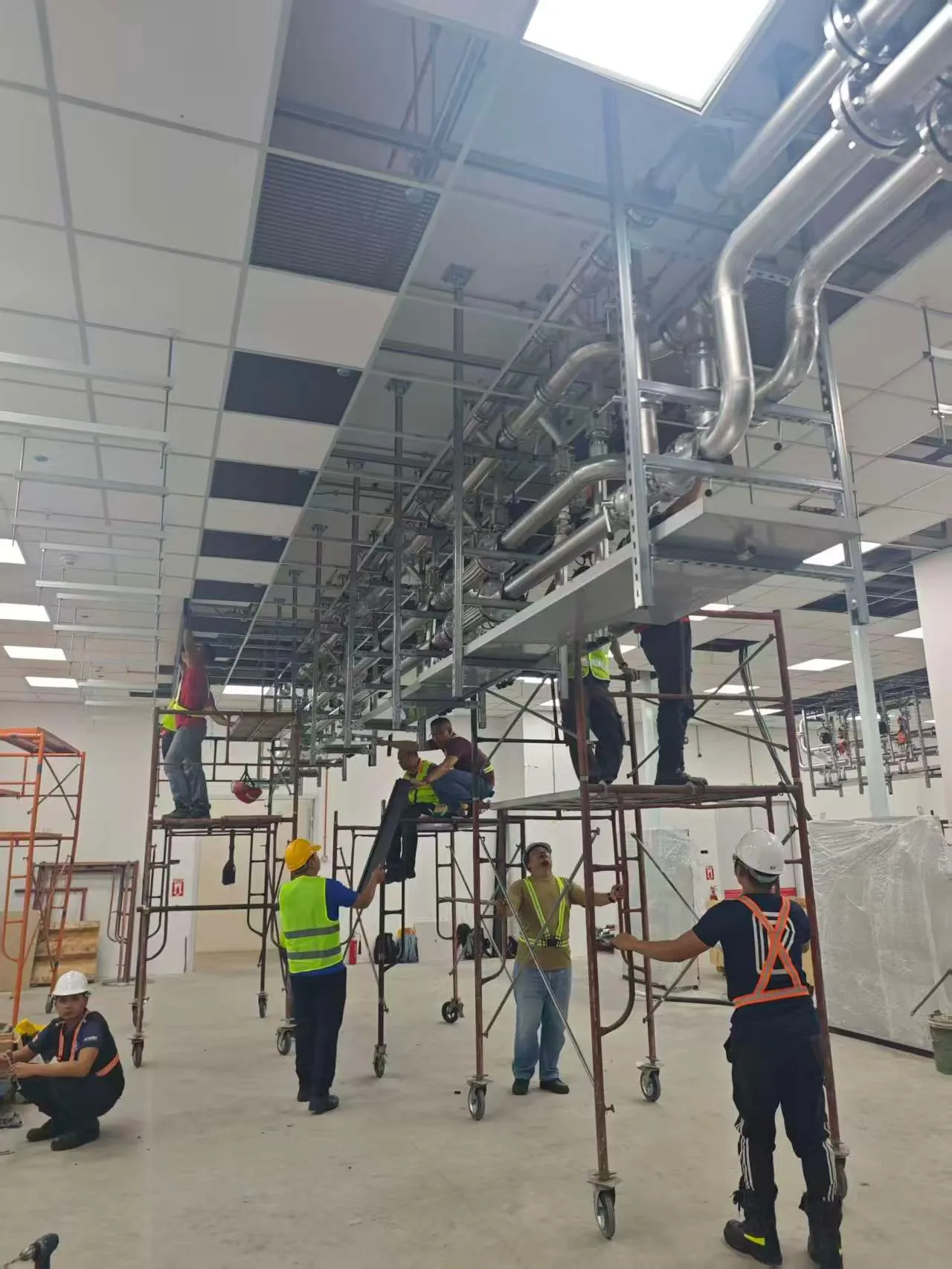
Hình ảnh minh họa những lợi ích của ống thép không gỉ trong các hệ thống làm mát
The main differences at a glance
A useful pipe material comparison should not treat these grades as completely separate materials. They are related stainless steel grades with overlapping uses, but each one has a best-fit role.
- 304 stainless steel pipe works well for many indoor, architectural, food-adjacent, utility, and general process applications where chloride exposure is limited.
- Ống thép không gỉ 304L is the low-carbon version of 304 and is commonly selected for welded assemblies where post-weld corrosion resistance matters.
- Ống thép không gỉ 316 adds molybdenum, making it a stronger choice for environments with chlorides, cleaning chemicals, coastal air, or more corrosive process media.
- 316L stainless steel pipe combines the molybdenum benefit of 316 with the low-carbon benefit of an L grade, making it a common choice for welded corrosive-service piping.
The International Trade Commission has described 304 and 316 as common austenitic chromium-nickel stainless grades used in stainless pressure pipe, with 304 containing roughly 18–20% chromium and 8.0–10.5% nickel, and 316 containing roughly 16–18% chromium, 10–14% nickel, and 2–3% molybdenum.
304 stainless steel pipe for general-purpose performance
304 is often the starting point for stainless pipe selection because it balances corrosion resistance, availability, fabrication behavior, and cost. It is suitable when the operating environment is not especially aggressive and when the pipe will not face persistent salt, brine, or high-chloride exposure. For many clean, dry, or mildly corrosive settings, 304 provides the stainless look and corrosion resistance people expect without moving into higher-alloy grades.
Its limitation is not that it is “weak” stainless steel. Rather, 304 can be vulnerable to pitting or crevice corrosion when chlorides are present at meaningful levels. That is why a proper specification should look beyond the label and ask what fluid, atmosphere, cleaning process, temperature, and maintenance conditions the pipe will actually experience.
304L stainless steel pipe for welded systems
304L is the low-carbon version of 304. The “L” matters because welding heats the metal near the joint, and higher carbon levels can contribute to chromium carbide formation at grain boundaries. When chromium is tied up this way, the heat-affected zone can become more vulnerable to intergranular corrosion.
Low-carbon grades reduce that risk, which is why 304L is often favored for welded pipework. The Nickel Institute notes that 304L and 316L have 0.03% maximum carbon and that using low-carbon grades helps prevent weld heat-affected zones from becoming sensitized to intergranular corrosion.
For many buyers, 304L is the practical default when the environment does not justify 316L but the pipe system includes welds. It gives the familiar performance profile of 304 while adding a margin of protection in fabrication-sensitive areas.
Why does 316 resist corrosion better than 304?
316 usually resists certain corrosive environments better than 304 because it contains molybdenum. Molybdenum improves resistance to localized corrosion, especially pitting and crevice corrosion, which are common concerns in chloride-bearing environments. The International Molybdenum Association explains that Type 316 contains a molybdenum addition, while the Nickel Institute notes that 316 and 316L contain 2–3% molybdenum that improves localized corrosion resistance.
This does not mean 316 is immune to corrosion. No stainless pipe grade is a universal solution for every chemical, concentration, temperature, or flow condition. But when your pipe is exposed to coastal air, washdown chemicals, mild brines, or more demanding process environments, 316 is often the more conservative choice compared with 304.
316L stainless steel pipe for demanding welded applications
316L is often selected when both corrosion resistance and welding performance matter. It keeps the molybdenum content associated with 316 while reducing carbon, so it is commonly used for welded systems in more corrosive environments. That combination is why 316L appears frequently in chemical processing, marine-adjacent, pharmaceutical, food processing, and sanitary-style pipe discussions.
The benefit is practical: you are not only choosing a more corrosion-resistant alloy family, but also reducing a common weld-related corrosion concern. For piping systems with many joints, fittings, branches, and field welds, that can be more important than the base metal comparison alone.
Pipe strength analysis should include more than grade name
A meaningful pipe strength analysis should never stop at “304 versus 316” or “304L versus 316L.” These grades are similar austenitic stainless steels, so the pipe’s pressure capability and mechanical performance also depend on wall thickness, pipe schedule, outside diameter, manufacturing method, heat treatment, temperature, joint design, and the governing specification.
When engineers compare steel pipe grades, they look at the full system. A thicker-wall 304L pipe may outperform a thinner-wall 316L pipe in a pressure scenario, while 316L may outperform 304L in a chloride corrosion scenario. Strength and corrosion resistance are related to service life, but they are not the same property.
For practical selection, review:
- Design pressure and temperature to confirm the pipe schedule and rating are appropriate.
- Fluid chemistry including chlorides, acidity, cleaning agents, and concentration.
- External atmosphere such as coastal exposure, condensation, or chemical fumes.
- Fabrication method including welding, bending, threading, or orbital welding.
- Inspection and maintenance access because hidden crevices increase corrosion risk.
- Applicable codes and specifications so the selected pipe is acceptable for the project.
Steel vs stainless in pipe selection
Cái steel vs stainless decision usually begins with corrosion. Carbon steel can be strong, economical, and widely available, but it typically needs coatings, linings, corrosion allowance, or controlled service conditions when rust is a concern. Stainless steel pipe costs more upfront in many cases, but its corrosion-resistant surface can reduce maintenance demands in the right environment.
That said, stainless is not automatically the best material for every job. Carbon steel may still be appropriate for dry mechanical service, structural uses, some closed-loop systems, or applications where coating and corrosion allowance are already part of the design. Stainless becomes more attractive when cleanliness, appearance, corrosion resistance, washdown, or long service life are major priorities.
A practical selection guide
Use this checklist as a starting point before final engineering review:
- Chọn 304 when the service is general-purpose, low-chloride, and not heavily welded.
- Chọn 304L when you want 304-type performance but the pipe will be welded.
- Chọn 316 when chloride exposure or localized corrosion risk is higher.
- Chọn 316L when the pipe is welded and exposed to a more corrosive environment.
- Consider dual-certified material, such as 304/304L or 316/316L, when allowed by the project specification. U.S. government trade documentation notes that welded pipe and tube are often produced to meet both regular and extra-low-carbon grade requirements.
- Escalate beyond 316L when conditions involve high chlorides, high temperatures, strong acids, or severe crevice conditions.
Final takeaway
Tốt nhất stainless pipe grade is the one that matches the actual service environment, not just the one that sounds more premium. For general use, 304 or 304L may be completely appropriate. For more corrosive or chloride-bearing conditions, 316 or 316L is often the safer stainless steel pipe comparison winner, especially when welding is involved.
If you are specifying pipe for pressure service, regulated systems, or corrosive media, treat this comparison as an early screening tool. Final material selection should be confirmed against project codes, mill certificates, operating conditions, and qualified engineering guidance.
 English
 Afrikaans
 Arabic
 Bengali
 Catalan
 Chinese
 French
 Dutch (Belgium)
 Dutch
Dutch German
 Czech
Czech Greek
Greek Hindi
Hindi Japanese
 Italian
 Portuguese
 Spanish (Chile)
 Spanish (Colombia)
 Spanish (Argentina)
 Persian
 Estonian
 Albanian
 Russian
 Spanish (Peru)
 Indonesian
 Thai
Thai Vietnamese
 Georgian
 Korean
 Nepali
 Polish
 Ukrainian
 Malayalam
 Xhosa
Xhosa