 Вэньчжоу Кайсинь Кайсинь Металл ЛТД

Сравнение супердуплексной и обычной нержавеющей стали
Super duplex stainless steel is a high-performance family within duplex stainless steel, designed for stronger resistance to pitting, crevice corrosion, stress corrosion cracking, and demanding chloride environments than many regular stainless steel grades. Regular stainless steel is a broader term that usually refers to common austenitic grades such as 304 and 316, along with ferritic and martensitic grades used in less severe service. The practical difference is simple: regular stainless steel is often enough for general corrosion resistance, while super duplex stainless steel is chosen when strength, chloride resistance, and service reliability matter more than ease of fabrication or lowest initial cost.
What is the main difference between super duplex and regular stainless steel?
The main difference is the balance of microstructure, alloy content, strength, and corrosion resistance. Duplex and super duplex марки нержавеющей стали have a mixed austenitic-ferritic structure, while common “regular” stainless steels such as 304 and 316 are typically austenitic. That duplex structure helps deliver higher strength and better resistance to chloride stress corrosion cracking than many standard austenitic stainless steels.
Super дуплексная нержавеющая сталь takes that concept further. A grade such as super duplex stainless steel 2507 is commonly associated with higher chromium, molybdenum, and nitrogen content than standard duplex grades, which improves resistance to localized corrosion in aggressive environments. Outokumpu describes super duplex 2507 as having higher corrosion resistance and mechanical strength than 2205 duplex and notes its use in extremely corrosive environments such as desalination, chemical, and offshore subsea applications.
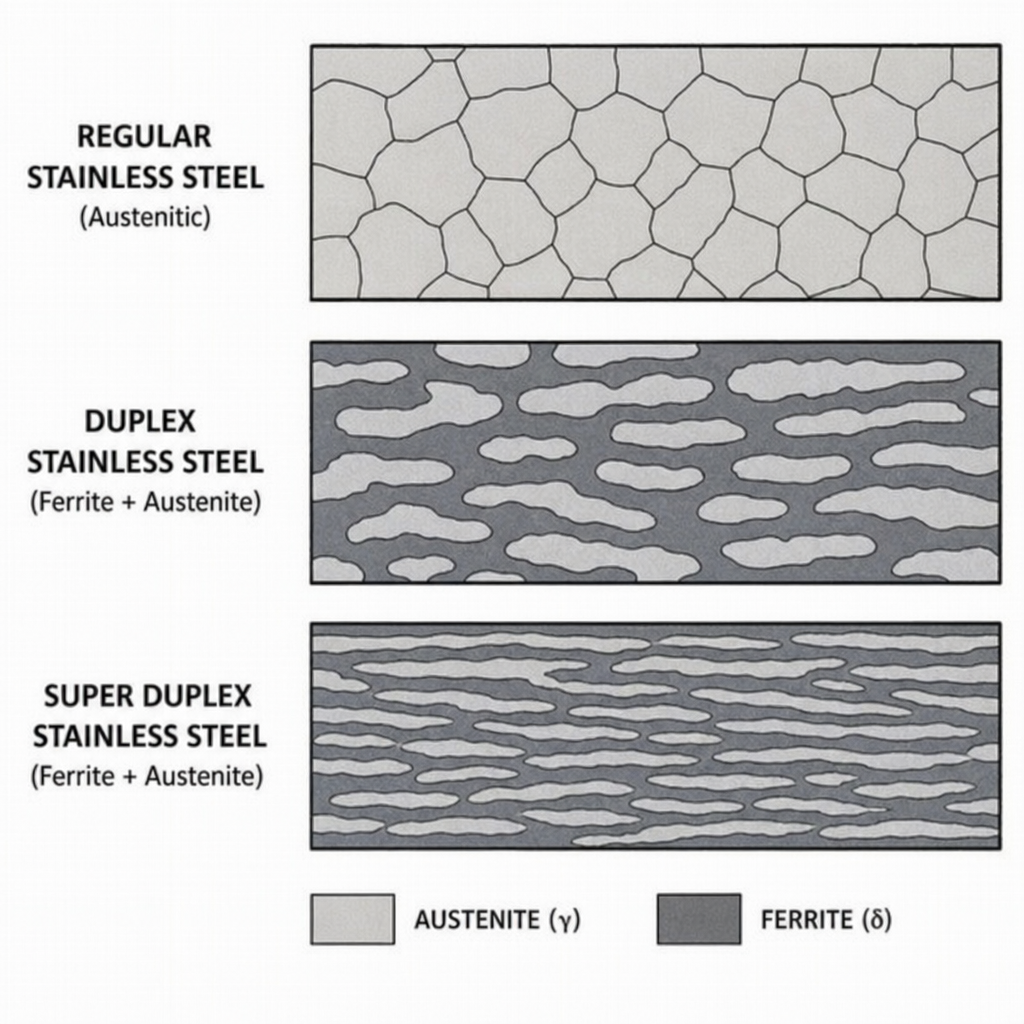
cross-section illustration of regular stainless, duplex stainless steel, and super duplex stainless steel microstructures
The defining characteristics of each material
Regular stainless steel is not one single metal. It is a category of corrosion resistant steel built around iron, chromium, and other alloying elements. The chromium helps form a passive surface layer that gives stainless steel benefits such as reduced rusting, cleaner appearance, and better service life than plain carbon steel in many environments.
Duplex stainless steel is more specific. It combines austenite and ferrite in the same microstructure, giving it a useful blend of strength, toughness, and corrosion resistance. Super duplex stainless steel is the more highly alloyed version of duplex, built for harsher conditions.
Ключевые характеристики включают:
- Regular stainless steel: Broad category covering many stainless steel grades, including 304, 316, ferritic, martensitic, and precipitation-hardening types.
- Duplex stainless steel: Austenitic-ferritic structure, generally stronger than many common austenitic grades and often selected for chloride resistance.
- Super duplex stainless steel: Higher-alloy duplex material designed for more severe corrosion exposure and higher mechanical demands.
- Super duplex stainless steel 2507: A well-known super duplex grade used where high strength and strong chloride resistance are required.
- Corrosion resistant steel performance: Depends on the exact grade, surface condition, fabrication quality, temperature, chemistry, and exposure time.
This is why “stainless” should never be treated as a universal specification. A decorative indoor panel, a food-processing component, a seawater valve, and a chemical-process pipe may all call for stainless steel, but they may not call for the same grade.
How does duplex stainless steel work?
Duplex stainless steel works by combining two metallurgical phases: austenite and ferrite. Austenite contributes ductility and toughness, while ferrite contributes strength and resistance to certain cracking mechanisms. The result is a material that can perform well in applications where standard stainless steels may be too soft, too vulnerable to chloride attack, or too expensive at the required wall thickness.
The alloying strategy matters. Chromium supports passivation, molybdenum improves resistance to pitting and crevice corrosion in many chloride-bearing environments, and nitrogen helps strengthen the steel while also supporting corrosion resistance. Nickel is also used, but duplex grades are often designed with different nickel levels than familiar 300-series stainless steels. The Nickel Institute notes that duplex stainless steels generally have higher chromium than standard austenitic grades and are valued by fabricators and end users for their practical performance balance.
For buyers, engineers, and maintenance teams, this means duplex super duplex stainless steel should be specified by grade and service condition, not by name alone. “Duplex” may point you in the right direction, but it does not prove that a material is suitable for hot seawater, sour service, high pressure, or a specific chemical stream.
Regular stainless steel strengths and limits
Regular stainless steel remains popular because it is versatile, available, attractive, and suitable for many everyday environments. Common grades can be formed, welded, polished, cleaned, and sourced more easily than specialized duplex and super duplex stainless steel. In architectural, kitchen, light industrial, and general fabrication settings, that combination often makes regular stainless the practical choice.
Its limits appear when the environment becomes more aggressive. Chlorides, elevated temperatures, stagnant solutions, crevices, poor drainage, and harsh chemicals can challenge ordinary марки нержавеющей стали. A grade that looks excellent in indoor air may stain, pit, or crack in coastal, marine, or chemical service.
This does not mean regular stainless steel is weak or low quality. It means the grade has to match the exposure. 316 stainless, for example, is often chosen over 304 when improved chloride resistance is needed, but it is still not automatically equivalent to duplex or super duplex stainless steel in severe chloride applications.
Super duplex stainless steel performance advantages
Super duplex stainless steel is chosen when the application demands a stronger safety margin against corrosion and mechanical loading. Its higher strength can sometimes allow thinner sections than lower-strength stainless materials, depending on design codes and service requirements. Its corrosion resistance can also reduce the risk of localized attack in conditions where less alloyed grades may struggle.
Important stainless steel benefits of super duplex include:
- High resistance to localized corrosion in many chloride-containing environments.
- Improved resistance to stress corrosion cracking compared with many regular austenitic stainless steels.
- High mechanical strength, useful for pressure, structural, and load-bearing components.
- Potential weight savings where design rules allow reduced thickness.
- Longer service potential in severe environments when properly specified, fabricated, and maintained.
Super duplex stainless steel 2507 is one of the best-known examples because it is associated with demanding applications such as seawater handling, desalination, offshore equipment, and chemical processing. This does not make it the best choice for every job. It makes it a candidate when the cost of corrosion failure, downtime, leakage, or replacement is high enough to justify a more specialized material.
Where are duplex and super duplex stainless steel used?
Duplex and super duplex stainless steel are used where corrosion resistance and strength must work together. Regular stainless steel is common in general fabrication, consumer products, food equipment, interior architecture, tanks, trim, and lower-risk process equipment. Duplex stainless steel often appears in more demanding industrial settings, while super duplex stainless steel is reserved for harsher exposures.
Practical examples include:
- Marine and offshore equipment: Pumps, valves, fasteners, piping, and subsea components exposed to chlorides.
- Desalination systems: Components that contact concentrated brine or seawater.
- Chemical processing: Piping, heat exchangers, tanks, and pressure equipment exposed to corrosive media.
- Pulp and paper operations: Equipment that faces aggressive process chemistry.
- Oil and gas service: Components where strength, pressure, and corrosion resistance are all relevant.
- Water and wastewater systems: Structures and components exposed to chlorides, treatment chemicals, or variable flow.
In less aggressive settings, regular stainless steel grades may be easier to justify. A handrail in a dry indoor space does not usually need the same material as a seawater pump shaft. Good material selection is less about choosing the “best” stainless steel and more about choosing the grade that fits the environment, fabrication method, code requirement, and budget.
Common misconceptions about stainless steel grades
A common mistake is assuming that all stainless steel is rustproof. Stainless steel is corrosion resistant, not corrosion immune. If the environment overwhelms the passive layer, or if the part has crevices, contamination, poor weld finishing, or stagnant chloride exposure, corrosion can still occur.
Another misconception is that super duplex stainless steel is always the smartest upgrade. It offers impressive performance, but it can require more careful welding, heat control, filler selection, and inspection than common regular stainless steel. Fabrication mistakes can reduce the very corrosion resistance the grade was selected to provide.
Keep these points in mind:
- “Stainless” does not define performance. The grade, condition, and environment do.
- Higher alloy content is not always necessary. Over-specifying can increase cost and complexity.
- Corrosion resistance is local. Crevices, welds, deposits, and stagnant zones often fail before open surfaces.
- Fabrication matters. Cutting, welding, pickling, passivation, and cleaning can affect final performance.
- Super duplex is not a shortcut. It still needs correct design, qualified procedures, and compatible components.
These misconceptions matter because material failures often start with vague specifications. “Use stainless steel” is rarely enough for demanding service. A stronger specification names the grade, standard, product form, finish, welding requirements, and expected exposure.
Choosing the right corrosion resistant steel
The right choice depends on the environment first. If the part will face mild indoor service, regular stainless steel may provide all the corrosion resistance needed. If it will face warm chlorides, seawater, high pressure, or aggressive chemicals, duplex stainless steel or super duplex stainless steel may deserve closer evaluation.
A practical selection checklist includes:
- Identify the fluid, atmosphere, or chemical exposure.
- Note chloride concentration, pH, temperature, pressure, and flow conditions.
- Look for crevices, deposits, stagnant areas, and weld zones.
- Confirm strength, toughness, and code requirements.
- Compare availability, machinability, weldability, and inspection needs.
- Consider total cost of ownership, not just purchase price.
- Specify the exact grade, such as 304, 316, 2205 duplex, or super duplex stainless steel 2507, when appropriate.
For many applications, the final decision is not regular stainless steel versus super duplex stainless steel in a broad sense. It is one grade against another under defined service conditions. That is where informed material selection creates the most value: fewer surprises, better durability, and a clearer match between performance and cost.
The simplest way to compare them
Regular stainless steel is the broad, everyday category. Duplex stainless steel is a higher-strength, two-phase family built for better performance in many chloride and industrial environments. Super duplex stainless steel is the more highly alloyed, more demanding option for severe corrosion and strength requirements.
If appearance, cleanability, moderate corrosion resistance, and easy sourcing are the priorities, a regular stainless grade may be suitable. If chloride exposure, cracking risk, mechanical strength, and long-term reliability are central to the design, duplex and super duplex stainless steel deserve serious consideration. The best material is the one that matches the real environment, not the one with the most impressive name.
 English
 Afrikaans
 Arabic
 Bengali
 Catalan
 Chinese
 French
 Dutch (Belgium)
 Dutch
Dutch German
 Czech
Czech Greek
Greek Hindi
Hindi Japanese
 Italian
 Portuguese
 Spanish (Chile)
 Spanish (Colombia)
 Spanish (Argentina)
 Persian
 Estonian
 Albanian
 Russian
 Spanish (Peru)
 Indonesian
 Thai
Thai Vietnamese
 Georgian
 Korean
 Nepali
 Polish
 Ukrainian
 Malayalam
 Xhosa
Xhosa