 Wenzhou Kaixin Metaal Co, LTD

ASTM A312 vs EN 10216-5: Stainless Steel Seamless Pipe Buying Guide
You have a mill test certificate in one hand and a tender document in the other, and the two do not speak the same language. One says ASTM A312 TP316L. The other says EN 10216-5 1.4404. Same alloy, different rulebook, and the gap between them decides whether your inspection passes. This guide compares ASTM A312 and EN 10216-5 line by line: scope, chemistry, tolerances, testing, marking and grade equivalence. You will finish knowing what to write on the purchase order, what to check on delivery, and when a straight swap is unsafe.
What Each Standard Actually Covers
ASTM A312 / A312M is the standard specification for seamless, welded and heavily cold worked austenitic stainless steel pipe. It is a US-inch document: sizes run in NPS, wall thickness runs in schedules taken from ASME B36.19M, and grades carry the TP prefix plus a UNS number. The grade list is austenitic only — TP304, TP304L, TP304H, TP316, TP316L, TP316H, TP317L, TP321, TP321H, TP347, TP347H and TP310S. Practically every ASTM A312 stainless steel seamless pipe you buy for a US-code project is ordered to this document.
EN 10216-5 is the European counterpart: seamless steel tubes for pressure purposes, part 5, stainless steel tubes. It is metric. Dimensions are given as outside diameter times wall thickness under EN ISO 1127, and grades carry a five-digit number such as 1.4404 alongside the steel name X2CrNiMo17-12-2. Crucially, EN 10216-5 covers both austenitic and austenitic-ferritic steels, so it reaches duplex grades that A312 does not touch. It is also the harmonised route for equipment under the Pressure Equipment Directive.
That single scope difference is where most procurement confusion starts. If your enquiry is duplex and someone quotes you “A312”, the standard is simply wrong for the job — duplex belongs to ASTM A789 or A790, or to EN 10216-5 on the European side. You can see the separate duplex roestvast stalen pijp range for reference.
If you only keep one line about the ASTM vs EN stainless steel pipe standards, keep this one: A312 is a specification for pipe, while EN 10216-5 is a technical delivery condition for tubes, which is why an EN 10216-5 stainless steel tube order is quoted in outside diameter and wall thickness rather than NPS and schedule. The words pipe and tube are used loosely in both documents, and in Europe you will see them used almost interchangeably for pressure service.
ASTM A312 vs EN 10216-5: Specification Comparison
Read this table before you read anything else on this page. It is the difference between the two standards in the order your purchasing team will ask about it.
| Topic | ASTM A312 / A312M | EN 10216-5 |
|---|---|---|
| Material scope | Austenitic stainless steels only | Austenitic and austenitic-ferritic (duplex) |
| Dimension system | Inch: NPS and schedule per ASME B36.19M | Metric: outside diameter and wall per EN ISO 1127 |
| Grade naming | TP prefix plus UNS, e.g. TP316L / S31603 | Number plus steel name, e.g. 1.4404 / X2CrNiMo17-12-2 |
| Size coverage | NPS 1/8 to 48 in the standard, seamless in practice to about NPS 24 | Outside diameter roughly 4 mm to 762 mm |
| Chemistry windows | Wider; carbon to 0.035% on L grades | Tighter; carbon to 0.030%, narrower Cr, Ni and Mo bands |
| Testing regime | Hydrostatic or electric non-destructive test per lot, plus tensile and flattening | Hydrostatic or NDT per EN 10216-1, with impact and corrosion tests available as options |
| Documentatie | Manufacturer’s test report to the ASTM specification | EN 10204 3.1 inspection certificate as normal practice |
| Pressure equipment status | Referenced by ASME B31.3 and the ASME Boiler and Pressure Vessel Code | Harmonised under Directive 2014/68/EU |
If you want the wider picture of how ASTM slots together internally, the earlier post on AISI vs ASTM standards explains why a grade name and a product specification are never the same thing.
Equivalent Grades: A312 TP304L vs 1.4307 and A312 TP316L vs 1.4404
The two grade systems map onto each other cleanly at the headline level. “Equivalent” here means the alloys are expected to behave the same in service. It does not mean the certificates are interchangeable.
| ASTM A312 grade | UNS | EN number | EN steel name | Watch out for |
|---|---|---|---|---|
| TP304 | S30400 | 1.4301 | X5HN18-10 | Standard carbon level |
| TP304L | S30403 | 1.4307 | X2CrNi18-9 | Carbon 0.035 vs 0.030 |
| TP304H | S30409 | 1.4948 | X6CrNi18-10 | High carbon, not a substitute for L grades |
| TP316 | S31600 | 1.4401 | X5HN17-12-2 | Often mislabelled as 1.4404 |
| TP316L | S31603 | 1.4404 | X2HN17-12-2 | Nickel and molybdenum bands differ |
| TP316Ti | S31635 | 1.4571 | X6HNM17-12-2 | Titanium stabilised, not an L grade |
| TP321 / TP321H | S32100 / S32109 | 1.4541 / 1.4878 | X6CrNiTi18-10 / X8CrNiTi18-10 | Carbon level splits the H version |
| TP347 / TP347H | S34700 / S34709 | 1.4550 / 1.4912 | X6CrNiNb18-10 / X7CrNiNb18-10 | Niobium stabilised |
| TP310S | S31008 | 1.4845 | X8CrNi25-21 | High temperature service |
| Not covered by A312 | S31803 / S32205 | 1.4462 | X2CrNiMoN22-5-3 | Order A789 or A790 instead |
Now look at the chemistry side by side, because this is where a “same grade” assumption falls over. The ASTM table gives a wider window; the EN table deliberately narrows it.
| Element, % | TP316L | 1.4404 | TP304L | 1.4307 |
|---|---|---|---|---|
| Carbon, max | 0.035 | 0.030 | 0.035 | 0.030 |
| Chroom | 16,0 – 18,0 | 16.5 – 18.5 | 18,0 – 20,0 | 17.5 – 19.5 |
| Nikkel | 10,0 – 14,0 | 10.0 – 13.0 | 8,0 – 12,0 | 8.0 – 10.5 |
| Molybdeen | 2.00 - 3.00 | 2.0 – 2.5 | – | – |
| Sulphur, max | 0.030 | 0.015 | 0.030 | 0.015 |
The mechanical side is just as revealing. ASTM A312 sets minimum values only, so a mill may ship a heat well above the floor. EN 10216-5 publishes a range with both a floor and a ceiling. For 1.4404 the room temperature figures are a tensile strength of 490 to 690 MPa, a 0.2% proof stress of at least 190 MPa and elongation of at least 40%. For TP316L, A312 asks for at least 485 MPa tensile, 170 MPa proof and 35% elongation. The practical consequence: an EN-certified pipe is capped, an A312 pipe is not.
Values above are taken from the current standard tables at room temperature. Always re-check against the edition your purchase order cites, because both documents are revised on a multi-year cycle.
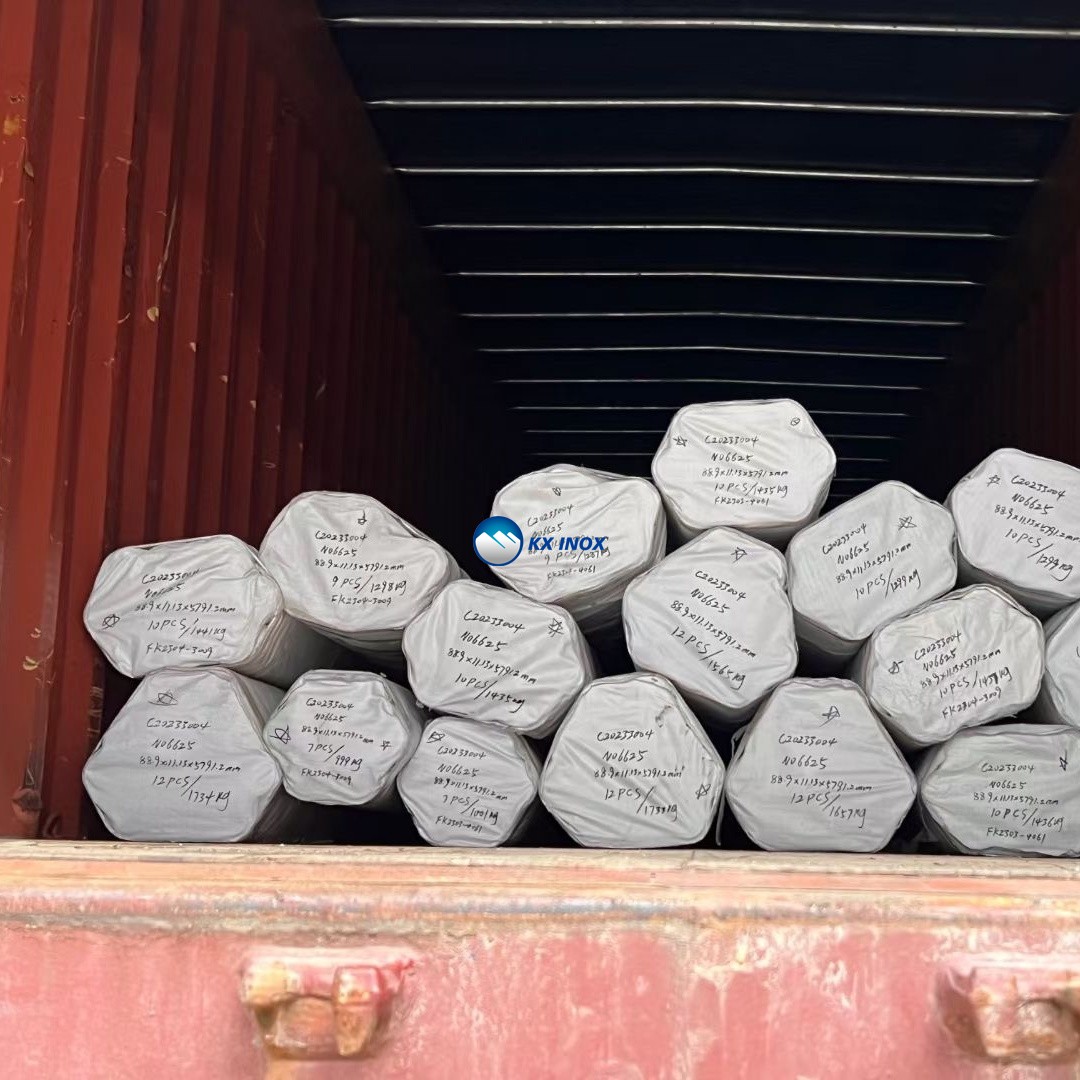
Need one heat that satisfies both documents?
Kaixin supplies ASTM A312 TP316L seamless pipe en A312 TP304L to either standard, and can dual-certify a heat against ASTM A312 and EN 10216-5 on request. Send the specification and we will confirm chemistry, sizes and lead time in one working day.
The Real Difference Between ASTM A312 and EN 10216-5
Grade equivalence gets you to the right alloy. These three sections decide whether the pipe you receive will be accepted.
Dimension and tolerance language
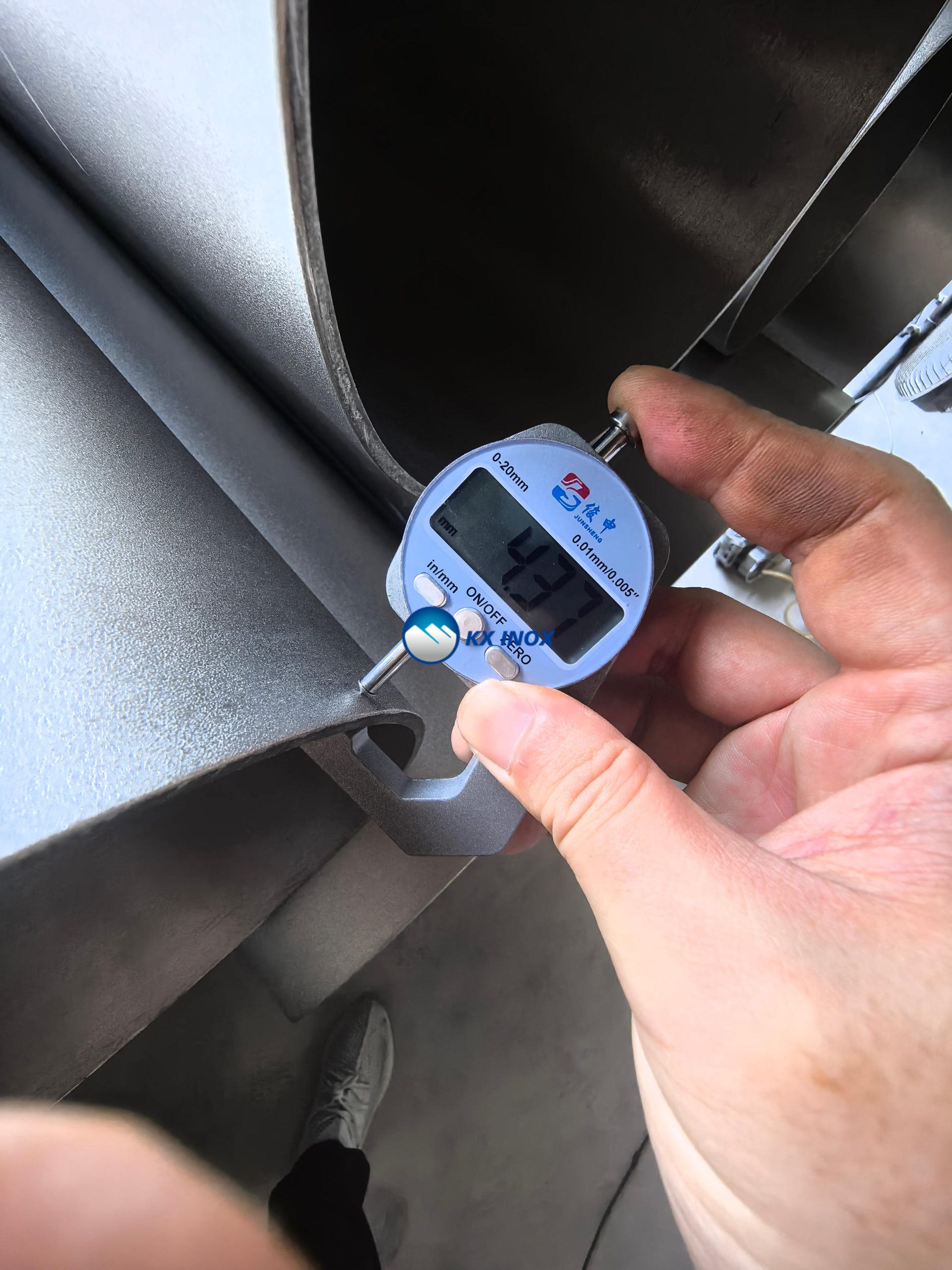
A312 talks in NPS and schedule. The stainless schedules in ASME B36.19M carry an S suffix, so SCH 10S is thinner than SCH 10 in carbon steel. EN 10216-5 talks in millimetres and, more importantly, in a tolerance class. Under EN ISO 1127 you nominate an outside diameter class such as D3 and a wall class such as T3. The class is not a footnote. A312 permits a minus wall tolerance of roughly 12.5% on seamless pipe, while a T3 order holds the wall to plus or minus 10%. Same nominal 4 mm wall, but the EN pipe usually delivers a heavier minimum wall and therefore more pressure capacity per metre.
This is the single most common source of disputes on cross-standard orders: the buyer converts NPS to millimetres, the mill ships to the ASTM tolerance, and the buyer measures against an EN expectation. Put the tolerance class on the order, or accept the minus tolerance in writing.
Testing and non-destructive examination
Both standards let the mill choose between a hydrostatic pressure test and an electric non-destructive test, and both require tensile and flattening tests on a lot basis. The difference sits in what the European document builds in as a purchasable option. EN 10216-5 carries a formal options structure, so impact testing, intergranular corrosion testing and specific surface condition requirements can be switched on inside the standard rather than bolted on as a customer deviation. With A312, anything beyond the base requirements becomes a supplementary requirement or a contract clause.
For a buyer this is good news on both sides. The risk is not the standard, it is an enquiry that names the grade and forgets the options. How each option is worded, and which tests are genuinely worth paying for, is covered in the FAQ section at the end of this guide.
Marking, traceability and the certificate
A312 requires each length to be marked with the manufacturer, the grade and the heat number. EN 10216-5 marking follows the EN system: standard number, steel name and number, heat identification, and a CE mark where the product falls under the Pressure Equipment Directive. When you dual-certify, both marking sets should appear, and the heat number on the pipe must match every document in the pack. If the marking is stencilled in one language and the certificate is in another, that is a traceability question you should raise before shipment, not after. Our walkthrough on how to read a mill test certificate shows the fields to check in order.
Can EN 10216-5 Pipe Replace ASTM A312 Pipe?
Sometimes yes, sometimes no, and the answer depends on the code the equipment is built to rather than on the alloy. Use this to decide quickly.
| Your situation | Can EN 10216-5 replace A312? | What to do |
|---|---|---|
| US project, ASME B31.3 or ASME code stamp | Geen | Order A312 material. An EN certificate will not satisfy the authorised inspector. |
| EU project under the Pressure Equipment Directive | Yes, and preferred | Order EN 10216-5 with an EN 10204 3.1 certificate. |
| Tender that names both standards | Yes, via dual certification | One heat, two documents, dual marking. |
| Replacement part on an existing EN line | Yes | Match the grade, tolerance class and wall series before ordering. |
| Duplex or super duplex service | Only from the EN side | A312 does not cover duplex. Use EN 10216-5 or ASTM A789 / A790. |
One more trap worth naming: ASTM A312 and ASTM A511 sit next to each other in the catalogue and are frequently quoted against the wrong enquiry. The comparison of ASTM A312 vs ASTM A511 explains which one owns which application, and it matters before you compare anything against the European document.
Tool: Grade Cross-Reference and Verification Panel
Use this panel while you are writing the enquiry. Open the grade group you are buying, copy the purchase order wording, then use the verification list against the certificate when the documents arrive. It is built to be used at your desk, not read once.
Step 1 – open your grade group
Each panel gives you the wording to put on the purchase order and the two or three values that most often fail an inspection.
TP304L / 1.4307 – low carbon 18-8
Write on the PO: ASTM A312 TP304L, NPS and schedule, or EN 10216-5 1.4307 with tolerance class T3. Add “EN 10204 3.1 certificate” if the end user is in Europe.
Verify: carbon at or below 0.030% for a true dual certificate, nickel between 8.0 and 10.5% for the EN window, and a sulphur level of 0.015% or less on the EN document.
TP316L / 1.4404 – low carbon 316
Write on the PO: ASTM A312 TP316L, or EN 10216-5 1.4404. State molybdenum explicitly if the service is chloride-bearing.
Verify: molybdenum between 2.0 and 2.5% to satisfy both windows, nickel 10.0 to 13.0%, and carbon at or below 0.030%. A 2.6% molybdenum heat passes A312 but fails 1.4404.
TP316Ti / 1.4571 and TP321 / 1.4541 – stabilised grades
Write on the PO: name the stabilising element and its minimum ratio. Titanium at five times the carbon content or more is the usual requirement, and the EN steel name spells it out.
Verify: the titanium or niobium figure is reported on the certificate. A stabilised grade without a stabiliser value is an incomplete certificate, whatever the grade line says.
TP310S / 1.4845 – high temperature austenitic
Write on the PO: TP310S or 1.4845 plus the design temperature. Both documents are silent on creep data, so the design data has to come from the applicable code.
Verify: nickel around 19 to 22% and chromium around 24 to 26%. A 310S heat supplied against a 309 requirement will look similar and perform differently.
Duplex S31803 / S32205 / 1.4462
Write on the PO: never A312. Choose ASTM A789 for tube, A790 for pipe, or EN 10216-5 on the European side, and add a ferrite or austenite-to-ferrite ratio check.
Verify: the phase balance result and the corrosion test. Duplex failures are almost always thermal history problems, not chemistry problems.
Step 2 – run the delivery check
Work down this list at goods-in. Each line is something a site audit will ask you to prove.
- Heat number on the pipe marking matches the heat number on every certificate in the pack.
- Standard number and edition year on the certificate match the purchase order, not just the grade line.
- Chemistry sits inside the narrower of the two windows when the order was dual-certified.
- Tensile and proof stress are above the minimum, and below any ceiling if the order was EN.
- Wall thickness measured at the pipe end is inside the tolerance class you nominated.
- Hydrostatic or non-destructive test result is recorded per lot, with the test method named.
- Marking shows the grade in the system your end user reads, plus a CE mark if the project needs one.
- Certificate is signed by an authorised inspection representative where a 3.1 document was ordered.
If you also need to cross-check a weight figure on the certificate, the site’s stainless steel weight calculator takes the same outside diameter and wall values in millimetres.
How to Write a Purchase Order That Satisfies Either Standard
A well written order removes most of the risk before the mill cuts the first billet. Six lines do the work.
- Name the standard with its edition year, for example ASTM A312 / A312M and EN 10216-5:2016. Undated references invite arguments.
- Give the grade in both systems when the end user is international: TP316L and 1.4404 side by side, with the UNS number as a tiebreaker.
- State dimensions in both NPS and millimetres, and add the EN tolerance class if the pipe will be measured in Europe.
- List the option tests you are paying for, and the ones you are explicitly waiving. Silence is not a waiver.
- Specify the certificate type, the language, and whether a third-party inspector must witness testing at the mill.
- Name the marking requirement, including any client or project mark that has to be stencilled on each length.
For higher pressure classes the technical requirements get stricter and the wording matters more. The guide to sourcing high pressure stainless steel pipe sets out what to add above and beyond the base standard.
Sourcing Notes From a Working Mill
Wenzhou Kaixin Metal has been producing stainless steel seamless pipe and tube for 15 years and holds ISO 9001:2015 certification. In that time the same pattern shows up on every cross-standard order, and it is rarely the alloy that causes trouble. An ASTM A312 seamless pipe enquiry and an EN 10216-5 enquiry can name the same grade and still need different paperwork, different marking and a different inspection routine. Metric sizes and EN certificates usually add a few days to lead time because the marking and the inspection certificate are produced after the tests clear, not before.
Two habits shorten that cycle. First, send the end user’s specification, not a paraphrase of it — most mismatches are traceable to a summary someone rewrote. Second, decide whether you need a single standard or a dual certificate on the day you send the enquiry, because re-certifying a heat after it has been cut and marked is far more expensive than certifying it once. If you are still weighing the two material routes on a project, the discussion of seamless vs welded stainless steel pipe belongs in the same conversation, since the manufacturing route changes which standards even apply.
The full range of sizes and schedules is listed under naadloze roestvrij stalen pijp, and the thinner wall equivalents are grouped as naadloze buis van roestvrij staal for heat exchanger and instrument work.
Veelgestelde vragen
These are the questions that come up after the comparison, when the specification has already been chosen and the details start to matter.
Is TP316 the same as 1.4401?
Yes on alloy, no on carbon. TP316 is the ASTM A312 designation for UNS S31600 and matches EN 1.4401 (X5CrNiMo17-12-2). TP316L matches 1.4404 instead. The confusion costs money because the two pairs are not cross-compatible on a certificate: if your specification says 1.4404, a heat certified as TP316 will not satisfy it even though both are molybdenum-bearing 316.
Can one heat be dual-certified to both ASTM A312 and EN 10216-5?
Yes, and mills do it routinely. The heat is tested once and two documents are issued: an ASTM A312 test report and an EN 10204 3.1 certificate. For the chemistry to clear both windows at once, a 316L heat needs carbon at or below 0.030%, chromium 16.5 to 18.0%, nickel 10.0 to 13.0% and molybdenum 2.0 to 2.5%. Ask for both documents and dual marking on the pipe.
Does ASTM A312 pipe arrive with an EN 10204 3.1 certificate?
Not by default. A312 requires a manufacturer’s test report. EN 10204 3.1 is an EN-system document signed by the mill’s authorised inspection representative. Many mills will issue one on request, usually against a small premium, but it has to be asked for. If the project is EN-based, write the certificate type on the purchase order rather than assuming it ships with the pipe.
Can I use ASTM A312 pipe in PED-categorised equipment?
Not on its own. Directive 2014/68/EU expects a harmonised standard such as EN 10216-5, or a documented particular material appraisal. A312 material can still be accepted, but the route involves a PMA, notified body involvement and complete traceability. Settle the material standard before the order is released, because retrofitting compliance after fabrication is expensive and sometimes impossible.
What is the practical difference between ASTM A312 and ASTM A213?
A312 covers pipe: NPS and schedule dimensions, pressure piping, ASME B31.3 service. A213 covers seamless and welded tube for boiler, superheater and heat exchanger duty, ordered by outside diameter and wall. The chemistry tables look almost identical, which is exactly why the mix-up happens. If your drawing is a tube drawing, order A213 or EN 10216-5 tube, not A312 pipe.
Do I need impact testing on austenitic pipe for a minus 20 degree service?
Impact testing is not a base requirement of ASTM A312 for austenitic grades, and A312 publishes no absorbed energy values. EN 10216-5 handles impact testing through its options structure. For low temperature austenitic service the requirement almost always comes from the project specification or the end user rather than the product standard, so get it in writing before the heat is rolled.
Why does EN 10216-5 pipe cost more than A312 for the same grade?
Three real reasons and one habit. The EN chemistry windows are narrower, so more heats are rejected at the mill. A 3.1 certificate and option testing add cost. European mills carry PED approvals and metric tooling that a mill focused on US customers may not. The habit is specification creep: an A312 order with no options is a much lighter package than an EN order with impact testing and corrosion testing.
How do I convert SCH 10S and SCH 40S to millimetres?
For SCH 10S: 2.77 mm at NPS 1, 3.38 mm at NPS 1.5, 3.68 mm at NPS 2. For SCH 40S: 3.73 mm, 3.91 mm and 5.54 mm at the same sizes. The S series in ASME B36.19M is the stainless wall series and is thinner than the carbon steel schedule carrying the same number. Convert both ways on the order when the end user works in millimetres.
Which intergranular corrosion test applies, ASTM A262 or EN ISO 3651-2?
They are different methods and not interchangeable. ASTM A262 Practice E is the copper sulfate test normally associated with A312 deliverables. EN ISO 3651-2 is the method referenced on the European side. Specimen preparation and acceptance criteria differ, so name the method your end user’s specification requires. On a dual-certified order, confirm whether one test can serve both documents.
How can I verify that a 1.4404 pipe really is 316L before it ships?
Ask for positive material identification by X-ray fluorescence or optical emission, then cross-check the heat number between the pipe marking and the certificate. Look specifically at carbon and molybdenum, the two values where substituted material usually fails. A third-party inspection at the mill before packing costs far less than a rejected delivery at site. Kaixin issues a 3.1 certificate with heat level chemistry on request.
The Short Version
The difference between ASTM A312 and EN 10216-5 is not the alloy, it is the rulebook wrapped around it. A312 gives you inch dimensions, a wider chemistry window and minimum mechanical values. EN 10216-5 gives you metric dimensions, a tighter window, published mechanical ranges and a certificate type your European inspector expects. Match the standard to the code your equipment is built to, dual-certify when a tender demands both, and put the tolerance class and option tests in writing. Do that, and the pipe on site will match the paperwork in your hand.
Send us your standard, not just your grade
Tell us the standard and edition, the size, the tolerance class and the certificate type you need. Our engineers reply with a compliant offer, the grade equivalents that apply and a realistic lead time — usually within one working day.
Related Products
- ASTM A312 TP316 seamless pipe – the standard carbon 316 grade, sizes and schedules on one page.
- 316 roestvrij stalen pijp – product overview for molybdenum-bearing austenitic pipe.
- ASTM A270 naadloze buis van roestvrij staal – the sanitary route, and how it differs from A312.
 English
 Afrikaans
 Arabic
 Bengali
 Catalan
 Chinese
 French
 Dutch (Belgium)
 Dutch
 German
 Czech
 Greek
 Hindi
 Japanese
 Italian
 Portuguese
 Spanish (Chile)
 Spanish (Colombia)
 Spanish (Argentina)
 Persian
 Estonian
 Albanian
 Russian
 Spanish (Peru)
 Indonesian
 Thai
 Vietnamese
 Georgian
 Korean
 Nepali
 Polish
 Ukrainian
 Malayalam
 Xhosa