 温州開新開新金属有限公司

パイプ規格表:完全ガイド
A pipe schedule is a standardized way to describe pipe wall thickness, which affects pressure capacity, inside diameter, weight, and fit with fittings. A good pipe schedule chart helps engineers, buyers, fabricators, and maintenance teams compare pipe dimensions quickly before selecting or ordering material. This guide explains how to read a schedule chart, what common schedules mean, and why pipe sizing should always be checked against the applicable pipe standards for the job.
| ASME B36.19:Stainless Steel Pipe Size | |||||||
| 公称 パイプサイズ | OD in(mm) outside diameter | Stainless steel(ASME B36.19) | |||||
| DN | NPS | Sch5S in(mm) | Sch10S in(mm) | Sch40S in(mm) | Sch80S in(mm) | Sch160S in(mm) | |
| 6 | 1/8 | 0.405(10.3) | 0.049(1.24) | 0.068(1.73) | 0.095(2.41) | 0.124(3.15) | |
| 8 | 1/4 | 0.540(13.7) | 0.065(1.65) | 0.088(2.24) | 0.119 (3.02) | 0.145 (3.68) | |
| 10 | 3/8 | 0.675(17.1) | 0.065(1.65) | 0.091(2.31) | 0.126(3.20) | 0.158(4.01) | |
| 15 | 1/2 | 0.840(21.3) | 0.065(1.65) | 0.083(2.11) | 0.109(2.77) | 0.147(3.73) | 0.188(4.78) |
| 20 | 3/4 | 1.050(26.7) | 0.065(1.65) | 0.083(2.11) | 0.113(2.87) | 0.154(3.91) | 0.219(5.56) |
| 25 | 1 | 1.315(33.4) | 0.065(1.65) | 0.109(2.77) | 0.133 (3.38) | 0.179(4.55) | 0.250(6.35) |
| 32 | 1 1/4 | 1.660(42.2) | 0.065(1.65) | 0.109(2.77) | 0.140(3.56) | 0.191(4.85) | 0.250(6.35) |
| 40 | 1 1/2 | 1.900(48.3) | 0.065(1.65) | 0.109 (2.77) | 0.145(3.68) | 0.200(5.08) | 0.281(7.14) |
| 50 | 2 | 2.375(60.3) | 0.065(1.65) | 0.109(2.77) | 0.154(3.91) | 0.218(5.54) | 0.344(8.74) |
| 65 | 2 1/2 | 2.875(73) | 0.083(2.11) | 0.120(3.05) | 0.203 (5.16) | 0.276(7.01) | 0.375(9.52) |
| 80 | 3 | 3.500(88.9) | 0.083(2.11) | 0.120(3.05) | 0.216(5.49) | 0.300(7.62) | 0.438(11.13) |
| 90 | 3 1/2 | 4.000(101.6) | 0.083(2.11) | 0.120(3.05) | 0.226(5.74) | 0.318(8.08) | |
| 100 | 4 | 4.500(114.3) | 0.083(2.11) | 0.120(3.05) | 0.237(6.02) | 0.337(8.56) | 0.531(13.49) |
| 125 | 5 | 5.563(141.3) | 0.109(2.77) | 0.134(3.40) | 0.258(6.55) | 0.375(9.52) | 0.625(15.88) |
| 150 | 6 | 6.625(168.3) | 0.109(2.77) | 0.134(3.40) | 0.280(7.11) | 0.432(10.97) | 0.719(18.26) |
| 200 | 8 | 8.625(219.1) | 0.109(2.77) | 0.148(3.76) | 0.322(8.18) | 0.500(12.70) | |
| 250 | 10 | 10.750(273.1) | 0.134(3.40) | 0.165(4.19) | 0.365(9.27) | 0.500(12.70) | |
| 300 | 12 | 12.750(323.9) | 0.156(3.96) | 0.180(4.57) | 0.375(9.52) | 0.500(12.70) | |
| 350 | 14 | 14.000(355.6) | 0.156(3.96) | 0.188(4.78) | 0.375(9.52) | 0.500(12.70) | |
| 400 | 16 | 16.000(406.4) | 0.165(4.19) | 0.188(4.78) | 0.375(9.52) | 0.500(12.70) | |
| 450 | 18 | 18.000(457) | 0.165(4.19) | 0.188(4.78) | 0.375(9.52) | 0.500(12.70) | |
| 500 | 20 | 20.000(508) | 0.188(4.78) | 0.218(5.54) | 0.375(9.52) | 0.500(12.70) | |
| 550 | 22 | 22.000(559) | 0.188(4.78) | 0.218(5.54) | |||
| 600 | 24 | 24.000(610) | 0.218(5.54) | 0.250(6.35) | 0.375(9.52) | 0.500(12.70) | |
| 650 | 26 | 660 | |||||
| 700 | 28 | 711 | |||||
| 750 | 30 | 30.000(762) | 0.250(6.35) | 0.312(7.92) | |||
The dimensions behind every schedule chart
A pipe schedule chart is built around a few measurements that appear again and again in engineering and procurement documents. Understanding these terms makes the chart much easier to use and helps avoid common ordering mistakes.
重要 配管の寸法 以下を含みます:
- NPS, or nominal pipe size: The named pipe size used in North American pipe sizing. It is a designation, not always the exact measured diameter.
- DN, or nominal diameter: The metric designation often used internationally. DN in millimeters is roughly related to NPS in inches, though smaller sizes do not always convert perfectly.
- OD, or outside diameter: The external pipe diameter. For a given NPS, this normally remains constant across schedules.
- 肉厚: The pipe wall measurement. This increases as the pipe schedule increases.
- ID, or inside diameter: The internal opening of the pipe. It gets smaller as wall thickness increases.
- Weight per foot or meter: The approximate pipe weight, which affects shipping, handling, supports, and installed cost.
A simple way to estimate inside diameter is to subtract twice the wall thickness from the outside diameter. For example, if a pipe has an outside diameter of 4.500 inches and a wall thickness of 0.237 inches, the estimated inside diameter is 4.026 inches. The actual value should still be confirmed in the relevant pipe schedule chart pdf or project specification.
Common pipe schedules and where they are used
Schedule 40 and Schedule 80 are among the most commonly referenced schedules, but they are not the only options. Schedules such as 5, 10, 20, 30, 40, 80, 120, 160, and double extra strong may appear depending on pipe size, material, and standard.
Schedule 40 is often used for general-purpose service where moderate strength and manageable weight are important. It is common in water, air, and many utility applications, depending on the material and design pressure. Schedule 80 has a thicker wall than Schedule 40 for the same nominal size, so it is often considered where higher pressure, mechanical durability, or additional corrosion allowance is needed.
Very light schedules, such as Schedule 5 or Schedule 10, may be used in selected low-pressure or ステンレス鋼の用途 where corrosion resistance matters more than wall thickness. Heavier schedules, such as Schedule 160, are used when demanding pressure or mechanical conditions justify the added weight and cost.
Carbon steel and stainless steel schedules are not always identical
Pipe standards matter because the same schedule label can be governed by different dimensional standards. Carbon steel pipe dimensions are commonly associated with ANSI/ASME B36.10M, while stainless steel pipe is commonly associated with ANSI/ASME B36.19M. Stainless schedules may include an “S” designation, such as 10S or 40S, to distinguish them from carbon steel schedules.
This distinction matters when someone searches for a ステンレス鋼管 schedule chart pdf and assumes it will match a carbon steel chart exactly. In many cases the outside diameter system remains familiar, but available schedules, wall thicknesses, and common stock options can differ. For procurement, the safest approach is to specify the material grade, NPS or DN, schedule, standard, and any end finish or testing requirements together.
A clear specification might include:
- Pipe material, such as carbon steel or stainless steel
- Applicable pipe standards
- Nominal pipe size or DN
- Required pipe schedule
- End type, such as plain end, threaded, or beveled
- Quantity and length requirements
- Service conditions when relevant, such as pressure, temperature, or corrosion exposure
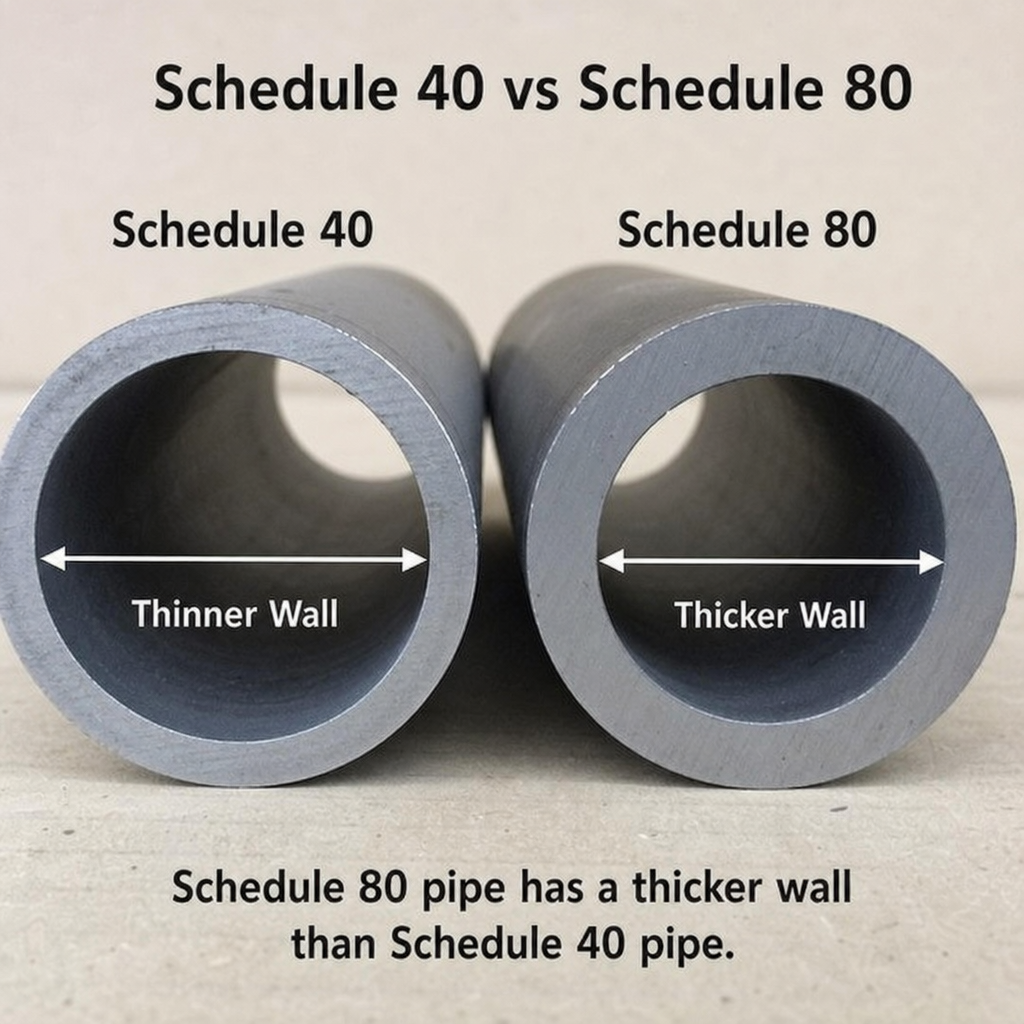
close-up comparison of Schedule 40 and Schedule 80 pipe wall thickness
実用的な配管サイズ選定チェックリスト
Before using a pipe schedule chart pdf for ordering or design review, run through a short checklist. It can prevent small dimensional assumptions from becoming expensive field problems.
- Confirm whether the project uses NPS, DN, or both.
- Verify the material, not just the schedule number.
- Use the correct ansi pipe schedule chart for carbon steel or stainless steel.
- Check OD for fitting and flange compatibility.
- Confirm ID if flow capacity or pressure drop matters.
- Review weight when supports, racks, or shipping constraints are important.
- Make sure the schedule is available from suppliers in the required size and material.
- Ask a qualified engineer to validate pressure-rated or hazardous applications.
The main takeaway
A pipe schedule chart is more than a dimension reference. It connects pipe sizing, wall thickness, weight, material standards, and real installation decisions in one place. When used carefully, it helps teams choose pipe that fits correctly, performs safely, and avoids unnecessary cost.
For everyday reference, keep both a general pipe schedule chart and the material-specific chart your project requires. If ステンレス鋼 is involved, use a stainless steel pipe schedule chart pdf rather than assuming carbon steel dimensions or schedules apply automatically. The right chart, paired with the right standard and engineering judgment, makes pipe selection clearer from design through procurement and installation.
FAQ
How schedule affects performance and cost
Choosing a pipe schedule is a balance between safety, function, and practicality. A thicker wall can provide greater pressure capacity and more allowance for wear or corrosion, but it also reduces inside diameter. That reduction can increase flow velocity or pressure drop if the system was not designed for it.
Weight is another practical factor. A heavier schedule can increase material cost, freight cost, lifting requirements, and support loads. Over-specifying pipe may feel conservative, but it can create unnecessary expense and installation difficulty. Under-specifying pipe, however, can lead to leaks, premature failure, or noncompliance with design codes.
For this reason, a pipe schedule should never be selected from a chart alone. The chart gives dimensions. The final decision should also consider pressure, temperature, fluid type, corrosion allowance, joining method, applicable codes, and the allowable stress of the selected material. A commonly cited relationship is schedule approximates 1000 times pressure divided by allowable stress, but real-world design requires the full standard and engineering review.
What does pipe schedule mean?
Pipe schedule means the wall thickness assigned to a nominal pipe size. In general, a higher pipe schedule number means a thicker wall, a smaller inside diameter, greater weight, and higher potential pressure capacity when the material and temperature conditions are suitable.
The key point is that pipe schedule is not the same thing as pipe size. A 2-inch pipe, for example, has a nominal pipe size, often called NPS, but its actual inside diameter changes depending on whether it is Schedule 40, Schedule 80, or another schedule. The outside diameter usually stays the same for a given NPS, which helps pipes remain compatible with matching fittings, flanges, and valves.
This is why an ansi pipe schedule chart is so useful. It places the main data points in one reference so a specifier can confirm the nominal size, outside diameter, wall thickness, approximate weight, and sometimes inside diameter before a purchase order or drawing is finalized.

engineer reviewing a pipe schedule chart beside steel pipe sections
How do you read a pipe schedule chart?
To read a pipe schedule chart, start with the nominal pipe size, then move across the chart to the required schedule and compare outside diameter, wall thickness, inside diameter, and weight. The schedule tells you how thick the wall is for that size, while the material standard and design conditions determine whether it is appropriate for the service.
A practical reading process looks like this:
- Identify the NPS or DN required by the design. Start with the size shown on the drawing, line list, or equipment connection.
- Find the matching schedule. Look for Schedule 10, 40, 80, 160, or another listed value.
- Check the OD. Confirm that the outside diameter matches the fittings, valves, or flanges being used.
- Review the wall thickness. This is the main schedule-related dimension and a major factor in strength and pressure capability.
- Calculate or confirm the ID. Inside diameter affects flow area, velocity, and pressure drop.
- Check the weight. Heavier schedules may require stronger supports, more careful handling, and higher transportation allowances.
- Verify the governing standard. Do not rely on a generic chart alone when code compliance, pressure containment, or hazardous service is involved.
This method is especially helpful when comparing pipe types such as carbon steel, stainless steel, and alloy pipe. Similar schedule numbers can appear across materials, but material strength, corrosion resistance, temperature limits, and manufacturing standards can change the final selection
 English
 Afrikaans
 Arabic
 Bengali
 Catalan
 Chinese
 French
 Dutch (Belgium)
 Dutch
Dutch German
 Czech
Czech Greek
Greek Hindi
Hindi Japanese
 Italian
 Portuguese
 Spanish (Chile)
 Spanish (Colombia)
 Spanish (Argentina)
 Persian
 Estonian
 Albanian
 Russian
 Spanish (Peru)
 Indonesian
 Thai
Thai Vietnamese
 Georgian
 Korean
 Nepali
 Polish
 Ukrainian
 Malayalam
 Xhosa
Xhosa