 Wenzhou Kaixin Kaixin Metal Co.,LTD

304 VS UNS32205 For Heat exhcanger What Difference
Choosing between 304 stainless steel and UNS S32205 duplex stainless steel can change how long a heat exchanger lasts, how often it needs maintenance, and how safely it performs in corrosive service. In simple terms, 304 is a practical and widely used option for mild environments, while UNS S32205 is built for higher strength and stronger corrosion resistance in tougher industrial heat exchangers.
For engineers, buyers, and plant teams, the best choice is not the material with the most impressive data sheet. It is the material that matches the fluid chemistry, temperature, pressure, fabrication requirements, and lifecycle cost of the heat exchanger.
What is the real difference between 304 and UNS S32205 for heat exchangers?
The real difference is that 304 stainless steel is an austenitic stainless steel suited to general corrosion resistance in relatively mild conditions, while UNS S32205 is a duplex stainless steel designed for higher mechanical strength and better resistance to chloride-related corrosion. In a heat exchanger, that difference matters because tubes, plates, shells, and welds are constantly exposed to heat, pressure, fluid velocity, and chemical attack.
A 304 vs uns32205 heat exchanger decision often begins with the service environment. If the exchanger handles clean water, low-chloride process fluids, or indoor utility service, 304 may be adequate and economical. If the unit sees seawater, brine, chlorides, sour service, or aggressive chemicals, UNS S32205 usually offers a stronger safety margin.
The distinction is also structural. UNS S32205 has much higher yield strength than 304, which can allow thinner sections in certain designs while still meeting mechanical requirements. That can reduce weight and may partly offset the higher material price, especially in larger industrial heat exchangers.
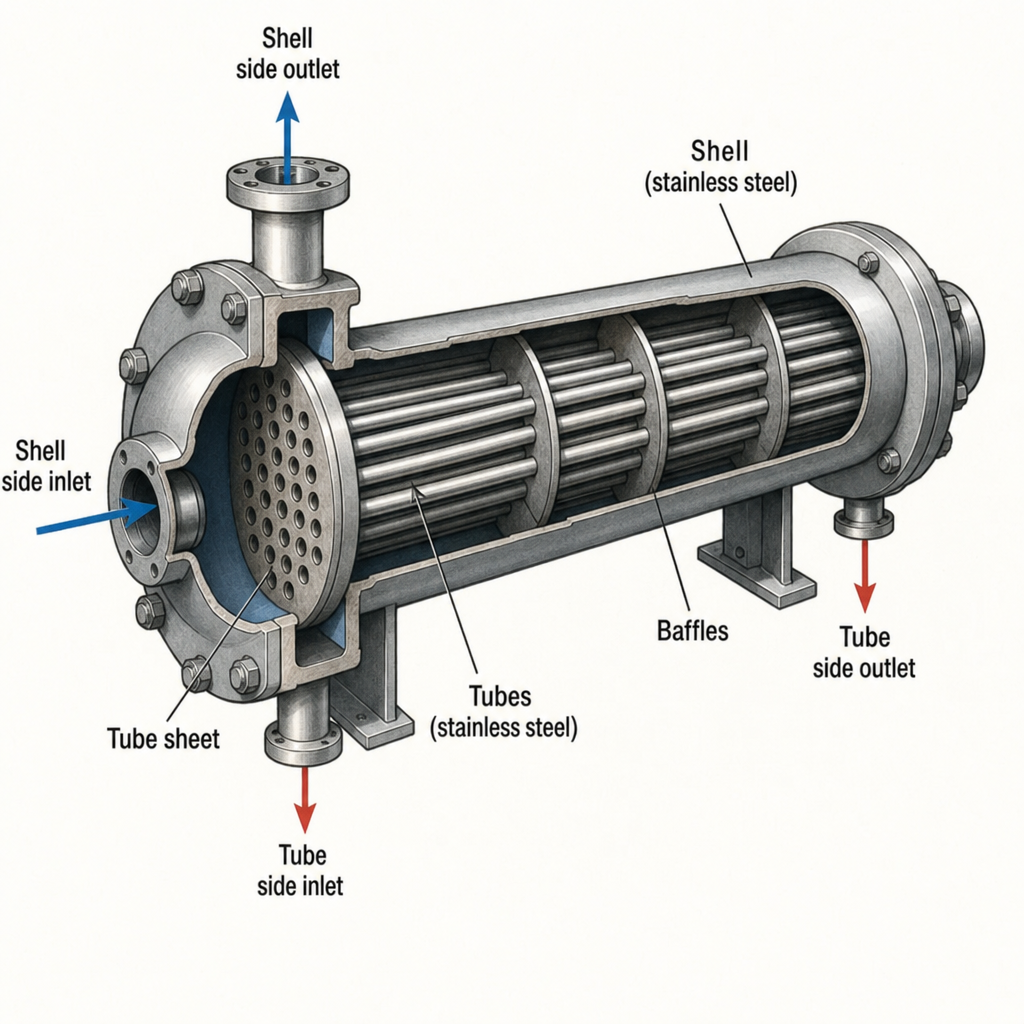
cutaway illustration of stainless steel heat exchanger tubes and shell
Material structure shapes performance
304 stainless steel belongs to the austenitic stainless family. It is commonly described as an 18Cr-8Ni grade, meaning it contains roughly 18 percent chromium and 8 percent nickel. This chemistry gives it good general corrosion resistance, good formability, and excellent weldability, which is why it appears across many heat exchanger types and general industrial systems.
UNS S32205, often associated with 2205 acciaio inossidabile duplex, has a mixed austenitic-ferritic microstructure. Its chemistry typically includes higher chromium, lower nickel than many austenitic grades, molybdenum, and nitrogen. The combination improves resistance to pitting and crevice corrosion, especially where chlorides are present.
That duplex structure is the reason UNS S32205 behaves differently in service. It is stronger and more resistant to chloride stress corrosion cracking than 304. However, it also requires more care during fabrication, welding, and machining.
For heat exchanger materials, this is the core trade-off: 304 is easier and usually cheaper to fabricate, while UNS S32205 brings higher strength and better corrosion performance in demanding environments.
Corrosion resistance is the main dividing line
Corrosion resistance is often the deciding factor because corrosion failures in heat exchangers can be expensive and disruptive. A small tube leak can cause cross-contamination between fluids, reduce thermal efficiency, trigger shutdowns, or damage downstream equipment.
304 stainless steel performs well in many clean, neutral, and low-chloride environments. It can be a sensible choice where the process fluid is not aggressive and where cleaning practices are controlled. But it is vulnerable to pitting, crevice corrosion, and stress corrosion cracking when chlorides are present, especially at elevated temperatures.
UNS S32205 is designed to handle more aggressive conditions. Its chromium, molybdenum, and nitrogen content gives it better pitting and crevice corrosion resistance than 304. In practical terms, that makes it more suitable for seawater, brine, desalination systems, chemical processing, and other chloride-bearing environments.
Common corrosion risks in heat exchangers
When evaluating heat exchanger materials, pay close attention to these risks:
- Pitting corrosion: Localized attack that creates small, deep holes, often in chloride-containing fluids.
- Crevice corrosion: Corrosion that develops in tight gaps, deposits, gasket areas, or stagnant zones.
- Cricche da corrosione sotto sforzo: Cracking driven by tensile stress and a corrosive environment, commonly associated with chlorides in stainless steels.
- Galvanic corrosion: Accelerated corrosion caused by contact between dissimilar metals in an electrolyte.
- Under-deposit corrosion: Attack beneath scale, sediment, biofilm, or fouling layers.
304 can be reliable when these risks are low. UNS S32205 becomes more attractive when these risks are built into the service conditions rather than occasional exceptions.
Strength changes the design conversation
Mechanical strength is not just a number on a specification sheet. In a heat exchanger, it affects wall thickness, pressure capability, vibration tolerance, handling, and the ability to withstand mechanical stress during operation.
304 stainless steel has good ductility and toughness, with a typical 0.2 percent yield strength around 205 MPa and elongation often around 40 percent. This makes it forgiving during forming and fabrication. It is well understood by manufacturers and commonly stocked in many product forms.
UNS S32205 has much higher strength, with yield strength commonly at or above 450 MPa and tensile strength often at or above 620 MPa. Its elongation is lower than 304, often around 25 to 30 percent, but still sufficient for many industrial designs when fabrication is properly managed.
This higher strength can be valuable in pressure vessels, tube bundles, plates, and components exposed to mechanical loads. In some cases, engineers can specify thinner walls or lighter components while maintaining strength requirements. That does not automatically mean every UNS S32205 exchanger is cheaper or lighter, but it gives designers more options.
How do 304 and UNS S32205 perform in different heat exchanger services?
304 performs best in mild, controlled services where corrosion risk is limited, while UNS S32205 performs better in chloride-rich, chemically aggressive, or mechanically demanding services. The more severe the operating environment becomes, the more the balance shifts toward acciaio inossidabile duplex.
In utility water systems with low chloride content, 304 can provide dependable performance if temperatures, cleaning chemicals, and fouling are controlled. It may also be used in indoor process environments where the fluid chemistry is stable and not highly corrosive.
For marine, offshore, desalination, and brine applications, 304 is usually a risky choice. Chlorides can attack stainless steel quickly under the right conditions, especially in crevices, stagnant areas, or hot zones. UNS S32205 is more appropriate because it was developed for better resistance to exactly these kinds of environments.
In chemical processing, the answer depends on the specific chemical, concentration, temperature, and contamination level. Some mild chemicals may be compatible with 304, while more aggressive mixtures may require UNS S32205 or even higher alloy materials. Material selection should always account for both normal operating conditions and upset conditions.
Practical application guidance
Use 304 acciaio inox when:
- The service is mild, clean, and low in chlorides.
- Budget pressure is high and corrosion risk is clearly limited.
- Ease of fabrication, forming, and welding is a major priority.
- The heat exchanger operates in a controlled indoor environment.
- Maintenance access is easy and failure consequences are manageable.
Consider UNS S32205 when:
- The system handles seawater, brine, or chloride-bearing process fluids.
- Pitting, crevice corrosion, or stress corrosion cracking is a serious concern.
- Higher strength could reduce wall thickness or improve mechanical reliability.
- Downtime, leaks, and contamination would create major operating costs.
- The exchanger serves offshore, desalination, chemical, pulp and paper, or sour service applications.
Fabrication and welding affect the final result
A strong alloy can still fail early if it is fabricated incorrectly. This is especially important for duplex stainless steels, because their corrosion resistance and toughness depend on maintaining the right phase balance and avoiding harmful metallurgical changes.
304 is one of the easier stainless steels to work with. It welds readily using common stainless procedures, forms well, and is familiar to most fabrication shops. For simple heat exchanger projects, this familiarity can reduce production risk and help control cost.
UNS S32205 requires more discipline. Machining is more difficult because the alloy is stronger and harder on tools. Fabricators may need carbide tooling, lower cutting speeds, rigid setups, and careful coolant use to manage heat and tool wear.
Welding UNS S32205 also requires qualified procedures. Heat input, interpass temperature, filler selection, and cooling rate must be controlled to preserve the duplex structure. Poor welding practice can reduce corrosion resistance or create brittle phases, particularly in heat-affected zones.
Fabrication checklist for UNS S32205 heat exchanger projects
Before specifying UNS S32205, confirm that the manufacturer can manage duplex fabrication requirements:
- Qualified welding procedures: Procedures should be appropriate for acciaio inossidabile duplex, not simply adapted from 304 practice.
- Experienced welders: Personnel should understand heat input control and the importance of phase balance.
- Correct filler metals: Filler selection should support strength, corrosion resistance, and weld integrity.
- Controlled interpass temperature: Excessive heat can damage the desired microstructure.
- Proper cleaning and pickling: Contamination or heat tint can reduce corrosion performance.
- Suitable machining methods: Tooling, speeds, feeds, and cooling should reflect the alloy’s higher strength.
- Inspection planning: Weld quality, surface condition, and critical areas should be checked before service.
These steps add complexity, but they are part of getting the performance that UNS S32205 is chosen for in the first place.
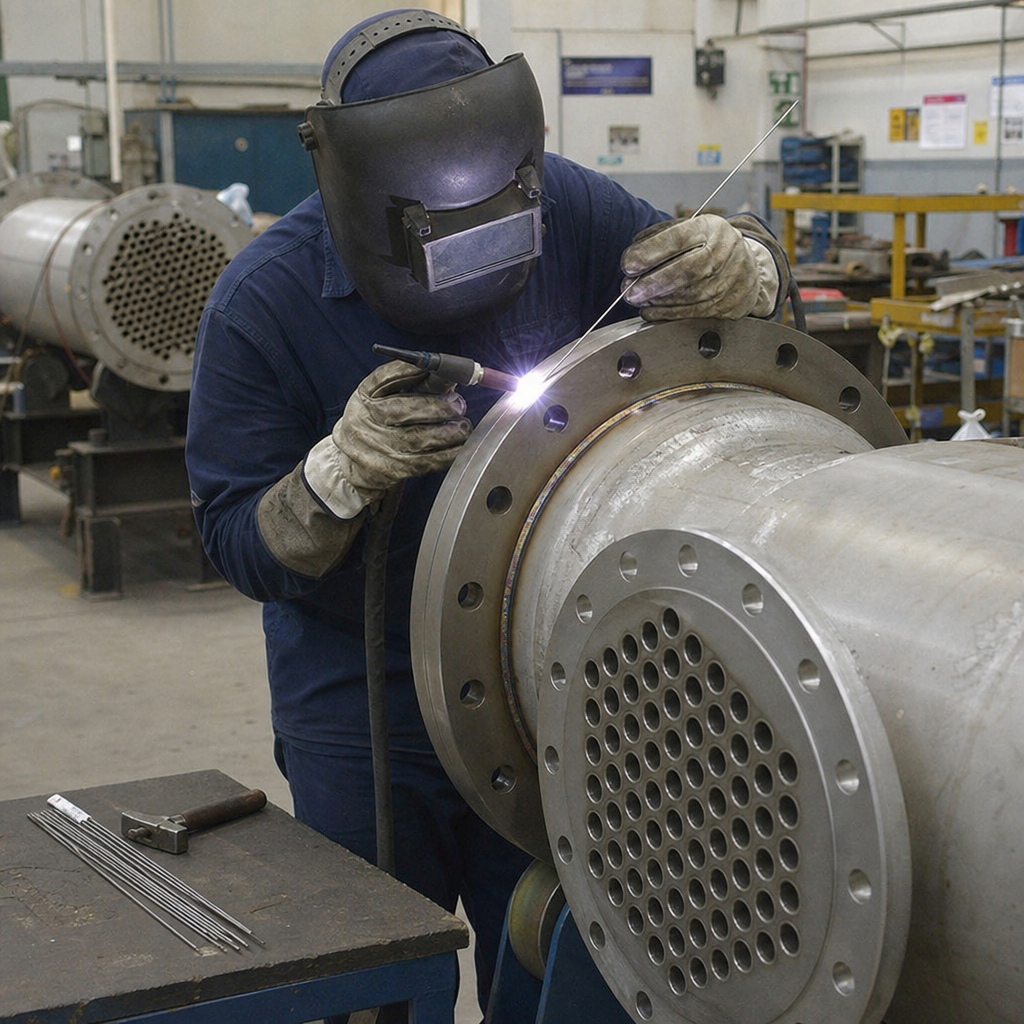
welder fabricating duplex stainless steel heat exchanger components
Cost should be measured over the exchanger’s service life
It is easy to compare only the purchase price of 304 and UNS S32205, but that can lead to a short-sighted decision. 304 usually has the lower initial material and fabrication cost. It is widely available, easier to work with, and familiar to many suppliers.
UNS S32205 generally costs more upfront and may increase fabrication complexity. Welding, machining, inspection, and procurement may require more planning. For a mild service application, that added expense may not be justified.
However, lifecycle cost can tell a different story in corrosive or high-stress environments. If 304 pits, cracks, leaks, or requires frequent maintenance, the lower purchase price disappears quickly. Downtime, replacement tube bundles, emergency repairs, lost production, and contamination risks can outweigh the original savings.
UNS S32205 can also reduce cost indirectly through its strength. In suitable designs, thinner walls or lighter construction may reduce material weight while maintaining pressure and structural requirements. This needs engineering validation, but it is one reason duplex stainless steels are often considered for demanding industrial heat exchangers.
Heat exchanger types influence material choice
Different heat exchanger types expose materials to different stress patterns and corrosion risks. A shell-and-tube exchanger may have crevice-prone tube-to-tubesheet joints, stagnant shell-side regions, and vibration concerns. A plate heat exchanger may have narrow channels, gasket areas, and high heat-transfer efficiency but also many crevice-like features.
304 can perform well in heat exchanger types where the service fluid is clean and the design avoids stagnant deposits. It is often considered when fabrication simplicity and cost are important. But if the design has many crevices and the fluid contains chlorides, 304 becomes less attractive.
UNS S32205 is better suited when the design or service increases localized corrosion risk. Plate, tubular, and welded units in seawater or chemical service may benefit from duplex stainless steel because the material has greater resistance to pitting and crevice attack. The final choice should still be checked against the actual process chemistry, temperature, pressure, and cleaning program.
A simple decision path for material selection
Material selection becomes easier when the operating conditions are reviewed in the right order. Instead of starting with price, begin with failure risk.
Use this decision path:
- Identify the fluids on both sides of the exchanger. Include normal chemistry, contaminants, cleaning chemicals, and possible upset conditions.
- Check chloride levels and temperature. Chlorides become more dangerous as temperature rises and as crevices or deposits form.
- Review pressure and mechanical loads. Higher pressure, vibration, or cyclic stress may favor the higher strength of UNS S32205.
- Assess failure consequences. If leakage could cause shutdown, contamination, safety issues, or expensive repairs, a more resistant material may be justified.
- Evaluate fabrication capability. Choose UNS S32205 only when the fabricator can meet duplex welding and machining requirements.
- Compare lifecycle cost. Include purchase cost, inspection, maintenance, downtime risk, expected repair frequency, and replacement planning.
This approach prevents the most common mistake: choosing the cheapest stainless steel before confirming whether it can survive the actual service.
The better choice depends on the operating environment
There is no universal winner between 304 and UNS S32205. 304 is a practical material for mild services, especially when cost, availability, and easy fabrication matter. It remains a strong option for low-corrosion environments where the process conditions are well understood.
UNS S32205 is the stronger candidate for harsh service. Its corrosion resistance, chloride performance, and mechanical strength make it a better fit for seawater, brine, offshore, desalination, chemical, and other demanding applications. It asks more from the fabricator, but it can reward that care with longer service life and fewer corrosion-related problems.
For any serious 304 vs uns32205 heat exchanger selection, the key is to match the material to the real risks inside the equipment. If the environment is mild, 304 may be the efficient choice. If corrosion, pressure, or downtime risk is high, UNS S32205 is often the more durable and cost-conscious decision over the full life of the heat exchanger.
 English
 Afrikaans
 Arabic
 Bengali
 Catalan
 Chinese
 French
 Dutch (Belgium)
 Dutch
Dutch German
 Czech
Czech Greek
Greek Hindi
Hindi Japanese
 Italian
 Portuguese
 Spanish (Chile)
 Spanish (Colombia)
 Spanish (Argentina)
 Persian
 Estonian
 Albanian
 Russian
 Spanish (Peru)
 Indonesian
 Thai
Thai Vietnamese
 Georgian
 Bhojpuri
 Moroccan Arabic
 Korean
 Nepali
 Polish
 Ukrainian
 Malayalam
 Xhosa
Xhosa