 Wenzhou Kaixin Kaixin Metal Co., LTD.

304 VS 316L Hardness of Stainless steel pipe
304 and 316L stainless steel pipe are close in hardness when supplied in the common annealed condition, so the better choice usually depends less on hardness alone and more on corrosion exposure, welding requirements, and service environment. For most buyers comparing stainless steel pipe hardness, 304 offers dependable general-purpose performance, while 316L adds molybdenum and low carbon chemistry for better durability in chloride-rich or welded applications. ASTM A312 is one of the common specifications used for seamless, welded, and heavily cold-worked austenitic stainless steel pipe, including grades such as TP304 and TP316L.
Which is harder, 304 or 316L stainless steel pipe?
In typical annealed stainless pipe, 304 is often slightly harder than 316L on a Rockwell B reading, but the difference is usually small enough that it should not be the only selection factor. Manufacturer data for 304/304L stainless lists typical Rockwell B hardness values in the low 80s, while 316/316L data can show a typical value around HRB 79; however, product form, cold work, heat treatment history, and mill practice can shift actual results.
A practical hardness comparison should start with the material test certificate rather than a generic grade chart. Stainless steel grades are chemistry families, not a guarantee that every pipe has the same measured hardness. Two pipes marked 304 and 316L may test closer to each other than two different lots of the same grade if one has more cold work, different wall thickness, or a different manufacturing route.
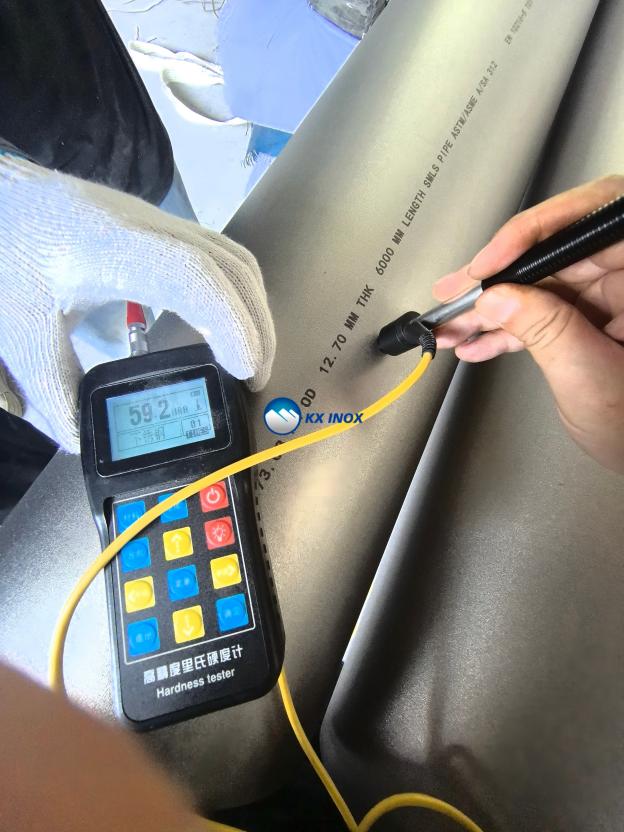
technician measuring stainless steel pipe hardness with a portable tester
Hardness, strength, and durability are related but not identical
Stainless steel hardness describes resistance to indentation or localized permanent deformation. Stainless steel strength describes how the pipe resists pulling, yielding, or rupture under load. Stainless steel durability is broader: it includes hardness and strength, but also corrosion resistance, weld integrity, surface finish, temperature exposure, cleaning conditions, and fatigue behavior.
This distinction matters because 316L is not usually selected because it is dramatically harder than 304. It is selected because its chemistry is better suited to aggressive environments. Outokumpu describes 304L as a widely available general-purpose stainless steel, while 316L is used in process industries and more aggressive environments where higher corrosion resistance is required.
Sest pipe systems, hardness becomes most important when the pipe is exposed to mechanical wear, clamping, forming, machining, indentation, or contact with harder components. Corrosion resistance becomes more important when the pipe handles chlorides, chemicals, salt air, cleaning agents, or wet process media. That is why a grade with slightly lower hardness may still deliver better service life in the right environment.
Typical hardness values for 304 and 316L
Published data should be treated as guidance unless it comes from the exact pipe heat and specification you are buying. Still, typical values help explain the general relationship between the grades.
Common reference points include:
- 304 stainless steel: Cleveland-Cliffs product data lists Type 304 with a typical Rockwell B hardness of 84 and Type 304L at 82 in typical room-temperature mechanical properties.
- 316L stainless steel: Cleveland-Cliffs product data for 316/316L lists a typical Rockwell B hardness of 79 in typical room-temperature mechanical properties.
- Maximum hardness in some flat-product specifications: North American Stainless data for 304, 304L, 316, and 316L lists maximum hardness values of 95 HRB for those grades in the referenced product data.
These numbers show why the phrase “304 vs 316L hardness” can be misleading. The difference in stainless steel hardness is often modest in annealed material. In real purchasing, a specified maximum hardness, minimum tensile strength, yield strength, elongation, pipe standard, and inspection plan may matter more than a single typical hardness value.
What changes stainless steel pipe hardness?
Hardness is not fixed by grade name alone. Austenitic stainless steels, including 304 and 316L, are strongly affected by cold work. Outokumpu notes that austenitic stainless steels are soft and formable in a quench-annealed state, while cold stretched or temper-rolled conditions have increased hardness and strength.
Key influences include:
- Annealed versus cold-worked condition Solution annealed pipe is usually softer and more ductile. Cold drawing, cold rolling, sizing, straightening, bending, or forming can raise hardness and stainless steel strength.
- Manufacturing method Seamless, welded, and heavily cold-worked welded pipe can have different steel pipe properties because each route introduces different deformation and thermal history. ASTM A312 specifically covers seamless, welded, and heavily cold-worked austenitic stainless steel pipe.
- Sein thickness and test locati0n Hardness taken on a pipe surface can vary from hardness taken on a prepared cross-section. Thin-wall pipe also limits which hardness measurement method can be used reliably.
- Welding and heat-affected zones Welded pipe can show local differences around the weld, especially if the weld area has been cold worked, finished, or heat treated differently from the base metal.
- Specification limits A purchase order may require a maximum hardness, a minimum strength, or testing to a specific standard. Without that requirement, the mill may certify to the grade and product standard but not to a custom hardness target.
Why 316L may outperform 304 even when it is not harder
316L contains molybdenum, which improves resistance in many chloride-bearing and chemically aggressive environments compared with standard 304-type stainless steel. The “L” grade also has lower carbon, which supports welded fabrication by reducing the risk of sensitization-related corrosion problems in many applications. Cleveland-Cliffs data describes reduced carbon in 304L as helpful for avoiding carbide precipitation during welding, and 316L follows the same low-carbon principle within the 316 family.
Choose 316L when the pipe may face:
- Coastal air, salt spray, or marine-adjacent service
- Chloride-containing washdown, brines, or process fluids
- Food, pharmaceutical, chemical, or process systems requiring higher corrosion resistance
- Welded assemblies where low carbon chemistry is preferred
- Applications where corrosion failure is a bigger risk than surface indentation
Choose 304 when the application is less aggressive and cost-effective general corrosion resistance is the priority. Typical examples include many indoor utility lines, architectural pipe, mild process environments, and general fabrication where chlorides are limited. The main point is simple: roostevaba teras durability is not only a hardness issue.
How hardness measurement works for stainless steel pipe?
Hardness measurement for roostevabast terasest toru is usually performed with Rockwell, Brinell, or Vickers methods, depending on pipe size, wall thickness, surface condition, and specification requirements. ASTM E18 covers Rockwell hardness testing of metallic materials, ASTM E10 covers Brinell hardness testing, and ASTM E384 covers microindentation hardness testing such as Knoop and Vickers methods.
Rockwell B is common for annealed austenitic stainless steels because the material is usually not hard enough to require the Rockwell C scale. Brinell may be used where a larger impression and average response over a wider area are useful. Vickers or microindentation methods can help where the wall is thin, the test area is small, or the user needs to check a weld zone, surface layer, or localized feature.
For reliable results, the pipe surface should be properly prepared. Scale, heavy roughness, curvature, oil, coating, and unstable support can distort readings. A hardness test is simple in concept, but poor fixturing or the wrong method can create a misleading hardness comparison.
Selecting the right grade by application
A clean grade decision should balance mechanical and environmental requirements. If the design needs higher strength, neither standard annealed 304 nor 316L may be enough; you may need cold-worked material, a different stainless family, or a revised wall thickness. If the design needs chloride corrosion resistance, 316L may be the better option even when the stainless steel pipe hardness is slightly lower.
Use this checklist before ordering:
- Confirm the pipe standard, such as ASTM A312, and the exact grade designation.
- Ask for the material test certificate and review heat number, chemistry, tensile properties, and any hardness values.
- Specify the hardness scale if hardness matters, for example HRB, HBW, or HV.
- Define whether hardness is required on base metal, weld seam, heat-affected zone, or finished surface.
- Consider corrosion exposure before choosing 304 only because it appears marginally harder.
- For formed or bent pipe, account for work hardening after fabrication.
- For critical systems, align the grade choice with engineering codes, pressure requirements, and service media.
The practical conclusion
304 stainless steel pipe is often marginally harder than 316L in typical annealed data, but the difference is not large enough to make hardness the deciding factor in most projects. 304 is a strong general-purpose choice, while 316L is usually preferred when corrosion resistance, welding performance, and chloride exposure carry more weight.
The best specification is not “the harder grade” but the grade and condition that match the actual service. Review the pipe standard, confirm hardness measurement requirements, and compare stainless steel strength, corrosion resistance, and fabrication needs together. That approach gives a more accurate picture of steel pipe properties than a single hardness number ever can.
 English
 Afrikaans
 Arabic
 Bengali
 Catalan
 Chinese
 French
 Dutch (Belgium)
 Dutch
Dutch German
 Czech
Czech Greek
Greek Hindi
Hindi Japanese
 Italian
 Portuguese
 Spanish (Chile)
 Spanish (Colombia)
 Spanish (Argentina)
 Persian
 Estonian
 Albanian
 Russian
 Spanish (Peru)
 Indonesian
 Thai
Thai Vietnamese
 Georgian
 Korean
 Nepali
 Polish
 Ukrainian
 Malayalam
 Xhosa
Xhosa