 Wenzhou Kaixin Kaixin Metal Co.,LTD

Die richtige Schlauchgröße für Sie auswählen
Tube size is the measurement that tells you whether a tube, pipe, frame, or airway device will fit its job safely and comfortably. The “right” size depends on the category: a bicycle tube is chosen for rider fit, a pipe or industrial tube is chosen for flow and connection, and a dog endotracheal tube is chosen by a trained veterinary professional for airway management. A good tube size chart helps narrow the options, but it should never replace context, measuring, and professional judgment where safety is involved.
What does tube size actually mean?
Tube size means the key dimensions used to describe a hollow cylindrical part or structure. In most everyday uses, that includes diameter, wall thickness, and sometimes length. The challenge is that “tube size” is not one universal measurement, so a tube chart size for BMX bikes will not mean the same thing as a Rohrgröße chart or a dog endotracheal tube size chart.
In practical terms, tube size answers three questions: how wide it is, how strong or thick it is, and how well it fits the thing it connects to. For a rider, that may affect reach and control. For plumbing or fabrication, it may affect flow, pressure, and compatibility. For veterinary airway equipment, it may affect ventilation and patient safety, which is why sizing belongs in clinical hands.
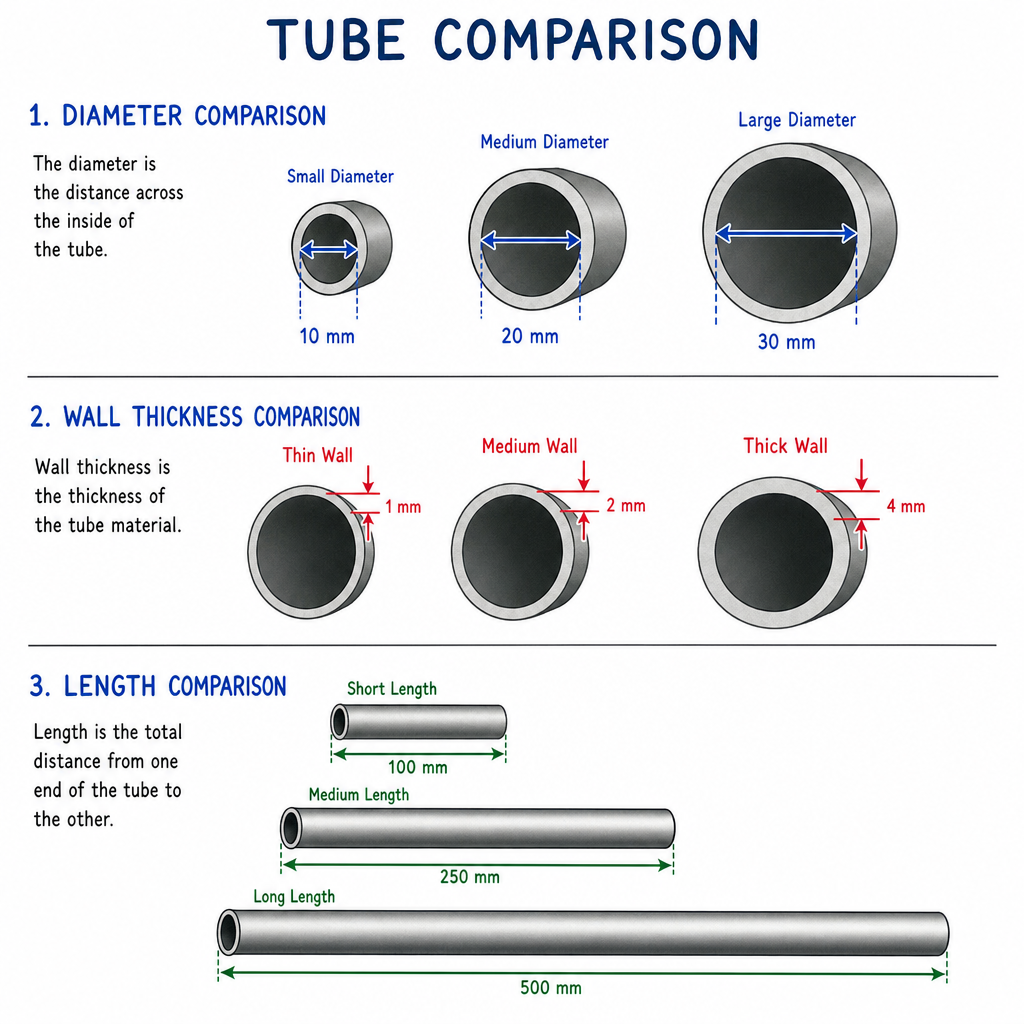
Illustration comparing tube diameter, wall thickness, and length
The core measurements in a tube size chart
Ein Rohr Größentabelle is useful because it turns scattered measurements into a quick reference. Still, the numbers only help if you know what they describe. Before using any tubing diameter chart, confirm whether the chart is measuring inside diameter, outside diameter, nominal size, or another field-specific standard.
Key sizing terms include:
- Außendurchmesser: The full width across the outside of the tube. This matters when a tube must fit into a clamp, frame, bracket, or connector.
- Innendurchmesser: The open space inside the tube. This matters for airflow, fluid flow, cables, and airway applications.
- Wandstärke: The material between the inside and outside surfaces. Thicker walls may add strength but reduce internal space.
- Länge: The usable distance from one end to the other. Length can affect fit, comfort, routing, or function.
- Nennweite: A naming convention that may not equal the exact measured diameter, especially in Rohrdimensionierung.
- Material: Steel, aluminum, plastic, rubber, and medical-grade materials can behave differently even at similar dimensions.
The safest habit is simple: read the chart legend before reading the numbers. A pipe size chart, for example, may use nominal labels, while a tube size chart for fabrication may focus on outside diameter and wall thickness.
Wie wählt man die richtige Schlauchgröße aus?
You choose the right tube size by starting with the application, then matching the chart to the measurement that actually affects fit. Do not begin with a random number or a chart from a different industry. A tube that is perfect for one purpose may be completely wrong for another.
Use this basic process:
- Define the use. Is the tube for a bike frame, plumbing, fabrication, pet anesthesia equipment, or another purpose?
- Identify the controlling measurement. For flow, inside diameter may matter most. For clamps or frames, outside diameter may matter more.
- Check compatibility. Match the tube to fittings, connectors, rider proportions, equipment, or manufacturer guidance.
- Allow for real-world conditions. Pressure, movement, body position, heat, wear, and material flex can all change what “fits” means.
- Avoid guessing in high-risk settings. If the tube affects breathing, pressure systems, load-bearing structure, or safety, get qualified help.
This is why broad searches such as “tube chart size” can be helpful but incomplete. The chart gives a range; the situation determines the final choice.
Common tube sizing examples
Different fields use similar words in very different ways. Seeing those differences side by side helps prevent costly or unsafe assumptions.
- BMX top tube sizing: A bmx top tube size chart usually helps riders compare frame reach. A longer top tube often suits taller riders or those who prefer more room, while a shorter top tube can feel more compact and responsive. Riding style, bar position, stem length, and personal preference still matter.
- Pipe and plumbing sizing: A pipe size chart is commonly used to match pipe, fittings, and flow requirements. In many pipe systems, the named size may not be the exact outside measurement, so measuring alone is not always enough.
- General tubing and fabrication: A tubing diameter chart can help compare outside diameter, inside diameter, and wall thickness for metal, plastic, or rubber tubing. Strength, weight, bendability, and connection type all influence the choice.
- Veterinary ET tubes for dogs: Searches like “et tube size chart dogs” or “dog endotracheal tube size chart” refer to endotracheal tubes used by veterinary teams during anesthesia or assisted ventilation. Veterinary sources emphasize that the appropriate tube is critical, and tube length may be assessed against the dog’s neck so the tip sits in the proper airway region.
For dogs, body weight can provide a starting estimate, but it is not the whole decision. Breed, anatomy, procedure, cuff seal, and clinical assessment all matter; for example, one university veterinary anesthesia guideline gives example size ranges for larger dogs while still presenting them in a professional anesthesia context.
When is a chart not enough?
A chart is not enough when the tube affects safety, performance, or compatibility beyond simple visual fit. This is especially true when small differences create big consequences, such as airway resistance, leaks, pressure loss, structural weakness, or poor body positioning.
Watch for these signs that you need more than a chart:
- The chart does not say whether it uses inside or outside diameter.
- The tube must connect to a regulated fitting, valve, machine, or medical device.
- The material changes how the tube bends, seals, or handles pressure.
- You are choosing for a living patient, animal, or child.
- The size affects steering, posture, load, flow, breathing, or safety.
- Two charts disagree and neither explains the standard used.
In these cases, the best next step is to consult the manufacturer, a qualified mechanic, a licensed plumber, an engineer, or a veterinarian, depending on the use. Charts are references, not guarantees.
Practical sizing mistakes to avoid
Most tube sizing errors come from mixing categories or reading the wrong dimension. A BMX rider looking at a top tube number is not solving the same problem as someone comparing industrial tubing diameter. A veterinary technician using an ET tube reference is working in a clinical environment where patient assessment matters more than a generic chart.
Common misconceptions include:
- “Diameter is always diameter.” It may be inside, outside, or nominal diameter.
- “Bigger is safer.” Oversizing can cause poor fit, added weight, leaks, discomfort, or damage.
- “Smaller is more flexible.” It may be easier to route, but it can restrict flow or reduce strength.
- “All charts use the same standard.” They do not. Always check the source and labels.
- “A chart replaces measuring.” It should guide measuring, not eliminate it.
A quick checklist before you choose
Before you commit to a tube size, pause and verify the essentials:
- Match the chart to the exact use case.
- Confirm inside diameter, outside diameter, wall thickness, and length where relevant.
- Check the required fitting, frame, connector, or equipment standard.
- Consider movement, pressure, load, comfort, and material behavior.
- Use professional guidance for medical, veterinary, structural, or pressurized systems.
- If comparing multiple charts, choose the one from the manufacturer or most relevant authority.
The right tube size is the one that fits the purpose, not just the one that looks close on a chart. Use a tube size chart as a starting point, then confirm the real measurements and the real-world conditions before making your final choice.
 English
 Afrikaans
 Arabic
 Bengali
 Catalan
 Chinese
 French
 Dutch (Belgium)
 Dutch
Dutch German
 Czech
Czech Greek
Greek Hindi
Hindi Japanese
 Italian
 Portuguese
 Spanish (Chile)
 Spanish (Colombia)
 Spanish (Argentina)
 Persian
 Estonian
 Albanian
 Russian
 Spanish (Peru)
 Indonesian
 Thai
Thai Vietnamese
 Georgian
 Korean
 Nepali
 Polish
 Ukrainian
 Malayalam
 Xhosa
Xhosa