 شركة ونزو كايشين كايشين كايشين للمعادن المحدودة

Two ASTM specifications, one alloy family, and a decision that reaches your purchase order in minutes. ASTM A790 covers duplex stainless steel pipe; ASTM A789 covers duplex stainless steel tube. Mix them up and you will spend weeks re-cutting or re-testing material, or discover at fit-up that the pipe will not mate with the tubesheet your exchanger was designed around. This buyer’s guide walks you through scope, dimensions, grades, testing, heat treatment and paperwork, so you can tell the difference between ASTM A790 and A789, specify correctly the first time, and buy duplex with confidence.
The Short Answer: Pipe or Tube Decides the Standard
ASTM does not publish A790 and A789 to compete with each other. Each one is attached to a physical product form, and that form is decided long before you choose a grade.
- If the item is a run of pipe bolted to flanges, butt-weld fittings and valves, and carries fluid along a line, you want ASTM A790 pipe.
- If the item slides through a tubesheet, coils inside a shell, or feeds an instrument, and its job is to transfer heat or signal, you want ASTM A789 tube.
- If a project needs both, the same duplex alloy can appear twice, once as A789 tube for the bundle and once as A790 pipe for the connected line. They are separate line items on the order, with separate dimensions and separate test schedules.
That is the whole logic of the duplex pipe vs tube standard question. Everything below explains how that single distinction ripples through sizing, tolerances, testing and documentation.
What ASTM A790 and ASTM A789 Actually Cover
ASTM A790: duplex pipe in NPS and Schedule
ASTM A790 covers seamless and welded ferritic/austenitic stainless steel pipe for general corrosive service, with particular emphasis on resistance to chloride stress corrosion cracking. Because it is a pipe specification, it speaks in nominal pipe size and schedule: NPS 2 SCH 10S, NPS 4 SCH 40S, NPS 6 SCH 80S. Stainless schedules follow ASME B36.19, and the general requirements for tolerances, test methods and marking come from ASTM A999. Welded A790 pipe is produced with an automatic process that adds no filler metal, which is one reason a separate specification, A928, exists for electric-fusion-welded duplex pipe made with filler. Typical stock is ASTM A790 duplex stainless steel pipe, and you can review the full duplex stainless steel pipe range we hold for process and marine work.
ASTM A789: duplex tube in OD and wall
ASTM A789 covers seamless and welded duplex stainless steel tubing for general service, again with emphasis on chloride stress corrosion cracking resistance, but written for tube. It speaks in outside diameter and wall thickness: 25.4 mm OD x 1.65 mm WT, 19.05 x 1.24, 12.7 x 0.89. General requirements come from ASTM A1016, formerly A450, and that reference is where the practical differences live: tighter outside diameter and wall tolerances, plus flaring and flanging tests that exist because tube ends get expanded or rolled into a tubesheet. See our ASTM A789 UNS S32205 duplex tube specification for a typical small bore scope.
ASTM A790 vs ASTM A789: Side-by-Side Comparison
The table below is the version worth printing and keeping next to your RFQ template.
| Point | ASTM A790 | ASTM A789 |
|---|---|---|
| Product form | Pipe for lines, headers and process piping | Tube for heat transfer, equipment and instruments |
| How you size it | NPS x Schedule to ASME B36.19 | Outside diameter x wall thickness |
| Typical size range | NPS 1/8 up to NPS 48 in standard schedules | Small bore per specification, larger sizes by agreement |
| General requirements | ASTM A999 | ASTM A1016 (formerly A450) |
| Manufacturing | Seamless or straight-seam welded, no filler added | Seamless or welded |
| Tests that decide acceptance | Tensile, hardness, flattening, hydrostatic or NDT | Tensile, hardness, flaring, flanging, flattening, hydrostatic or NDT |
| Dimensional character | Mill tolerance on wall typically minus 12.5 percent | Tighter OD and wall control, average or minimum wall by agreement |
| What it connects to | Flanges, butt-weld fittings, valves | Tubesheets, headers, instrument fittings |
| Who usually buys it | EPC contractors, process plants, offshore projects | Heat exchanger and packaged equipment fabricators |
The Difference Between ASTM A790 and A789 Is Not the Grade
Both specifications draw on nearly the same duplex family, so a grade comparison will not tell you which standard to buy. What differs is how the material is made, measured and tested. The grades you will actually see quoted are:
- UNS S31803 and S32205, both sold as 2205. This is the workhorse duplex grade, with a pitting resistance equivalent number around 34 to 36.
- UNS S32750, sold as 2507 or SAF 2507. Super duplex, PREn above 40, minimum yield strength around 550 MPa, roughly twice that of 316L.
- UNS S32760, a super duplex with tungsten and copper additions used where erosion and fatigue matter. Our note on UNS S32750 versus UNS S32760 explains where the two diverge.
- Lean duplex grades such as S32101 and S32304, which trade some corrosion resistance for cost and are unsuitable for warm chloride service.
The screening number is PREn, calculated as chromium plus 3.3 times molybdenum plus 16 times nitrogen. Use it to separate standard duplex from super duplex, never to separate A790 from A789.
ASTM A790 or A789 for Duplex 2205? Follow the Connection
When a drawing specifies 2205 and leaves the standard open, the connection type answers the question for you. Ask three things about the joint, not about the alloy.
- Does it bolt or butt-weld to a standard piping component? If yes, the component was designed to NPS and Schedule dimensions, so buy A790 pipe.
- Does it pass through a drilled tubesheet or a baffle? If yes, the hole was drilled to a tube outside diameter, so buy A789 tube.
- Is the joint a large diameter weld that requires filler metal? Then neither A790 nor A789 is the right call; specify A928 electric-fusion-welded pipe instead.
One more fork worth knowing: seamless or welded. Both standards permit either, and the choice is a pressure, corrosion and delivery question rather than a standard question. We compare the two routes in seamless versus welded stainless steel pipe if your project still leaves it open.
Free Tool: 60-Second Duplex Pipe or Tube Selector
Use this selector before you open your RFQ template. Open the scenario closest to your drawing, read the standard it points to, then check your order against the matrix and the checklist. It runs entirely in your browser, with no files to upload and nothing to install.
Step 1. Pick your scenario
A. Fluid transport line with flanges, fittings or valves
B. Heat exchanger, condenser or cooler bundle
C. Instrument, impulse or sampling line
D. Large diameter welded header made with filler metal
Step 2. Confirm against the decision matrix
| Your item | Standard to specify | Why |
|---|---|---|
| Process pipe joined to flanges or butt-weld fittings | ASTM A790 | NPS and Schedule dimensions match standard piping components |
| Tube expanded or rolled into a tubesheet | ASTM A789 | OD and wall control plus flaring and flanging tests |
| Small bore instrument line with ferrule fittings | ASTM A789 | Tight OD tolerance suits compression fittings |
| Welded pipe over NPS 8 with filler metal | ASTM A928 | A790 welded pipe is made without filler addition |
| U-bend exchanger tube | ASTM A789 | U-bend radii and heat treatment are covered by agreement |
| Pipe and tube of the same 2205 heat | Both, as separate lines | Same alloy, two forms, two test schedules |
Step 3. Run the RFQ checklist
| Check | Why it protects you |
|---|---|
| Standard and edition are named, not just the alloy | Prevents a mill shipping tube against a pipe order |
| UNS number is written, for example UNS S32205 | Removes ambiguity between S31803 and S32205 chemistry |
| Product form matches the drawing, pipe or tube | Stops the re-machining and re-testing loop |
| Dimensions use the right system, NPS x SCH or OD x WT | Keeps your item compatible with fittings or tubesheets |
| Seamless or welded is stated | Both are permitted, and price and lead time differ |
| Heat treatment condition is stated | Solution annealed is not optional for duplex |
| Inspection level is stated, hydrostatic or NDT | Decides whether the mill test is accepted at goods-in |
| Documentation is stated, EN 10204 3.1 with heat numbers | Gives you traceability your client will audit |
This selector is a screening aid for procurement planning. Final material selection stays with your design engineer and the project specification, which always overrides a generic guide.
Need the two standards quoted on one inquiry?
Send us your line list or exchanger data sheet. We will come back with matched ASTM A790 pipe and ASTM A789 tube offers, both solution annealed and both with full mill traceability.
Five Buying Mistakes That Cost Weeks
Most duplex problems we see are not metallurgical. They are ordering errors that only surface when the material arrives.
- Writing ASTM A790 tube on the order. The specification does not cover tube. A mill will either query it or, worse, ship pipe to a tube drawing and let you find out at fit-up.
- Rounding an OD and wall size to the nearest NPS. A 25.4 mm outside diameter tube is not NPS 1. NPS 1 pipe measures 33.4 mm outside, so the two will never share a fitting.
- Dropping the S from the schedule. SCH 40S and SCH 40 are not the same wall at the same nominal size, and at larger sizes the stainless schedule is markedly thinner. Your pressure design was probably run on one of them.
- Mixing A789 tube with A790 fittings because both are 2205. The alloy matches and the dimensions do not. Check every transition on the drawing before the order is placed.
- Assuming welded A790 pipe is made with filler metal. It is not. If your welding procedure or client specification requires filler, move the line to A928.
What to Write on the Purchase Order
A duplex order that cannot be misread looks like this:
ASTM A790 UNS S32205, seamless, NPS 4, SCH 40S, solution annealed, 6 m random length, beveled ends, EN 10204 3.1, hydrostatic test.
ASTM A789 UNS S32205, seamless, 25.4 mm OD x 1.65 mm WT, solution annealed and pickled, 6 m, EN 10204 3.1, flaring and flanging test, eddy current test.
Both lines contain the same information in the same order: standard, grade, method, dimensions, condition, length, ends, documentation, inspection. Notice that neither line wastes space on the word duplex, because the standard and the UNS number already say it.
Documentation deserves its own line item. Ask for a mill test certificate to EN 10204 3.1 that ties each bundle to a heat number, and specify third party inspection if your client requires it. Our guide to reading a mill test certificate shows which fields to check before you release material to the shop, including chemistry against the UNS range, tensile and yield results, and the heat treatment record.
Heat Treatment: Where Duplex Is Won or Lost
Duplex earns its strength and corrosion resistance from a roughly balanced mix of ferrite and austenite, and that balance is set by thermal treatment, not by the alloy alone. Both standards require the finished product to be solution annealed and rapidly cooled, and both make that a condition of acceptance rather than a suggestion.
For 2205, published requirements in ASTM A790 and A789 place the solution annealing temperature in the region of 1020 to 1100 degrees Celsius, followed by rapid cooling in water or by forced air. Slow cooling or holding the steel in the wrong temperature band lets sigma phase and nitrides form, and both of them take away toughness and pitting resistance that you paid for. Our explanation of why solution annealing for stainless steel pipe is mandatory covers the mechanism in more detail.
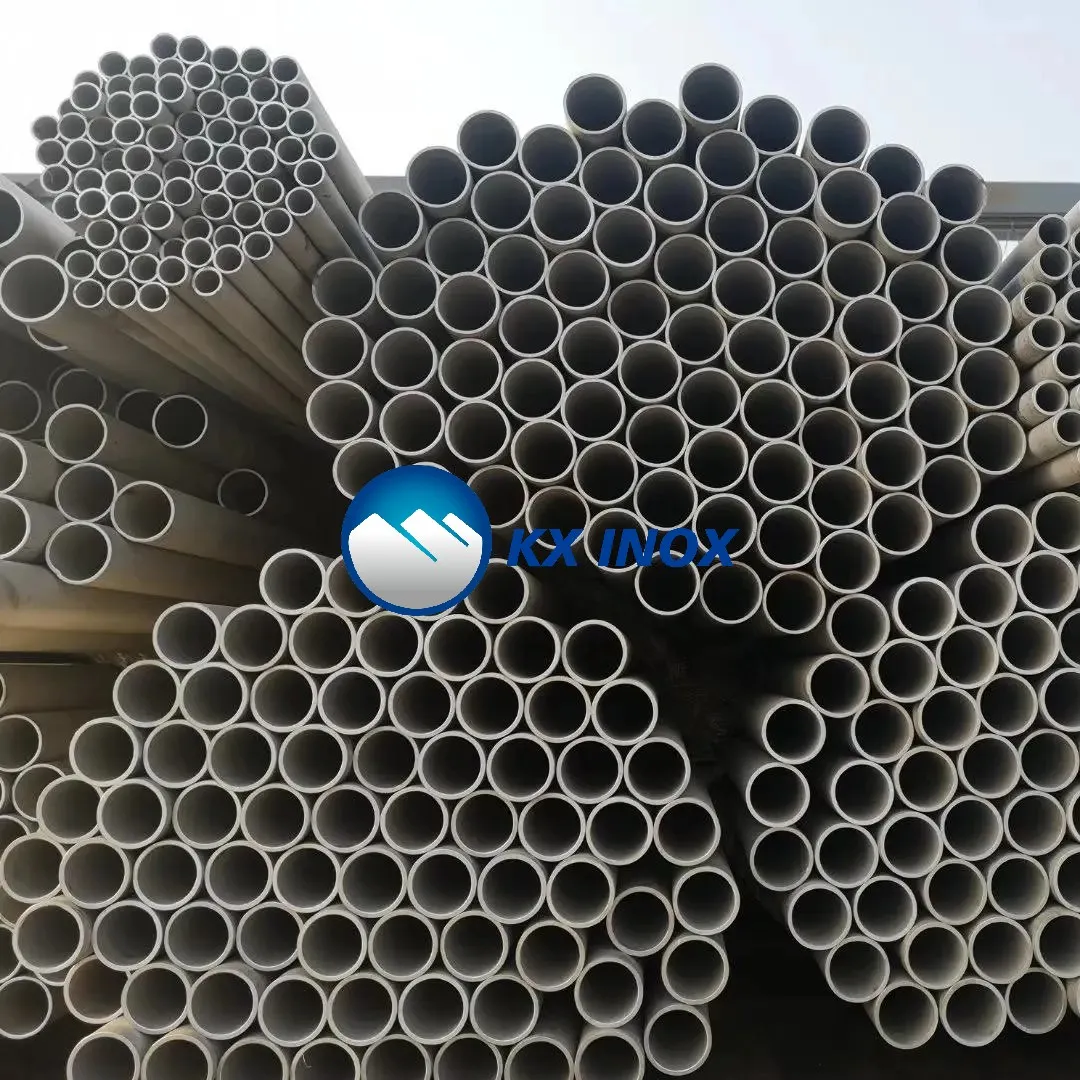 Pipe and tube both leave the mill solution annealed and rapidly cooled. Ask for the furnace record, not just the certificate.
Two practical points follow. First, ask for the heat treatment temperature and cooling method on the record, not only a tick box that says annealed. Second, keep fabrication heat under control, because a good mill certificate cannot rescue a weld that was cooled too slowly in your yard.
Where Duplex Pipe and Tube Standards Are Used
A790 pipe turns up wherever a line carries aggressive fluid and needs to connect to standard piping hardware: chemical process lines, desalination trains and brine circuits, offshore process and utility piping, flue gas desulfurization loops, and pulp mill liquor lines. The buyer is usually an EPC contractor or a plant project team working to a piping specification.
A789 tube turns up wherever surface area and heat transfer decide the design: shell and tube exchangers, condensers, feedwater heaters, seawater coolers, and instrument or sampling runs. The buyer is usually an equipment fabricator who needs a mill certificate to match a pressure vessel file. For high chloride duties, the ASTM A789 SAF 2507 duplex tube is the usual step above 2205, and our comparison of super duplex and regular stainless steel sets out where that step pays for itself. If you are still weighing a 304 or 316L exchanger against 2205, this note on 304 versus UNS32205 for heat exchangers covers the trade-off in cost and wall thickness.
Specify once, receive once
Tell us the drawing or the duty and we will confirm whether A790 pipe, A789 tube or A928 welded pipe is the correct call, then supply it solution annealed with heat level traceability and third party inspection if you need it.
الخاتمة
ASTM A790 and ASTM A789 are not rivals and they are not interchangeable. A790 is the pipe specification, sized in NPS and Schedule, tested for line integrity and destined for flanges and butt-weld fittings. A789 is the tube specification, sized in outside diameter and wall, tested for flaring and flanging, and destined for tubesheets and instrument fittings. The alloy behind both is usually the same 2205 or 2507 duplex, so the standard, not the grade, must be written correctly on your order. Get the product form right, state dimensions, heat treatment, inspection and documentation, and duplex becomes a straightforward purchase.
الأسئلة الشائعة
No. ASTM A312 covers austenitic stainless steel pipe such as 304, 316L and 321, while A790 covers ferritic/austenitic duplex pipe. The practical difference is chemistry, strength and welding behaviour: duplex grades have roughly twice the yield strength of 316L and need nickel-enriched filler plus tighter heat input control. If a drawing calls for duplex and names A312, query it before ordering.
Duplex contains a ferrite phase, typically around half the microstructure, so it responds to a magnet much more than 304 or 316L. That is normal and not a sign of wrong material. It does mean you cannot use magnetism alone to sort grades, and it gives you a useful field check: a ferrite meter reading in the expected band supports the certificate, while a reading near zero suggests you were shipped austenitic steel.
Continuous service is normally limited to about 300 degrees Celsius. Above that, the ferrite phase progressively converts to sigma and other intermetallic phases, and toughness falls sharply. Duplex is not the right choice for hot service above roughly 300 degrees Celsius, where a high temperature austenitic or a nickel alloy will serve you better.
Only down to a limited range. Duplex has a ductile to brittle transition and most specifications impose a minimum service temperature around minus 50 degrees Celsius, with impact testing required below that. For liquefied gas or deep cryogenic duty, specify an austenitic grade instead, because duplex toughness drops off quickly as temperature falls.
Yes, and it is common. S32205 is the tighter chemistry version of S31803, with higher minimum chromium, nitrogen and molybdenum, so a heat meeting S32205 automatically meets S31803. If your corrosion calculation assumed S32205, write UNS S32205 on the order, because a mill certificate showing only S31803 may sit at the lower end of the older chemistry range.
It does, and U-bends are normally supplied by agreement on radius, leg length and heat treatment. The important clause for buyers is that the bend region must not be left in a sensitised or work hardened condition, so ask for the U-bend procedure and any post-bend heat treatment record when the tubes are destined for a registered pressure vessel.
Common options are pickled and annealed, bright annealed, and mechanically polished to a specified roughness. Pickled and annealed is the default for process duty, bright annealed suits clean service where oxide scale is unacceptable, and polished finishes are chosen for fouling or hygiene sensitive duties. State the finish and the roughness value on the order, because finish is not fixed by the standard.
It is required whenever the process stream contains wet hydrogen sulfide. Duplex grades such as 2205 and 2507 are listed in ISO 15156 with limits on temperature, pH and partial pressure, so compliance depends on your actual duty, not on the alloy name. State the sour service condition on the enquiry and ask for compliance to be confirmed against your specific parameters.
Cold bending and field welding are both done routinely, within limits. The constraint is that you must not apply a post-weld heat treatment in the 300 to 1000 degrees Celsius band, because that is where detrimental phases form. Control heat input, limit interpass temperature, use matching duplex consumables and clean the joint afterwards; any stress relief needs metallurgical advice first.
Use positive material identification on a sample of ends and heat numbers, check the ferrite content with a calibrated ferrite meter, and confirm the hardness result on the mill certificate sits in the duplex range. These three checks take minutes at goods-in and catch mix-ups that paperwork alone will not reveal, especially on mixed loads from a stockist.
 English
 Afrikaans
 Arabic
 Bengali
 Catalan
 Chinese
 French
 Dutch (Belgium)
 Dutch
 German
 Czech
 Greek
 Hindi
 Japanese
 Italian
 Portuguese
 Spanish (Chile)
 Spanish (Colombia)
 Spanish (Argentina)
 Persian
 Estonian
 Albanian
 Russian
 Spanish (Peru)
 Indonesian
 Thai
 Vietnamese
 Georgian
 Korean
 Nepali
 Polish
 Ukrainian
 Malayalam
 Xhosa