 温州凯信金属有限公司

Seawater is one of the most aggressive environments a piping system can face. High chloride levels, fluctuating temperatures, and constant biological activity make material selection a decision you cannot afford to get wrong. Specify the wrong grade and you risk pitting, crevice corrosion, and premature failure that can take an entire cooling or process line offline. This guide walks you through how chloride concentration, temperature, flow velocity, and welding quality influence corrosion, compares the grades most often used in seawater service, and shows you how to match a material to your specific application.
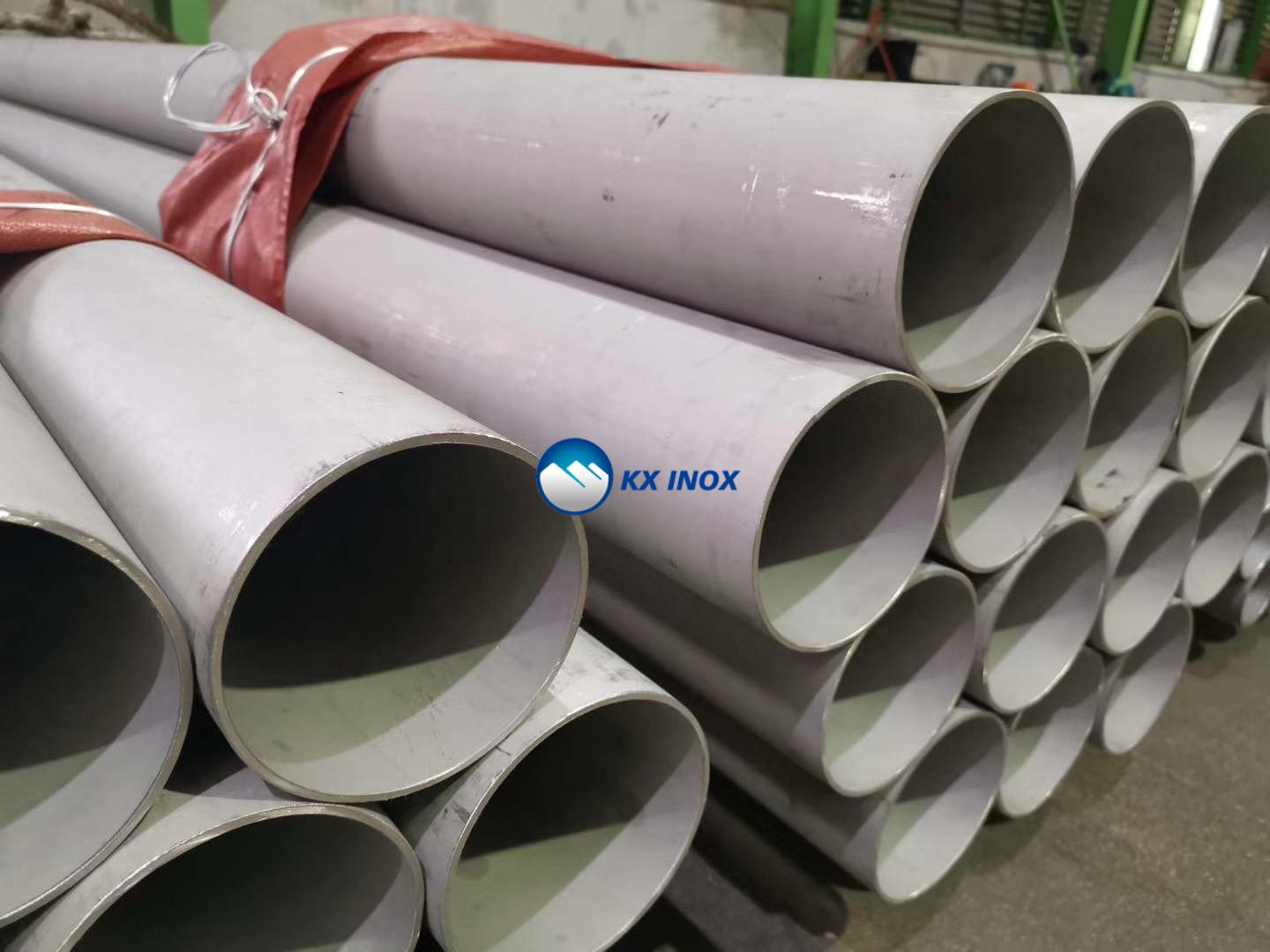
Stainless steel seamless pipe inventory prepared for industrial seawater and process service.
Why Seawater Is a Harsh Environment for Pipes
Ordinary carbon steel rusts quickly in seawater, which is why you turn to stainless steel in the first place. But stainless steel earns its name from a passive chromium oxide film, and that film is vulnerable to breakdown in the presence of chlorides. Once the film is breached at a microscopic point, corrosion can advance as pitting (deep, localized holes) or crevice corrosion (attack inside gaps such as flange faces, gaskets, and tube supports).
The practical takeaway for you as a specifier is simple: in seawater, the question is never “is it stainless?” but “does this specific grade resist chloride under my specific conditions?” Temperature, chloride concentration, and stagnation all shift that answer.
Key Factors That Drive Corrosion in Seawater Piping
Chloride concentration and temperature
Corrosion risk rises with both chloride level and temperature. Warm, open ocean water is far more aggressive than cold, low-chloride intake. A useful rule of thumb is the pitting resistance equivalent number (PREn): higher PREn means better chloride resistance. When you screen candidate grades, PREn is the first number you should compare, because it captures how much chromium, molybdenum, and nitrogen the alloy contributes to corrosion resistance.
Flow velocity and stagnation
Seawater that moves keeps surfaces clean and oxygenated, which helps the passive film stay intact. Stagnant or low-velocity zones invite deposits and crevice attack. On the other hand, very high velocity with entrained sand causes erosion-corrosion. You should design for a healthy flow window and avoid dead legs where water sits between shutdowns.
Deposits, biofouling, and crevices
Marine growth, silt, and debris create local crevices that block oxygen and trigger crevice corrosion underneath. Weld roots, poor fit-ups, and trapped gaskets do the same. Your detailing and fabrication discipline matter as much as the base material, because a perfect alloy still fails inside a tight, oxygen-starved gap.
Welding and heat-affected zones
Welding can sensitize or dilute the alloy near the joint, lowering corrosion resistance if the procedure is wrong. Duplex and super duplex grades are especially sensitive to heat input and cooling rate, which affect the ferrite-austenite balance. You must control welding consumables, interpass temperature, and post-weld treatment so the joint matches the parent pipe. See our notes on solution annealing for stainless steel pipe for why thermal treatment matters.
Quick check for your spec: before choosing a grade, write down your worst-case chloride level, peak operating temperature, design velocity, and every crevice you cannot eliminate. Those four numbers decide your material.
Comparing the Common Seawater-Grade Materials
The grades below cover almost every seawater application and represent the most common seawater corrosion resistant pipe options. PREn values are approximate and intended for screening, not for final design.
| Grade (common designation) | Approx. PREn | Best suited for | Main limitation |
|---|---|---|---|
| 316L (EN 1.4404 / UNS S31603) | ~25 | Low-temperature, low-velocity, treated or brackish water | Limited in warm, open seawater |
| Duplex 2205 (UNS S32205) | ~35 | Cooling water, ballast, general seawater service | Sensitive to incorrect welding heat input |
| Super duplex (UNS S32750 / S32760) | ~40–42 | Offshore, high chloride, high pressure | Higher cost; strict welding control |
| 254 SMO (UNS S31254) | ~43 | Desalination, aggressive chloride, high temperature | Premium material cost |

Duplex stainless steel pipe sections compared with other corrosion-resistant alloys.
316L stainless steel pipe for seawater
316L不锈钢管 is the entry point for chloride service. For 316L stainless steel pipe seawater duty, the “L” (low carbon) chemistry reduces sensitization during welding, while molybdenum lifts chloride resistance above 304. It performs best in cooler, cleaner, or treated water and in systems you can keep moving. In warm open seawater it is risky, so you should only rely on it where conditions are mild and crevices are well controlled.
Duplex stainless steel pipe for seawater
双相不锈钢管 roughly doubles the PREn of 316L while using less nickel, which also helps cost and strength. Grade 2205 is the workhorse for seawater cooling, ballast, and firewater systems. Its main caveat is fabrication discipline: welding must preserve the two-phase structure, or you lose the corrosion advantage you paid for.
Super duplex stainless steel pipe
Super duplex stainless steel (UNS S32750 / S32760) pushes PREn above 40, making it suitable for the most demanding offshore and subsea duties with high chloride and high mechanical load. You choose it when downtime is expensive and the environment is unforgiving. The trade-off is material and welding cost, plus tighter quality control.
254 SMO stainless steel pipe
254 SMO (UNS S31254) is an austenitic 6% molybdenum grade with PREn around 43. It is often the right call for desalination and other high-chloride, high-temperature duties where you want austenitic weldability with near-super-duplex resistance. Expect a premium price, but also the longest service window in aggressive duty.
Seawater Material Selection Helper
Use the scenarios below to get a starting grade for your duty. These are screening recommendations only; your project standard and a corrosion assessment should confirm the final choice. Sound seawater piping material selection always starts from your worst-case duty conditions, not from a generic grade list.
Selecting by Application Scenario
Seawater cooling systems
对于 seawater cooling system piping, duplex 2205 is the common baseline, with 316L accepted only in mild, well-controlled loops. Keep velocity in the recommended range, design out dead legs, and specify crevice-free supports.
Desalination plants
Reverse osmosis and multi-stage flash trains expose pipe to concentrated, warm, high-chloride streams. Here, stainless steel pipe for desalination plants is typically 254 SMO or super duplex, selected against the worst brine concentration rather than the intake condition.
Marine and shipboard piping
Vessels balance weight, space, and mixed duties. Duplex 2205 serves cooling, ballast, and firewater, while 316L is limited to low-risk branches. Fabrication at shipyards demands strict weld procedure control to protect the alloy.
Offshore platforms
Offshore duty combines high chloride, high pressure, and often sour conditions. Super duplex is the default for critical lines, with full traceability and corrosion testing. Every joint is qualified, and material is verified before it ever reaches the platform.
Need a grade recommendation for your seawater project?
Send us your operating temperature, chloride level, design pressure, and service. Our team will match a grade from 316L through 254 SMO and supply mill test certificates with every order.
What to Confirm Before You Purchase
Good material selection fails at procurement if the documentation does not back it up. Before you release a purchase order, confirm these points with your supplier:
- Material grade and product standard – e.g. ASTM A312 / A790, EN 1.4404, UNS S32205. Match the standard to your project specification.
- Wall thickness and schedule – confirm against your pressure and corrosion-allowance calculation; our pipe schedule chart guide explains the sizing logic.
- Welding requirements – welding procedure, consumables, and any post-weld heat treatment the grade demands.
- Inspection documents – mill test certificate (MTC / EN 10204 3.1), PMI, hydrostatic test, and any third-party inspection.
- Corrosion evaluation – PREn / CPT basis and any project-required corrosion testing, referenced to your duty conditions.
At KXINOX we supply ASTM A312 stainless steel seamless pipe across these grades with full material documentation, so your procurement file is complete from day one.
常见问题解答
What is the difference between PREn and CPT in stainless steel selection?
PREn (pitting resistance equivalent number) is a calculated screening value from the alloy’s chromium, molybdenum, and nitrogen content. CPT (critical pitting temperature) is a measured temperature threshold above which pitting begins in a standardized chloride test. Use PREn for quick comparison and CPT when your specification demands test-verified data.
Can 304 stainless steel be used in seawater?
Generally no. 304 has a PREn around 18–19 and lacks the molybdenum that 316L uses to resist chloride. In open or warm seawater it pits quickly, so 304 is reserved for atmospheric or decorative marine use, not process piping.
How does cathodic protection affect stainless pipe selection?
Cathodic protection reduces the risk of pitting on passive alloys, which can let you use a lower grade than unprotected service would allow. But over-protection with impressed current can cause hydrogen embrittlement in higher-strength duplex grades, so the protection design and material must be specified together.
What welding filler metal should be used for duplex stainless steel in seawater?
For duplex 2205, over-alloyed fillers such as ER2209 are typical to preserve corrosion resistance and ferrite balance in the weld. The exact consumable, heat input, and interpass temperature must follow a qualified welding procedure specification for your service.
How do biofouling and marine organisms influence material choice?
Biofouling creates local crevices and traps chlorides against the surface, accelerating crevice corrosion. Materials with higher PREn resist the underlying attack, but good design (higher velocity, antifouling, cleanable layouts) is still essential regardless of grade.
Is super duplex stainless steel worth the cost over 316L for seawater?
It depends on duty. In mild, cold, well-controlled loops, 316L is cost-effective. In warm, high-chloride, high-pressure, or offshore service, the extra cost of super duplex is usually small compared with the cost of failure, so it becomes the economical choice over the asset life.
What standards apply to stainless steel pipe for offshore and marine use?
Common references include ASTM A790/A312 for material, NACE MR0175 / ISO 15156 for sour service, and NORSOK M-630/M-650 for offshore qualification and traceability. Your EPC or operator specification will name the exact set you must meet.
How does crevice corrosion differ from pitting, and where does it occur?
Both are localized chloride attacks, but crevice corrosion starts in oxygen-starved gaps (flange faces, tube supports, under deposits), while pitting can start on open surfaces. Crevice attack is especially dangerous because it is hidden until leakage appears, which is why crevice-free design matters.
What is the typical service life of 316L pipe in seawater?
It varies widely with temperature, chloride, and velocity. In cool, flowing, treated water it can last many years; in warm open seawater with crevices it may fail in months. Lifetime is condition-dependent, which is exactly why duty-based selection beats a one-size guess.
Can stainless steel pipe handle variable salinity such as brackish or estuarine water?
Yes, often better than open seawater, because lower chloride reduces risk. Brackish intake is a common reason 316L is acceptable for cooling, while the high-salinity concentrate side of the same plant still needs duplex or 254 SMO.
结论
Selecting stainless steel pipe for seawater systems is rarely about picking the most expensive grade on the shelf. It is about matching the material to your chloride load, temperature, flow regime, and fabrication reality. Start with 316L for mild duty, step up to duplex or super duplex as chloride and mechanical demands rise, and reserve 254 SMO for the most aggressive desalination and offshore duties. Document your corrosion basis, qualify your welding procedure, and work with a supplier who can evidence every grade and test report. When your specification is ready, the team at KXINOX can help you confirm the right pipe and deliver it with full certification.
相关资源
- 超级双相不锈钢与普通不锈钢的比较
- Hastelloy C-276 vs Super Duplex Stainless Steel Pipe
- Which Material Grade Suits a Desulfurization Tower
- 管材规格表:全面指南
- 254 SMO (UNS S31254) Stainless Steel Pipe
Talk to a KXINOX material specialist
Share your seawater duty conditions and we will recommend a grade, supply certified pipe, and support your inspection requirements from first inquiry to delivery.
 English
 Afrikaans
 Arabic
 Bengali
 Catalan
 Chinese
 French
 Dutch (Belgium)
 Dutch
 German
 Czech
 Greek
 Hindi
 Japanese
 Italian
 Portuguese
 Spanish (Chile)
 Spanish (Colombia)
 Spanish (Argentina)
 Persian
 Estonian
 Albanian
 Russian
 Spanish (Peru)
 Indonesian
 Thai
 Vietnamese
 Georgian
 Korean
 Nepali
 Polish
 Ukrainian
 Malayalam
 Xhosa