 온주 카이신 카이신 금속 유한공사

Two Architectures, Two Sets of Piping Rules
Before you specify a single length of pipe, it helps to be clear about what each method actually does to the fluid path. They solve the same thermal problem, but they solve it in ways that place very different demands on the stainless steel tubing, joints, and fittings that hold the system together.
Direct-to-chip (DTC) at a glance
Direct-to-chip cooling circulates a water-glycol coolant through cold plates mounted directly on the processors. The fluid travels through manifolds, flexible hose assemblies, and facility piping to a coolant distribution unit (CDU), which rejects heat to the building’s chilled-water loop. It is the dominant approach in current accelerated-computing builds, and it is the architecture most reference designs are drawn around.
Immersion cooling at a glance
Immersion cooling submerges the compute boards in a dielectric fluid instead of running coolant through metal cold plates. Single-phase fluids stay liquid throughout; two-phase fluids boil at low temperature and capture heat through phase change. It removes on-chip manifolds from the equation, but it introduces a different set of fluid-handling, containment, and joining requirements that your piping plan has to absorb.
Both paths are scaling at the same time. Industry analysts valued the global immersion-cooling segment at roughly $490 million in 2024 and project a compound annual growth rate near 23% through the end of the decade, while direct-to-chip continues to carry the bulk of near-term deployment volume. For the teams who specify and install these systems, that means you are increasingly expected to understand both — not only the one in this quarter’s scope.

304 and 316 stainless steel pipe — the grades most facility loops are built from.
What Direct-to-Chip Cooling Asks of Your Piping
A direct-to-chip loop typically runs at moderate facility pressure — often in the 30–60 PSI range — with coolant temperatures moving from roughly 15°C on supply to 45°C or higher on return. The glycol concentration, usually 25–40% propylene glycol, touches every flexible connection point and drives four demands you should design around.
Thermal-cycling tolerance
Every startup, shutdown, and workload swing cycles the loop between ambient and operating temperature. That is hundreds of expansion-and-contraction events per year through every pipe run, manifold connection, and flexible joint. Rated rubber expansion joints handle this; generic HVAC-grade parts fatigue faster than you would expect.
Glycol compatibility
Propylene glycol at elevated concentration and temperature is more aggressive on elastomers than plain water. Every connector and joint tube must be rated for glycol service, not merely “water compatible.” EPDM is the standard for glycol loops, and 304/316L 스테인리스 스틸 심리스 파이프 gives you a clean, weldable backbone that resists the corrosion this environment encourages.
Vibration isolation at every pump
CDU pumps, chilled-water pumps, and secondary circulators are all vibration sources. Pump connectors have to absorb axial, lateral, and angular movement without transmitting that energy into brazed or welded manifold connections — exactly where you do not want fatigue stress to accumulate.
Anchor and guide placement
DTC runs are often longer than they look on paper — CDU to chiller plant, up risers, across data halls. Each run needs a guide-and-anchor system that steers thermal growth into the expansion joints. Skip it and the joints absorb forces they were never sized for.
What Immersion Cooling Asks of Your Piping
Immersion swaps water-glycol for a dielectric fluid — a synthetic hydrocarbon in single-phase service or a fluorocarbon in two-phase. That single change rewrites the material rules for the entire fluid path.
Chemical compatibility is the first constraint
Dielectric fluids are aggressive solvents for many common elastomers. Standard EPDM, neoprene, and nitrile can swell, soften, or dissolve on contact. You need fluoroelastomers (FKM/Viton) and PTFE-lined components throughout the path, because a single incompatible seal can contaminate an entire tank. This is where a 니켈 합금 스테인리스 스틸 파이프 program earns its place — the alloy resists the aggressive chemistry while keeping the loop weldable and documentable.
Lower pressure does not mean lower standards
Immersion loops often sit below 20 PSI — lower than a DTC chilled-water system. But chemical compatibility overrides the pressure number. A low-pressure connector built from the wrong compound will fail sooner than a high-pressure connector built from the right one.
Fluid cost drives a zero-tolerance leak policy
Dielectric fluid can run from $15 to $80-plus per liter, and a single rack tank holds several hundred liters. Any leak is thousands of dollars in material plus a full drain, clean, and recharge. That pushes the specification toward metal expansion joints, PTFE-lined hose assemblies, and welded or flanged connections rather than push-fit couplings.
Heat-exchanger connections need special care
Heat leaves the dielectric loop through a heat exchanger into the facility water side. The flexible connections at that interface sit against dielectric fluid on one face and treated water or glycol on the other, so dual-material or PTFE-lined joints are the safe answer. Get it wrong and you risk contaminating either loop.
Planning an immersion-ready loop?
If your build may touch dielectric fluid — now or later — talk to our engineering team about FKM- and PTFE-compatible tubing and nickel-alloy options before the layout is locked. A short specification call up front avoids a costly retrofit after concrete is poured.
Material Selection: Why Stainless Steel Leads the Conversation
Whichever architecture you deploy, the alloy behind the pipe is doing quiet, long-term work. The growth in high-density compute has pulled corrosion-resistant stainless steel and high-reliability joining into the center of facility engineering, and the grade you choose sets the floor for everything else.
| Alloy | 냉각 루프에 가장 적합함 | Why specify it |
|---|---|---|
| 304 / 316L | DTC facility loops, CDU piping | 316L resists glycol and treated-water corrosion; welds cleanly for leak-tight runs |
| Duplex (2205 / 2507) | Higher-stress or corrosive service | Roughly double the strength of 316L at similar corrosion resistance — see our 듀플렉스 스테인리스 스틸 파이프 range |
| Nickel alloy (625, C-276) | Dielectric-side and aggressive-chemistry interfaces | Holds up where fluorocarbon fluids and high chloride meet the metal |
| Capillary & small-bore tube | Manifold feeds, sensor and sample points | Tight, repeatable bores for the small connections that decide loop balance |
For the most corrosive interfaces, a high-alloy option such as a 254SMO stainless steel pipe gives you 6Mo-class resistance in a form that still welds and documents like standard stainless. Where you need duplex strength in tube form, a SAF2507 duplex steel tube is a common spec. And for the fine-bore work inside manifolds, our 스테인리스 스틸 모세관 튜브 line keeps those connections consistent.
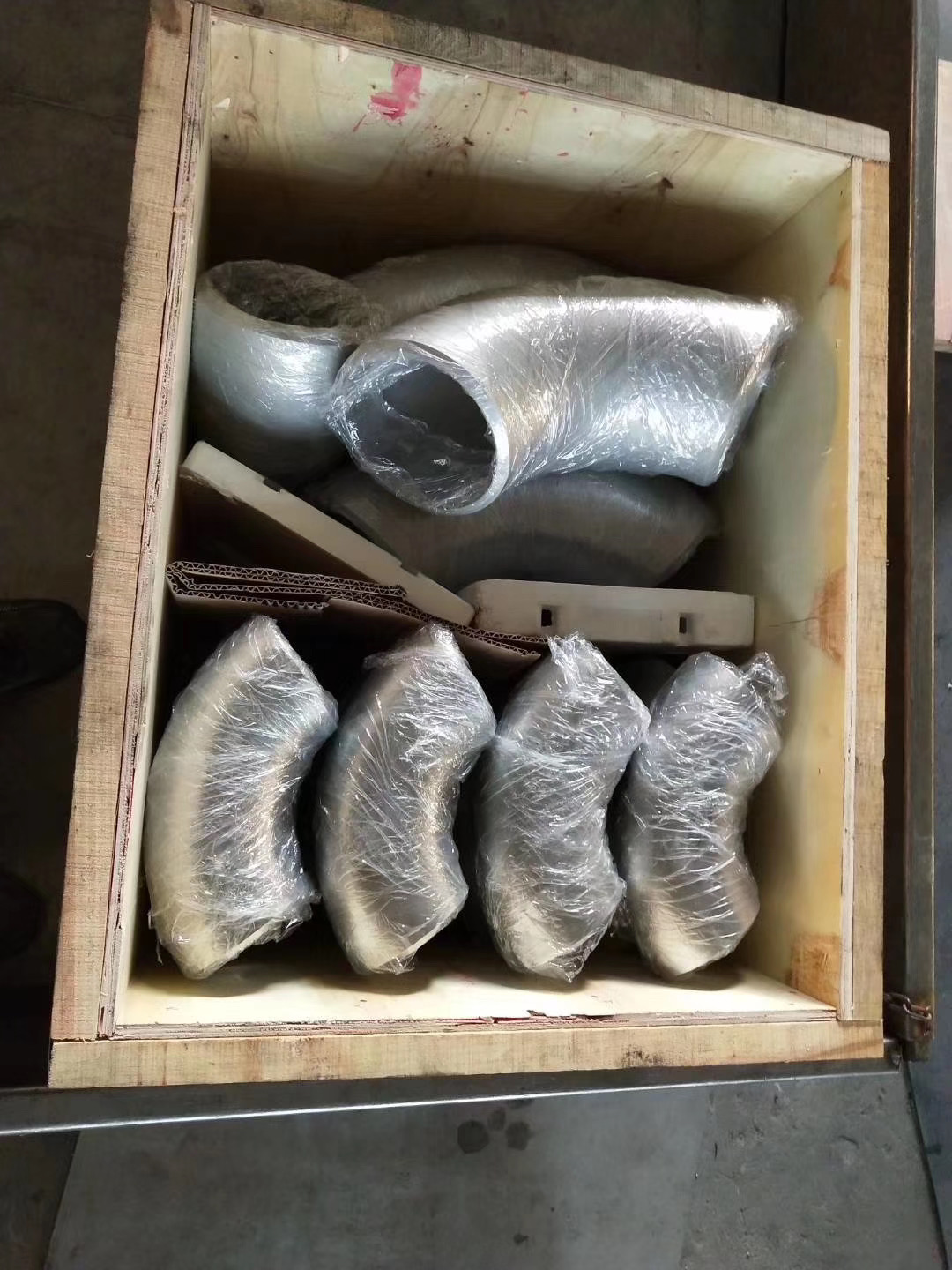
Fittings and tubing staged for fabrication — the joining method is as important as the alloy.
The Hybrid Build Is Now the Default
The assumption that a facility will be “all direct-to-chip” or “all immersion” is increasingly outdated. You are more likely to see direct-to-chip on the GPU racks, conventional chilled water on storage and networking, and reserved capacity for immersion as the technology matures. That hybrid reality is itself a signal of how fast accelerated-computing capacity is being stood up — and it changes your piping plan in one important way.
Your infrastructure now has to support multiple fluid types, multiple pressure ratings, and multiple material-compatibility rules, sometimes on the same floor. Expansion joints, flexible connectors, and pump connectors should be specified per loop, not per facility. A blanket spec that serves the chilled-water HVAC loop will not serve the dielectric immersion loop, and the reverse is just as true. For procurement, that argues for qualifying a supplier who can deliver EPDM for glycol, FKM and PTFE for dielectric, and stainless bellows for high-reliability service — from one source, with consistent documentation.
Specification Decisions You Cannot Reverse in the Field
Some choices are easy to fix after commissioning — swap a gasket, retorque a flange, replace a hose. Others are effectively locked in the day you pour. Treat these as design decisions, not field adjustments.
Expansion-joint material is permanent
An EPDM joint installed in what later becomes a dielectric loop has to be removed and replaced — there is no field retrofit. If immersion is even possible later, specify PTFE or FKM in any run that might carry dielectric fluid, even if you start on water-glycol.
Anchor and guide spacing is structural
Pipe anchors are welded or bolted to structural steel. Moving them is a structural modification, not a piping tweak. Wrong spacing leaves expansion joints absorbing movement they were never designed for.
Pump-connector sizing needs headroom
A connector that is marginal at 45 PSI will not serve an upgraded system at 60 PSI after you expand capacity. Specifying with headroom in both pressure rating and movement capacity is cheaper than replacing it mid-life.
How Kaixin Supports Your Cooling Piping Program
Kaixin (Wenzhou Kaixin Metal Co., Ltd.) is a source-factory stainless steel pipe and tubing manufacturer serving customers in more than 130 countries, with ISO 9001 quality systems and in-house production, testing, and R&D. We work with MEP contractors, design engineers, and procurement teams on specification support, custom sizing, and fast delivery for the compressed timelines these projects demand — from 304/316L seamless pipe through duplex and nickel-alloy programs.
Need a stainless steel piping quote?
Send us your loop spec — fluid, pressure, temperature, and alloy — and our team will return a material and sizing recommendation with lead time. One request, one source, documented quality.
자주 묻는 질문
Can you convert a direct-to-chip loop to immersion cooling after the facility is built?
Not economically. Once joints and gaskets are specified for water-glycol service, moving to dielectric compatibility means replacing joints, hose assemblies, and often the heat-exchanger interfaces. If immersion is likely later, specify PTFE-lined or FKM components from day one while you still run DTC.
What pipe schedule and sizes are typical for a CDU-to-rack cooling loop?
Facility loops commonly use smaller schedules (often SCH 10 or SCH 40) in 1–4 inch stainless steel tubing, sized to flow and pressure drop rather than mechanical load. The exact sizes come from the CDU manufacturer’s hydraulic specification — do not size them from HVAC rules of thumb.
How do you verify a stainless steel cooling loop is leak-tight before energizing?
Use documented hydrostatic or pneumatic pressure testing per the project spec — typically at about 1.5× operating pressure with a held soak — plus dye or helium leak checks on welded joints where the loop is safety-critical. Confirm passivation and cleanliness before the first fill.
Is stainless steel or copper better for data center liquid cooling piping?
Stainless steel (304/316L) is the default for facility loops because it resists glycol and treated-water corrosion and welds cleanly. Copper appears in some cold-plate internals but is generally avoided in shared facility piping, where mixing metals risks galvanic corrosion.
Which codes or standards apply to liquid cooling piping in a data center?
Expect ASME B31.9 (building services piping) and local mechanical codes as a baseline, with ASHRAE thermal guidance informing loop design. The owner’s specification and the CDU vendor’s requirements usually add the binding detail on top of those.
How does coolant water quality affect stainless steel pipe life?
Tight control of chloride content, pH, and dissolved oxygen is what keeps 316L reliable for decades. Stray chlorides or poor passivation are the usual cause of pitting, so water treatment and commissioning cleaning matter as much as the alloy you choose.
관련 자료
Keep building your specification from our existing technical library:
 English
 Afrikaans
 Arabic
 Bengali
 Catalan
 Chinese
 French
 Dutch (Belgium)
 Dutch
Dutch German
 Czech
Czech Greek
Greek Hindi
Hindi Japanese
 Italian
 Portuguese
 Spanish (Chile)
 Spanish (Colombia)
 Spanish (Argentina)
 Persian
 Estonian
 Albanian
 Russian
 Spanish (Peru)
 Indonesian
 Thai
Thai Vietnamese
 Georgian
 Korean
 Nepali
 Polish
 Ukrainian
 Malayalam
 Xhosa
Xhosa