 温州開新開新金属有限公司

How to Read a Stainless Steel Pipe Mill Test Certificate (MTC)
When you buy stainless steel pipe for a project, the material is only as trustworthy as the paperwork that travels with it. A stainless steel pipe mill test certificate (MTC) is the document that proves the pipes you received match the grade, standard, and properties you ordered. If you skip the check, you risk installing the wrong alloy, failing an inspection, or voiding a warranty. In this guide we walk you through how to read a stainless steel pipe MTC, what each field means, and the verification steps that protect your procurement.
What a Mill Test Certificate Actually Proves
You will usually hear the document called an MTC, an MTR (Mill Test Report), or a stainless steel material certification. Under the European standard EN 10204, the MTC is the manufacturer’s declaration that a specific consignment of stainless steel pipe conforms to the ordered specification. A 3.1 certificate is issued by the manufacturer’s quality function and is based on actual test results; a 3.2 certificate adds an independent inspector. Either way, the certificate is your traceable proof that the heat, chemistry, and mechanical values are real, not assumed.
Before you read the details, confirm you are looking at the right document type for your market. Many buyers ask for an EN 10204 3.1 certificate by default because it balances cost and assurance. If your project falls under pressure-equipment rules, you may need the 3.2 version instead.
Material grade (the first field you check)
The grade tells you the alloy family — for example 304, 304L, 316L, 2205, or 2507. This single line decides corrosion resistance, weldability, and price. On a stainless steel MTC the grade must match exactly what your purchase order specified, including the “L” (low carbon) suffix, because 304 and 304L are not interchangeable in many services.
Product standard
The standard defines the rules the pipe was made and tested to. Common references on an MTC for stainless steel pipe include ASTM A312 (seamless and welded austenitic pipe), ASTM A789 (duplex tube), ASTM A270 (sanitary tube), and EN 10216-5 (seamless circular steel tubes for pressure). If the standard on the certificate does not match the standard in your contract, the pipe is not compliant even if the grade looks right. Our ステンレスシームレスパイプ range is supplied against ASTM A312 and EN 10216-5 with full mill test certificates.
化学組成
The chemistry table lists the actual analyzed values for elements such as carbon, chromium, nickel, molybdenum, and nitrogen. You compare these against the limits in the relevant grade standard. A 二相ステンレス鋼管, for instance, must hit a tighter chromium and molybdenum window than an austenitic 316L. Small chemistry drift can mean the pipe will not survive the corrosive environment you designed for.
Mechanical properties
This section records tensile strength, yield strength, and elongation from the mill’s test pieces, plus hardness where required. These numbers confirm the pipe can handle the pressure and load in your system. If the MTC shows mechanical values below the standard minimum, reject the lot — do not assume it is a typing error. The photograph below shows the kind of portable hardness check that backs up the values printed on your certificate.
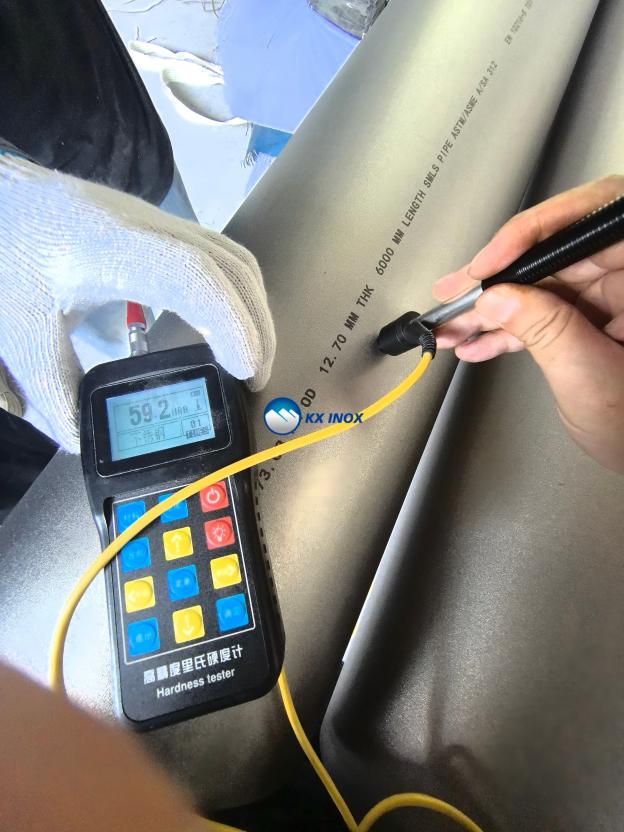
Portable hardness verification is one of the mechanical tests reflected on a stainless steel pipe mill test certificate.
Heat number and batch identity
The heat (or ladle) number is the most important traceability field on the certificate. It links every pipe in the batch to the exact melt that produced it. You must confirm the heat number on the MTC matches the heat number stamped or tagged on the pipe and on the packaging. A mismatch breaks the chain of custody and makes the certificate worthless for traceability.
Test results and inspection statements
Beyond the headline values, the MTC carries the inspection results — hydrostatic or pneumatic testing, eddy current or ultrasonic testing, flattening, and intergranular corrosion tests where specified. A complete stainless steel MTC leaves no blank cells in the fields your standard requires. Blank or “N/A” where a test is mandatory is a red flag.
Quick reference: which standard applies to your stainless steel pipe?
| Pipe type | Typical product standard | Common certificate |
|---|---|---|
| Austenitic seamless / welded pipe | ASTM A312 / EN 10216-5 | EN 10204 3.1 |
| Duplex & super-duplex tube | ASTM A789 / ASTM A790 | EN 10204 3.1 |
| Sanitary / hygienic tube | ASTM A270 | EN 10204 3.1 |
| ニッケル合金管 | ASTM B / SB series | EN 10204 3.1 |
| Pressure equipment (PED) | As above + PED 2014/68/EU | EN 10204 3.2 |
Need stainless steel pipe with full, verifiable documentation?
Kaixin (WZINOX) supplies 304/304L, 316/316L, duplex 2205/2507 and nickel alloy pipe manufactured under ISO 9001, with complete mill test certificates and EN 10204 3.1 files for every order. Tell us your grade, standard, and size — our engineers will confirm the specification and the paperwork together. Browse our stainless steel seamless pipe range.
How to Verify an MTC Step by Step
Reading the certificate is only half the job. You still have to prove the document belongs to the pipes in front of you. Run the following checks before you sign off the delivery. A practical mill test certificate for stainless steel pipe is only useful once it is tied to the physical material.
MTC verification checklist (run this at goods-in)
- ✔ Grade and “L” suffix match the purchase order
- ✔ Product standard matches the contract (and edition year)
- ✔ Heat number on MTC = heat number on pipe + packaging
- ✔ Chemistry values sit within the grade limits
- ✔ Mechanical values meet or exceed the minimums
- ✔ Required NDT / hydrostatic tests present and passed
- ✔ Certificate type correct (3.1 vs 3.2 for your project)
- ✔ No blank mandatory fields on the document
Match the MTC to your purchase order
Start with your PO. The grade, standard, dimensions, quantity, and certificate type on the MTC must line up with what you ordered. Discrepancies here are the most common cause of rejected shipments, and they are the easiest to catch on paper before the truck is unloaded.
Cross-check product markings
Stainless steel pipe is marked with the grade, heat number, size, and often the manufacturer’s logo. Lay the pipe marking next to the certificate. If the heat number or grade does not match, stop and query the supplier before unloading — a marking mismatch invalidates the whole stainless steel MTC for traceability.
Verify packaging labels
Each bundle or crate carries a tag repeating the heat number, grade, and dimensions. Confirm the packaging tag matches both the pipe marking and the MTC. In-transit mix-ups are real, and the label is your fastest check before the material goes into stock.
Confirm dimensions and tolerances
The MTC lists nominal size, wall thickness, and length. Use calipers or a micrometer on a sample to confirm the wall thickness is within the tolerance of the ordered schedule. Undersize wall is a hidden failure risk that only the MTC plus measurement will catch. For critical lines, specify an ASTM A789 SAF2507 duplex steel tube with documented UT and PMI so the paperwork and the product agree.
Common MTC Mistakes and Risks
Even experienced buyers get caught by the same avoidable errors. Knowing them helps you spot a problem before it becomes a field failure.
Grade mismatch (including the missing “L”)
The classic error is accepting 304 where 304L was ordered, or vice versa. The carbon difference changes weld sensitization behavior. Always read the suffix character by character, and confirm dual-certified heats list both sets of limits.
Heat number inconsistency
If the heat number on the pipe, the packaging, and the MTC do not all agree, the certificate cannot be trusted for traceability. This is one of the fastest ways to fail an audit or a client inspection.
Wrong or outdated standard cited
A certificate referencing a withdrawn or incorrect standard is not valid for your contract. Confirm the standard edition year if your specification calls for a specific revision, because the same grade can carry different test rules across editions.
Missing or altered test data
Blank mandatory fields, rounded-off values that look too perfect, or obvious edits to the PDF are warning signs. A genuine stainless steel material certification is issued as a controlled document; ask for the original, not a screenshot. See how sanitary tubing is specified and tested in our ASTM A270 sanitary tube guide.
When to Request Extra Verification
A clean MTC is usually enough for standard procurement. But some situations call for going further before you accept the pipes — and stating these requirements up front keeps the certificate and the extra report together.
材料の確実な同定(PMI)
PMI with a handheld XRF analyzer confirms the actual alloy on the pipe surface matches the certificate grade. Request PMI when the service is safety-critical, the alloy is high-value (duplex or nickel alloy), or you cannot visually trust the marking. It catches substitution that a paper MTC alone will not.
Non-destructive testing (NDT)
Beyond the mill’s routine NDT, you may require independent ultrasonic (UT), eddy current (ET), or dye penetrant (PT) testing for critical lines. State this in the PO so the MTC and the extra report travel together and reference the same heat numbers.
Third-party inspection and EN 10204 3.2
For pressure equipment or regulated projects, engage a third-party inspector (SGS, TÜV, BV) to witness tests and issue a 3.2 certificate. This adds cost but removes doubt about who verified the material. The image below shows the kind of in-factory inspection that feeds a trustworthy MTC.

In-factory inspection of stainless steel seamless pipes before the mill test certificate is issued and the order is shipped.
Specifying pipe for a critical system?
Kaixin (WZINOX) can supply an EN 10204 3.2 certificate with third-party witness, add PMI and independent NDT to your order, and deliver the full quality file your project needs. Share your specification and we will map the grade, standard, and inspection scope for you.
結論
Reading a stainless steel pipe mill test certificate does not require a metallurgist, but it does require discipline. When you match the grade, standard, heat number, chemistry, and mechanical values against your order — and against the pipe in front of you — you turn a sheet of paper into real assurance. Keep this checklist on hand for every delivery, and do not be shy about asking for PMI, NDT, or a 3.2 certificate when the job demands it. If you want pipes supplied with complete, verifiable documentation, Kaixin (WZINOX) is ready to help you specify with confidence.
よくある質問
Q1. What is the difference between EN 10204 2.1, 2.2, 3.1, and 3.2 certificates?
2.1 is a simple statement of compliance without test results; 2.2 adds test data from a similar product; 3.1 is based on actual tests of your specific batch, issued by the manufacturer’s quality department; 3.2 adds an independent inspector’s signature. For stainless steel pipe in most industrial and pressure applications, 3.1 is the default, and 3.2 is required where independent verification is mandated.
Q2. Is a Mill Test Certificate the same as an MTR or a Certificate of Conformance (CoC)?
They overlap but are not identical. MTC and MTR (Mill Test Report) usually mean the same test-record document. A Certificate of Conformance (CoC) may only declare compliance without showing the actual test values, so it carries less proof. Always ask for the document that includes the measured chemistry and mechanical results.
Q3. Who is allowed to issue the MTC, and can a trader issue a 3.1?
A 3.1 certificate must be issued by the manufacturer’s quality function under its own quality system. A stockist or trader can re-issue a 3.1 only if they are the legal manufacturer or hold controlled copies tied to the original melt — otherwise the chain of custody breaks. For 3.2, the independent inspector witnesses the tests regardless of who sells the pipe.
Q4. How long should I keep MTCs for stainless steel pipe?
Retention depends on your industry and local law, but a practical rule is to keep MTCs for the full service life of the installation plus any statutory period (often 10–30 years for pressure equipment and structural work). Treat the MTC as a permanent part of the asset’s quality file.
Q5. Can an MTC be digital or electronic, and is a PDF acceptable?
Yes. Most mills now issue the EN 10204 3.1 certificate as a controlled PDF, sometimes with a digital signature or verification portal. A plain PDF is acceptable if it is the original issued document; be cautious of screenshots or edited files, and use the issuer’s verification link where provided.
Q6. What does “dual certified” (for example 304/304L) mean on an MTC?
Dual certification means one heat of steel meets the limits of both grades simultaneously — typically because its carbon is low enough for the “L” grade while its other elements satisfy the non-L grade. This lets a single stainless steel pipe stock serve both 304 and 304L specifications, but confirm both sets of limits are listed on the MTC.
Q7. How can I tell whether an MTC is genuine and not forged?
Check the document control number, the issuer’s letterhead and quality stamp, and consistency of the heat number across pipe, packaging, and certificate. Use the manufacturer’s online verification portal if available, and be suspicious of perfect-looking values, missing signatures, or mismatched fonts. For high-value or safety-critical orders, request a 3.2 or third-party verification.
Q8. Does one MTC cover every pipe in the delivery, or only a sample?
A 3.1 certificate covers the specific heat or batch it references, not necessarily every piece if the delivery mixes multiple heats. Confirm that the heat numbers on all bundles appear on the accompanying certificates, and request separate certificates when the shipment contains more than one melt.
Q9. What is PMI and when should I require it beyond the MTC?
Positive Material Identification (PMI) uses a handheld XRF analyzer to verify the alloy on the actual pipe surface. Require PMI when the service is safety-critical, the material is high-value (duplex or nickel alloy), or you cannot fully trust the marking — it catches substitution that a paper MTC alone will not.
Q10. Are MTC requirements different for pressure equipment under the PED?
Yes. In the EU, pressure equipment must comply with PED 2014/68/EU, and notified bodies often require an EN 10204 3.2 certificate with independent inspection for higher hazard categories. Even where a 3.1 is allowed, the MTC must reference the correct material specification and show the tests the PED module demands.
関連リソース
- ASTM A270ステンレス鋼シームレス管 — how sanitary tubing is specified and tested.
- ステンレス丸棒:グレード、サイズ、用途、および選定ガイド — pairing bar and pipe specs.
- What Is a Stainless Steel Capillary Tube? Types, Materials & Applications — small-diameter grade choices.
- Stainless Steel Seamless Pipe (products) — grades, standards, and certifications.
- Stainless Steel Weight Calculator — cross-check the weight figure stated on your MTC.
 English
 Afrikaans
 Arabic
 Bengali
 Catalan
 Chinese
 French
 Dutch (Belgium)
 Dutch
 German
 Czech
 Greek
 Hindi
 Japanese
 Italian
 Portuguese
 Spanish (Chile)
 Spanish (Colombia)
 Spanish (Argentina)
 Persian
 Estonian
 Albanian
 Russian
 Spanish (Peru)
 Indonesian
 Thai
 Vietnamese
 Georgian
 Korean
 Nepali
 Polish
 Ukrainian
 Malayalam
 Xhosa