 Wenzhou Kaixin Kaixin Metal Co, LTD

If you are specifying pipe for a new project, one decision shapes almost everything else: do you need a seamless stainless steel pipe or a welded stainless steel pipe? Both start from the same grades of stainless steel, but they are made differently, behave differently under pressure and corrosion, and sit at very different price points. In this guide we walk you through exactly how to choose, with a side-by-side comparison, clear “when to use” rules, a cost breakdown, and a quick selector you can use on your own spec.
What Is a Seamless Stainless Steel Pipe?
A seamless pipe is produced from a solid stainless steel billet that is heated and pierced, then elongated and drawn or rolled into a hollow tube with no weld seam anywhere along its length. Because there is no longitudinal weld, the pipe has uniform metallurgy and no seam that can become a weak point. You typically see seamless pipe specified for high-pressure, high-temperature, and corrosive services where failure is not an option.
Common standards you will meet include ASTM A312 for seamless austenitic stainless pipe and ASTM A789 for duplex grades. If you want the full background on how it is made and where it fits, our introduction to stainless steel seamless pipe covers the manufacturing route in detail.
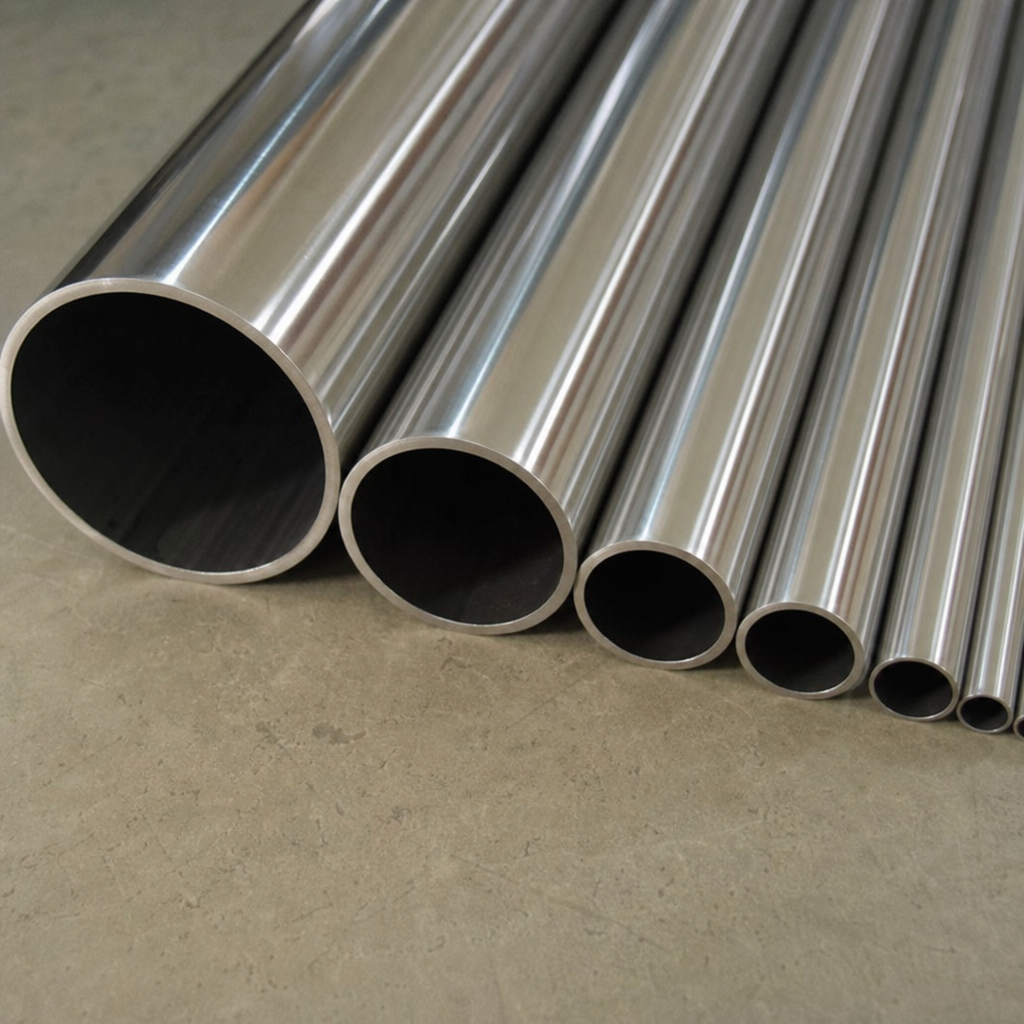
pipa baja tahan karat yang dipoles dengan berbagai diameter
What Is a Welded Stainless Steel Pipe?
A welded pipe starts as a flat stainless steel strip or plate that is rolled into a round shape and joined along its length by welding, then typically conditioned (such as bead contouring and annealing) to restore corrosion resistance at the weld. Modern welded lines use TIG or plasma welding with full penetration and 100% inspection, so for many services a welded pipe performs identically to a seamless one at a fraction of the cost.
Welded pipe (often covered by ASTM A358 for electric-fusion-welded austenitic pipe, or ASTM A269/A270 for welded tubing) is the default choice for large diameters, lower-pressure service, and hygienic process lines where a smooth, controlled interior finish matters more than a seam-free wall.

Seamless vs. Welded Stainless Steel Pipe: Side-by-Side Comparison
The fastest way to see the trade-off is a direct comparison. Use the table below as your at-a-glance reference when you brief your supplier.
| Factor | Pipa Seamless | Welded Pipe |
|---|---|---|
| Manufacturing | Pierced billet, no seam | Rolled strip + longitudinal weld |
| Pressure & temperature | Best for high pressure / high temp | Good for moderate service |
| Ketahanan korosi | Uniform wall, no seam risk | Weld zone needs proper treatment |
| Diameter range | Limited at large diameters | Excellent for large diameters |
| Cost | Higher (more material waste) | Lower, especially in big sizes |
| Lead time | Often longer for odd sizes | Usually shorter, more stock |
| Inspection | Hydrostatic + UT on wall | Hydrostatic + eddy current / RT on weld |
Need a material recommendation for your spec?
Tell our engineers your pressure, medium, and diameter, and we will recommend seamless or welded — plus the right grade (304, 316L, duplex, and more).
When to Use Seamless Pipe
You should reach for a seamless stainless steel pipe whenever the service is unforgiving. The clearest cases:
- High pressure or high temperature — boilers, heat exchangers, and hydraulic lines where the seam could be the failure point.
- Severe or unknown corrosion — uniform metallurgy avoids localized attack at a weld in aggressive media.
- Small to medium diameters — where seamless is readily available and the cost gap is modest.
- Critical safety or code-driven service — nuclear, petrochemical, and subsea where standards often mandate seamless.
If your question is simply “when to use seamless pipe,” the answer is: choose it when the cost of failure outweighs the cost of the material.
When to Use Welded Pipe
Welded pipe is the smarter choice far more often than buyers assume. You should choose it when:
- The diameter is large — beyond roughly 24 inches (600 mm), welded is the only practical and affordable option.
- Pressure is moderate — water, HVAC, structural, and general plant piping.
- Budget is a priority — welded pipe typically costs 20% to 40% less than seamless in the same size.
- You need a hygienic interior finish — sanitary process lines benefit from a controlled, smooth bore with proper weld conditioning.
When your question is “when to use welded pipe,” the answer is: choose it for larger diameters, lower-pressure duty, and any project where material cost drives the business case.
Seamless vs. Welded Pipe Cost: What Drives the Price Gap
The “seamless vs welded pipe cost” question is rarely a fixed number — it depends on diameter, wall thickness, grade, and order volume. Three rules of thumb help you budget:
- Small sizes, small gap. In 1/2″ to 4″ pipe the price difference can be modest, so seamless is easy to justify for critical lines.
- Large sizes, wide gap. As diameter grows, seamless scrap and forging cost balloon, while welded stays cheap — the gap can exceed 40%.
- Grade matters more than type. A 316L or duplex welded pipe can still cost more than a 304 seamless pipe, so compare like for like.
For a real number on your project, request a quote that lists both options side by side — many buyers are surprised how often welded meets the spec at a lower price. Browse our full range of stainless steel pipe products atau duplex grades.
Seamless vs. Welded — Quick Selector (Decision Matrix)
Match your project’s toughest condition to the right pipe type. Read from the top and follow the first row that fits your most demanding requirement.
| Your condition | Pilih | Why |
|---|---|---|
| Operating pressure above ~1,000 psi / 7 MPa, or high temperature | Tanpa sambungan | No longitudinal seam means no weak point under stress |
| Severe or unknown corrosion; critical or safety service | Tanpa sambungan | Uniform wall, no weld to localize attack |
| Diameter above 24 in / 600 mm | Welded | Seamless is not practical or affordable at large sizes |
| Moderate pressure, mild service, budget-sensitive | Welded | 20% to 40% lower cost, shorter lead time |
| Hygienic (food / pharma) with a controlled finish | Welded (sanitary) | Smooth controlled bore per ASTM A270 |
| Code or client specification mandates seamless | Tanpa sambungan | Compliance requirement |
Still unsure which way your spec points? Send us your size, grade, and service conditions and our engineers will confirm seamless vs welded for free.
Get a free material recommendation
Tell us your pressure, medium, and diameter — we will recommend the right pipe type and grade.
How to Choose: A Practical Decision Checklist
Before you send a purchase order, run through this checklist. If most boxes point one way, your decision is made:
- What is the design pressure and temperature? (High → seamless.)
- What medium will the pipe carry, and how corrosive is it? (Severe → seamless.)
- What outside diameter do you need? (Large → welded.)
- What is your budget and lead-time window? (Tight → welded.)
- Does the applicable code or client spec mandate seamless? (If yes → seamless.)
Ready to price both options?
Send us your size, grade, and quantity and we will return a seamless-vs-welded quote so you can choose with confidence.
Frequently Asked Questions
Can you weld a seamless pipe, and can a welded pipe be re-welded safely?
Yes to both. Seamless pipe is fully weldable using standard stainless procedures; its advantage is the absence of a factory seam, not that it cannot be welded in the field. A welded pipe can also be cut and re-welded, provided the weld procedure and post-weld treatment (such as pickling or passivation) are done correctly to restore corrosion resistance.
Which is better for high-temperature service?
Seamless is generally preferred for sustained high-temperature and high-pressure duty because there is no longitudinal weld to act as a creep or fatigue weak point. For high-temperature service, grade choice (such as 316H or stabilized grades) often matters as much as pipe type, so specify both together.
Does wall-thickness availability differ between the two?
It can. Very heavy wall thicknesses are easier to obtain as seamless, while welded pipe is produced across a wide range of schedules but may be limited at extreme wall thicknesses in large diameters. Always confirm availability against your required schedule (e.g., Sch 40, Sch 80, Sch 160).
Is there a maximum diameter for seamless pipe?
Practically yes. Seamless pipe becomes difficult and expensive above roughly 24 inches (600 mm) OD because it must be extruded or pierced from a billet. For larger diameters, welded pipe is the standard and often the only available option.
How does non-destructive testing differ?
Seamless pipe is typically verified by hydrostatic testing plus ultrasonic examination of the full wall. Welded pipe is hydrostatically tested and then inspected at the weld, commonly by eddy current or radiography (RT), with some specs requiring UT of the weld seam. Both routes give reliable, code-accepted assurance when specified correctly.
Which type has a shorter lead time?
Welded pipe usually wins on lead time because it is produced from readily available strip and stocked in common sizes. Seamless pipe, especially in unusual grades or dimensions, can take longer because it depends on billet availability and a more complex conversion route.
How do ASTM standards map to seamless vs welded?
Several standards cover both, but commonly ASTM A312 is specified for seamless (and welded) austenitic pipe, ASTM A358 for electric-fusion-welded pipe, ASTM A789 for seamless and welded duplex, and ASTM A270 for welded sanitary tubing. The standard alone does not decide the type — your service conditions do.
Can welded pipe be used for potable water or food and pharma?
Yes. With proper weld conditioning and a controlled interior finish (for example, ASTM A270 sanitary tubing), welded pipe is widely used in potable water, food, beverage, and pharmaceutical lines. The key is specifying the right finish and cleanliness, not avoiding welds entirely.
How much cheaper is welded pipe, really?
In small sizes the gap may be only 10% to 20%; in large diameters it can exceed 40%. Volume, grade, and wall thickness all shift the number, which is why a side-by-side quote is the only reliable way to compare “seamless vs welded pipe cost” for your exact requirement.
How can you tell seamless and welded pipe apart?
Visually, a welded pipe shows a faint longitudinal weld bead on the surface; a seamless pipe has none. Mill markings and the material certificate (MTC) state the manufacturing method and standard, so the safest check is always the documentation rather than the eye.
Related Resources
- Apa Itu Pipa Seamless Stainless Steel? — the manufacturing route and where it fits.
- Compare 304, 304L, 316, 316L Stainless Steel Pipe — pick the right grade for your medium.
- Tabel Jadwal Pipa: Panduan Lengkap — match wall thickness to pressure.
- Stainless Steel Seamless Pipe (Products)
- Stainless Steel Welded Pipe (Products)
Kesimpulan
Choosing between a seamless and a welded stainless steel pipe comes down to a simple trade-off: seamless gives you the most uniform wall and the highest margin of safety for pressure, temperature, and corrosion, while welded gives you larger diameters, shorter lead times, and a markedly lower price. Start with your service conditions, use the comparison table and quick selector above, and let total cost — not habit — decide. If you want a second opinion, our engineers will review your spec for free.
KXINOX (Kaixin) is a stainless steel pipe manufacturer producing both seamless and welded pipe to ASTM/ASME standards including A312, A358, A789, and A270. Contact our team for a tailored quote or a free material recommendation on your next project.
Talk to a KXINOX engineer
Send your size, grade, and service conditions and get a seamless-vs-welded recommendation plus a competitive quote within one business day.
 English
 Afrikaans
 Arabic
 Bengali
 Catalan
 Chinese
 French
 Dutch (Belgium)
 Dutch
 German
 Czech
 Greek
 Hindi
 Japanese
 Italian
 Portuguese
 Spanish (Chile)
 Spanish (Colombia)
 Spanish (Argentina)
 Persian
 Estonian
 Albanian
 Russian
 Spanish (Peru)
 Indonesian
 Thai
 Vietnamese
 Georgian
 Korean
 Nepali
 Polish
 Ukrainian
 Malayalam
 Xhosa