 Wenzhou Kaixin Kaixin Metal Co., Ltd.

Choosing between stainless steel press fittings and welded fittings rarely comes down to which joint is stronger. It comes down to your pressure class, your media, your schedule, and who is holding the tool. A press joint takes under a minute and needs no hot work permit; a weld gives you a homogeneous, radiographable joint with no elastomer anywhere in the line. Both are legitimate engineering answers, and picking the wrong one costs you either money or a rework order. That is why the stainless steel press fittings vs welded fittings question now shows up on almost every small-bore line list, in plants that never had to ask it before. This guide shows you how each joint actually works, where the real limits sit, and how to decide for your next line.
The Short Answer, Before You Read Further
| Decision factor | Favours press fittings | Favours welded fittings |
|---|---|---|
| Line size | DN15 to DN100 (1/2″ to 4″) | DN100 and above, or any size where the joint must be full-penetration |
| Pressure and temperature | Up to about 16 bar, with seal-limited temperature | Above the fitting listing, steam, thermal cycling |
| Site conditions | Occupied buildings, no hot work permit, tight shutdown window | Shop fabrication, new build, isolated plant area |
| Inspection | Visual press mark, tool calibration record | Radiography or penetrant testing available |
| Long-term risk | Elastomer ageing is the governing failure mode | Heat tint and weld defects are the governing risk |

Why This Comparison Keeps Landing on Your Desk
Thirty years ago the question did not exist for stainless lines under 2″. You either threaded it, welded it, or paid a specialist. Today a maintenance engineer can clamp a battery tool onto a fitting and hand over a leak-tight joint before the welder has finished rigging his torch. That shift is why the same argument now happens on every plant expansion, hospital refurbishment and food factory upgrade.
The disputes are almost never about metallurgy. They are about scope. A specifying engineer writes “ASTM A312 TP316L” on the line list, the contractor buys a thin-wall press system to save labour, and six weeks later someone asks why the joint is not covered by the piping class. Getting the two sides aligned early is the whole point of this comparison, and it is why the press fit vs weld pipe fittings decision now belongs at the line-list stage rather than on site.
If you are still deciding on the base material itself, our guide to 304 versus 316L stainless steel pipe covers the grade question, and the article on seamless versus welded pipe covers how the tube itself is made. This article assumes you have already chosen the grade and are now choosing the joint.
How a Stainless Steel Press Fitting Joint Actually Seals
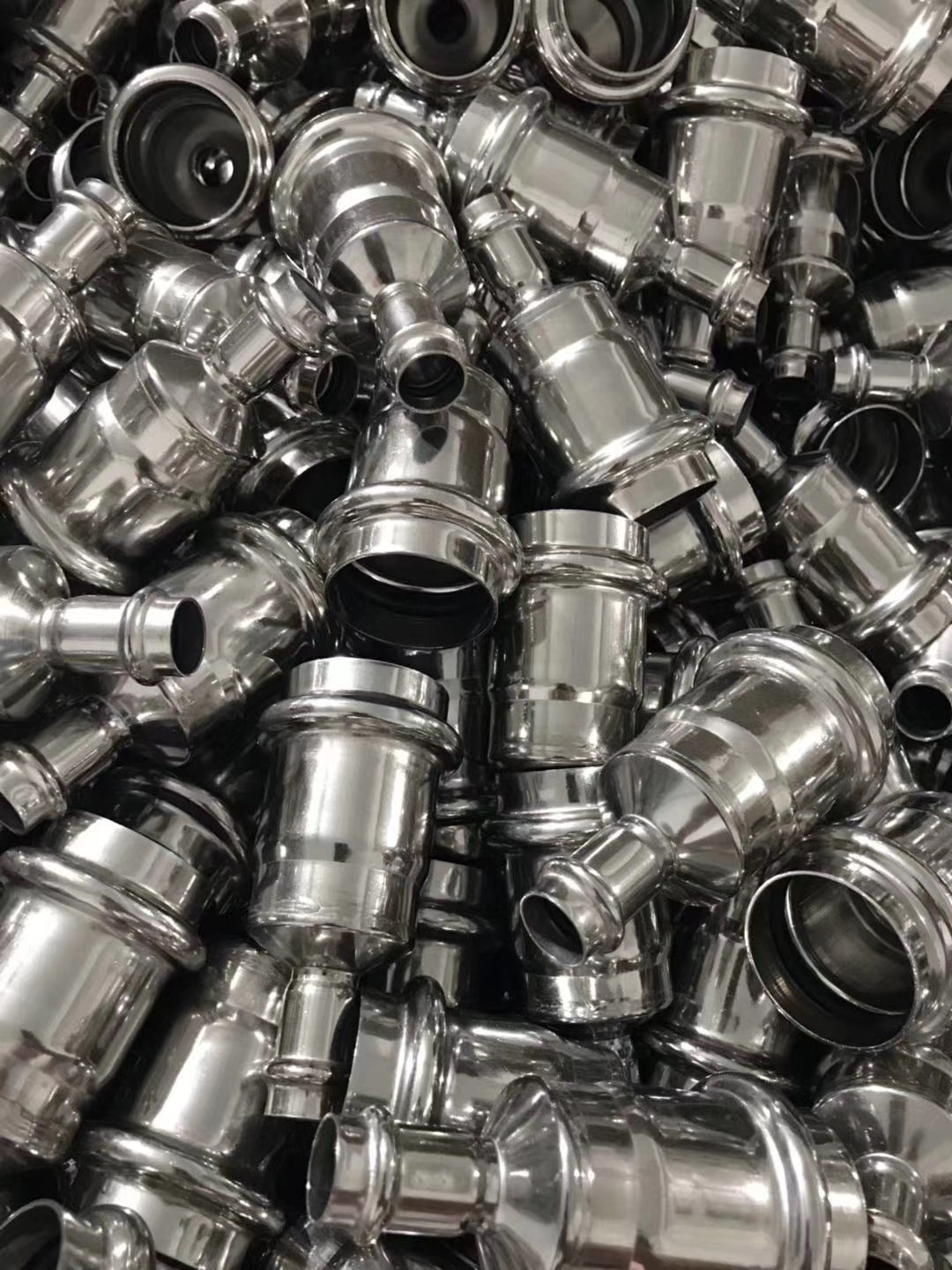
A press joint is a controlled deformation, not a compression fitting. You push the tube into the fitting until it bottoms out on the internal stop, then the tool closes a jaw around the profile and swages the fitting body and the tube wall together. Three things hold the line: a metal-to-metal grip, a shaped profile that resists axial pull-out, and an elastomer O-ring that does the actual sealing.
The profile is the system, not a detail
Two profiles dominate the market. The V profile (also written M profile in some catalogues) is the common European geometry and is what most DVGW-listed systems use; the jaw compresses a defined bead around the circumference. Other profiles exist for North American listings. The profile decides which jaw you need, which tool setting you use, and whether the joint is approved at all, which is why profile and jaw must come from the same system. Our stainless steel press fitting range is built around this geometry, including the V profile 316L equal tee and the DVGW M profile equal coupling.
The O-ring is your real pressure limit
This is the part most comparison tables skip. The stainless body will outlast almost any service you put it in. The seal will not. EPDM covers potable water, heating water, and many mild process fluids and is normally rated to about 110 °C continuous. FKM covers higher temperatures and a wider chemical range but costs more and is not the default choice for drinking water. The press fitting pressure rating printed on a datasheet is really a statement about that ring, so read the seal datasheet before you read the pressure column. Most 316 stainless steel press fittings ship with EPDM as standard and offer FKM as the upgrade.
The leak-before-press signal
A well-designed press system leaks at low pressure if you forget to crimp the joint, because the O-ring is not compressed until the jaw closes. That is a deliberate safety feature, not a defect. It means your pressure test catches an unpressed joint at 1 bar instead of discovering it at 10 bar behind a closed ceiling. Treat a drip on first fill as a checklist item, not a catastrophe.
How a Welded Stainless Joint Is Made
Welding fuses the fitting and the tube into one continuous metal section. For stainless you are usually looking at TIG, either manual or orbital, with argon shielding on the inside as well as the outside. The two joint types you will specify are socket weld, where the tube sits inside a recessed socket, and butt weld, where the ends are squared, tacked and fused end to end.
Unlike a press joint, a stainless steel welded fitting has no elastomer anywhere in the assembly, which is why it remains the default for critical service. The consequence for inspection is significant. A butt weld on a process line can be radiographed, penetrant tested, or at minimum visually inspected against a weld map. A press joint cannot be radiographed at all; its evidence is the embossed press mark from the jaw, a witness mark showing full insertion, and the calibration record of the tool. If your contract requires film, press is off the table before cost is even discussed.
One more point that decides long-term corrosion performance: welding burns the passive chromium oxide layer and leaves heat tint in and around the joint. On 316L in a chloride-bearing service, that tint is where pitting starts unless you remove it. Pickling paste, citric passivation or an electrochemical clean is part of the weld scope, not an optional extra. We cover the thermal side of this in the note on solution annealing for stainless steel pipe.
Head-to-Head Comparison
| Criterion | Ajuste a presión | Welded fitting |
|---|---|---|
| Joining principle | Mechanical swage plus elastomer seal | Metallurgical fusion |
| Typical size range | DN15 to DN100 (1/2″ to 4″) | 1/2″ upwards with no practical ceiling |
| Typical rating | PN16 for most sizes, seal-limited on temperature | Governed by pipe schedule and wall thickness |
| Time per joint | Under one minute once the tube is cut and marked | Roughly 10 to 20 minutes including fit-up, purge and clean |
| Hot work | None, so no permit, no fire watch, no purge gas | Permit, fire watch and gas purge normally required |
| Joint inspection | Press mark, insertion witness mark, tool log | Visual, penetrant, radiography |
| Rework | Cut out and remake; a joint is never pressed twice | Can be ground out and re-welded in most cases |
| Worker skill | Trained and carded, but not a coded trade | Coded welder with qualified procedure |
| Corrosion risk at joint | No heat tint, no sensitised zone | Heat tint must be removed and passivated |
| Aging mechanism | O-ring ageing and chemical attack | Fatigue and corrosion at the weld toe |
| Best fit | Water, HVAC, compressed air, small-bore process | High pressure, steam, hygienic, large bore, critical service |
Are Stainless Steel Press Fittings as Strong as Welded Fittings?
You will see this question phrased as a binary, and it deserves a straight answer rather than a sales line. A press joint is not as strong as a weld, and it does not need to be. It needs to exceed the loads your system actually applies, with margin, for the life of the asset.
In physical terms, a press joint resists axial pull-out through the grip of the swaged profile and retains pressure through the O-ring. Manufacturers burst-test these joints well beyond the rated pressure, typically several times the nominal rating, and pull-out tests on small sizes show capacities in the kilonewton range, far above the longitudinal loads a supported line generates. On that basis, for a DN50 water line at 10 bar, the joint is not the weak link.
Where the weld wins is where the comparison stops being about pressure. A qualified butt weld has essentially the same chemistry and thickness as the parent metal, so it carries full joint efficiency, survives thermal cycling without a creep-prone elastomer, and can be proven by radiography. Press joints have none of those three properties. If your line sees steam at 150 °C, forty thermal cycles a week, or a specification that says full radiography, the answer is welding and the debate is over.
A useful way to frame it for your review: press fittings compete on installed cost and schedule. Welded fittings compete on joint efficiency and inspectability. Choose the attribute your project is actually short of, then design the line so that the other attribute is not a hidden risk.
Pressure Rating and Temperature: Read the Fine Print
The rating on the box is not a single number, it is a family of curves. Published values usually assume water at moderate temperature, a properly supported line, and the manufacturer’s own seal. Once you move away from those assumptions, the figure you are relying on no longer applies.
| Size band | Typical nominal rating | Seal | Working temperature guide |
|---|---|---|---|
| DN15 to DN50 | PN16 | EPDM | Up to about 110 °C continuous for water |
| DN65 to DN100 | PN16 down to PN10 depending on system and wall | EPDM | Derated above about 90 °C on many listings |
| Any size, high temperature | Set by the FKM variant | FKM | Up to roughly 180 to 200 °C, pressure derated |
| Below freezing service | Special seal required | Low-temperature variant | Check the listing before you assume standard EPDM applies |
Values above reflect common European press systems and are indicative only. Always design to the pressure-temperature curve of the specific listed product you are buying, not to a generic table.
Two habits will keep you out of trouble. First, treat the rating as a system property: a PN16 fitting on a 1.5 mm wall tube in an unsupported 12 m run is a different system from the one that was tested. Second, if your fluid is not water, ask for chemical compatibility on the seal, not just the metal. Aromatic solvents, concentrated chlorine and some oils will attack EPDM long before the stainless notices.
When to Use Press Fittings Instead of Welding
These are the situations where pressing is usually the better engineering decision, not just the faster one.
- Your shutdown window is measured in hours. A tie-in that takes forty welds and two permits will not fit in a six-hour outage. The same tie-in pressed takes one shift including testing.
- Hot work is not permitted. Hospitals, pharmaceutical cleanrooms, food production halls, museums, fuel depots and occupied offices often ban open flame outright. Pressing removes the permit conversation entirely.
- You are on potable water. There is no heat tint, no pickling residue and no purge gas entering the line, and the joint stays clean on the inside. Systems listed to NSF/ANSI 61 are the norm here; our article on tubos de acero para agua potable covers the material side.
- The work is small bore and repetitive. DN15 to DN50 distribution, manifolds, terminal units and plant room pipework are where the labour difference is largest, because fit-up time dominates welding hours.
- You are retrofitting into an existing line. Cutting in a tee with a press tool needs a short isolation and no fire watch, which matters when the surrounding pipework cannot be drained or purged.
- Coded welders are your bottleneck. If the qualified welders on site are committed to the pressure vessels, pressing lets the mechanical crew close out the utility lines in parallel.
- You need an auditable, repeatable joint. A calibrated tool produces the same joint every time, and the press mark plus tool log is a clean record for handover.
- You are prefabricating modules. Pressed spools can be assembled, labelled and tested in the shop without a weld bay, then connected on site with a handful of joints.
This is also why stainless steel press fittings for industrial piping are usually specified alongside a welded scope rather than instead of it. If your scope includes threaded, socket weld and buttweld items alongside the press range, the overview of different types of pipe fittings is a useful cross-check before you finalise the bill of materials.
When Welding Is Still the Right Call
The reverse list matters just as much, and it is where most specification arguments should end quickly.
- Above DN100 or 4″. The tooling, jaw sets and joint economics stop making sense, and the weld becomes the practical option.
- Above your listed pressure class, or in steam service. Once you exceed the fitting’s pressure-temperature curve, welding is not a preference, it is the only compliant choice.
- Vibration, water hammer and thermal cycling. Pump discharge headers, compressor lines and cycling steam systems put repeated load into a joint. A homogeneous weld handles that better than a gripped elastomer joint.
- Hygienic process lines. Where 3-A or ASME BPE geometry and full drainability are required, orbital welding with a documented procedure is the standard route.
- Aggressive chemistry. If the fluid attacks the seal, the fitting is disqualified regardless of how good the stainless is.
- Contractual radiography or full joint efficiency. If the client’s specification demands film, you cannot substitute a press joint no matter how well it performs.
- Buried long-life assets with no access. Where a joint will never be seen again, many owners prefer to eliminate the elastomer entirely.
Building the bill of materials for a press line?
Send us your line list and we will confirm the profile, seal grade, size band and pressure class against the tube you are using. You get a single enquiry covering press fittings, industrial stainless steel pipe fittings and the matching tube, with mill certificates included.
Installation Details That Decide Whether the Joint Holds
Almost every press fitting installation failure you will read about in a root cause report traces back to one of five habits. None of them are difficult to control, and all of them are cheaper than a rework.
- Cut square and deburr. A burr left on the tube end can cut the O-ring on insertion. A cut that is not square leaves an uneven insertion depth around the circumference.
- Mark the insertion depth and hit the mark. The witness mark is what lets a supervisor confirm full insertion after the fact. If the mark is still visible outside the fitting, the joint is scrap.
- Keep the tool calibrated and the jaws clean. Worn or damaged jaws produce an incomplete swage that looks finished. Track calibration dates the same way you track torque wrenches.
- Match the seal to the fluid, not to the catalogue default. EPDM for water, FKM where temperature or chemistry demands it. This single decision sets the service life of the joint.
- Test at the right pressure. A hydrostatic test at 1.5 times design pressure is the standard expectation. Testing at 2 bar and declaring victory does not prove a PN16 joint.
Support and expansion still matter. A pressed line is a mechanical assembly like any other, and it needs anchors and guides so that thermal movement does not load the joints. If your layout has long straight runs between two fixed anchors, add an expansion loop or a compensator rather than relying on the fittings to absorb movement.
Installed Cost and Schedule: Where the Numbers Actually Differ
Purchase price is the least interesting number in this comparison, because fittings are a small share of installed cost. The difference sits in labour hours, permits, inspection and rework, and it scales with joint count.
| Cost element | Prensa | Weld |
|---|---|---|
| Labour per joint | About 0.5 to 1.5 minutes | About 10 to 20 minutes for small bore, more with purge and clean |
| Capital equipment | Tool plus jaw sets, one-off and reusable | Welding set, purge rig, usually already owned |
| Permits and fire watch | Not applicable | Per shift, plus standby labour |
| Inspection | Visual check and tool log | Sampled radiography or penetrant, plus pickling and passivation |
| Schedule risk | Low, parallel crews possible | Dependent on coded welder availability |
If you are running the press fit vs weld comparison for a live tender, these are the numbers to argue about. On a typical plant-room package the breaking point is usually somewhere between 30 and 80 joints, small bore, in an area where a permit is needed. Below that, welding with a crew you already have is often cheaper. Above it, the press tool pays for itself before the second week. The estimator below lets you run your own numbers.
Joint-Count Snapshot: Where Pressing Starts to Pay
You do not need software to run this comparison. The table below applies one consistent set of assumptions to a range of joint counts, so you can see how the gap widens as the scope grows. It assumes water service, a labour rate of 65 USD per hour, hot work permits at 250 USD per shift, and weld inspection on 10 percent of joints at 22 USD each.
| Tamaño | Joints | Press hours | Weld hours | Press cost | Weld installed cost | Saving per joint |
|---|---|---|---|---|---|---|
| DN15 | 20 | 0.2 | 3.7 | $13 | $532 | $26 |
| DN15 | 60 | 0.6 | 11.0 | $39 | $1,347 | $22 |
| DN25 | 20 | 0.3 | 4.3 | $17 | $576 | $28 |
| DN25 | 60 | 0.8 | 13.0 | $52 | $1,477 | $24 |
| DN50 | 40 | 1.0 | 12.7 | $65 | $1,411 | $34 |
| DN50 | 80 | 2.0 | 25.3 | $130 | $2,823 | $34 |
| DN100 | 20 | 0.7 | 11.3 | $48 | $1,281 | $62 |
| DN100 | 60 | 2.2 | 34.0 | $143 | $3,592 | $57 |
Press cost covers labour only, because the tool is a one-off purchase. Weld installed cost includes labour, permits and sampled inspection, but not pickling and passivation labour, which adds to the weld side again.
To run your own numbers, use the same formula we used. Press hours are joint count multiplied by press minutes per joint, divided by 60. Weld hours are joint count multiplied by weld minutes per joint, divided by 60, where weld minutes include fit-up, purge, weld and clean. Multiply each by your loaded labour rate, then add permit cost for every eight hours of welding and inspection cost for the fraction of joints you intend to test.
| Nominal size | Press minutes per joint | Weld minutes per joint |
|---|---|---|
| DN15 to DN20 | 0.6 to 0.7 | 11 to 12 |
| DN25 to DN40 | 0.8 to 1.2 | 13 to 17 |
| DN50 to DN80 | 1.5 to 2.0 | 19 to 29 |
| DN100 | 2.2 | 34 |
Read the table as a trend rather than a quote. The saving per joint barely moves with scope, because both methods scale almost linearly; what changes is the total exposure. At sixty DN25 joints you are looking at roughly half a day of welding against fifty minutes of pressing, and that difference is what decides whether the outage finishes on Saturday or Monday. It is also why the press tool decision is easier than most contractors make it: a tool and jaw set costs less than the labour on two hundred small-bore welds.
The break-even you should actually check: compare total press cost plus tool purchase against total weld cost. If your project sits under about thirty joints and you already own welding equipment, welding wins on cash. Above that, the tool purchase usually disappears into the labour saving before the job is handed over.
Standards and Approvals to Ask For
Press fittings are a listed product category, so evidence matters more than a datasheet claim. These are the documents worth requesting before you approve a submittal.
- System listing. DVGW W534 for M profile systems in Europe, plus WRAS or KIWA for potable water in the UK and Netherlands, and IAPMO or UPC for North America.
- Sanitation listing. NSF/ANSI 61 for contact with drinking water and NSF/ANSI 372 for lead content.
- Tube standard. EN 10312 for the light-wall stainless tube the fittings are designed to grip, which is not the same product as ASTM A312 pipe.
- Pressure equipment. A PED 2014/68/EU declaration where the line falls in scope.
- Material traceability. Inspection certificate to EN 10204 3.1 matched to the heat number, which is the same requirement you would place on a welded line.
- Tool calibration. A current certificate for every press tool on site, and the jaw sets that go with it.
The tube standard point catches people out. Press systems are engineered for thin-wall tube with a defined outside diameter and wall tolerance, not for schedule pipe. If your piping class specifies Schedule 40, you cannot simply bolt a press fitting onto it. This is the single most common mismatch we see when a contractor converts a welded scope to press without revisiting the line list.
Common Mistakes We See on Site
- Pressing a joint over a scratch or a gouge deep enough to breach the seal path, instead of cutting the damaged section out.
- Using a plumbing-rated fitting on a process line because the size matched, then discovering the seal was never approved for the fluid.
- Welding a 316L line and skipping the pickling step, so the heat tint becomes a pitting site within a year in a chloride environment.
- Pressing without a witness mark, which leaves no way to prove insertion depth at handover.
- Mixing jaws and fittings from different systems, which produces a joint that holds water but is not a listed assembly.
- Re-pressing a joint that failed the pressure test instead of cutting it out and starting again.
If you are comparing press systems against older methods on a refurbishment, our note on press fittings versus traditional joining methods and the installation tips for press fittings cover the practical differences in more detail.
Conclusión
The choice between stainless steel press fittings and welded fittings is a scope decision you can make in one meeting if you ask the right three questions: what is the pressure and temperature, what is the size, and what does the specification demand in terms of inspection? If the answers fit inside a PN16 envelope, DN100 and below, with visual inspection only, pressing will usually save you labour, permits and downtime. If any of those answers push outside the envelope, welding remains the only defensible route. Document the basis, keep the tool calibration records, and your decision will hold up at handover.
Preguntas frecuentes
Only on the tube the system was listed for, which is almost always light-wall tube such as EN 10312 with a defined outside diameter and tolerance. Schedule 40 pipe has a heavier wall that the jaw cannot swage correctly, so the joint is not a listed assembly even if it feels tight. If your line list says Schedule 40, you are designing a welded or threaded line.
Many tools will close the jaw on a wet line, and the joint may even hold, but water trapped in the fitting prevents a clean visual check and can hydraulic-lock the swage on larger sizes. More importantly, a joint made on a wet pipe cannot be leak-tested to the pressure you are certifying. Drain the section, press dry, then test.
No. Once a profile has been swaged, pressing it a second time does not restore the geometry and can damage the tube wall. Cut the joint out and remake it with a new fitting and a fresh section of tube. A re-pressed joint is unlisted work, and in a root cause investigation it will be the first thing questioned.
In practice, no. Profiles look similar across systems but the jaw geometry and the required swage depth are matched to a specific fitting design, and the listing covers the assembly as a set. Mixing a jaw from one system with a fitting from another produces a joint with no third-party approval, which means no defensible position if it leaks.
Seal life in storage is driven by light, heat and ozone rather than time alone. Most manufacturers publish a shelf life in the region of several years when fittings stay in original packaging, out of direct sunlight, below about 25 °C and away from solvents. Inspect the ring before use: a hardened, cracked or swollen seal means the fitting is scrap regardless of the date code.
Rarely as a default, and never with EPDM. Steam service pushes the joint beyond the standard seal rating and introduces thermal cycling that a gripped mechanical joint handles less gracefully than a weld. If a supplier offers an FKM variant for elevated temperature, that covers the seal but does not automatically give you a steam-listed assembly. Check the specific listing before you commit.
They survive normal system vibration when the line is properly supported, but they are not the right choice for a joint that sees repeated shock loading. Pump discharge headers, fast-acting valve downstreams and compressor lines put cyclic load into the connection, and a welded joint has no elastomer to fatigue. Add supports and consider welding at the source of the excitation.
Some systems permit it with a protective wrap and a listed detail, and some prohibit it outright. The deciding factor is whether the seal can be kept free of soil movement, groundwater chemistry and mechanical damage. For a buried asset that will never be accessible again, most owners eliminate the elastomer and weld.
Gas and sprinkler systems use separate, specifically listed product families with different seals, different markings and often different jaw profiles. A water-rated press fitting is not interchangeable with a gas-rated one even when the dimensions match. Treat them as different products with different approval files.
You verify it three ways: the embossed press mark from the jaw around the circumference, the insertion witness mark still sitting flush at the fitting mouth, and the calibration record of the tool used on that date. Record all three at the time of installation. After the fact, an unpressed or partially pressed joint is almost impossible to detect visually once insulation is on.
Related Products
- Stainless Steel Press Fitting Range
- V Profile 90 Degree Elbow Press Fitting
- Industrial Stainless Steel Pipe Fittings
Not sure which joint your line list points to?
Tell us the size, pressure class and fluid, and the team at Kaixin will confirm whether a press assembly or a welded assembly is the right answer, then quote the fittings and tube together with full material certification.
 English
 Afrikaans
 Arabic
 Bengali
 Catalan
 Chinese
 French
 Dutch (Belgium)
 Dutch
 German
 Czech
 Greek
 Hindi
 Japanese
 Italian
 Portuguese
 Spanish (Chile)
 Spanish (Colombia)
 Spanish (Argentina)
 Persian
 Estonian
 Albanian
 Russian
 Spanish (Peru)
 Indonesian
 Thai
 Vietnamese
 Georgian
 Korean
 Nepali
 Polish
 Ukrainian
 Malayalam
 Xhosa