 Wenzhou Kaixin Kaixin Metaal Maatskappy, Beperk

Watter materiaalgraad van vlekvrye staalpypleiding is die mees geskikte vir die desulfurisatietoring?
There is no absolute universal “optimal” stainless steel pipe material for desulfurization tower, and it needs to be selected comprehensively based on the chloride ion concentration, corrosion strength, and budget of the working conditions. Among them, 2205 duplex stainless steel is the most outstanding choice in terms of comprehensive performance in most medium to high corrosion desulfurization scenarios. The differences in suitable materials under different working conditions are as follows:
Preferred for mild and low corrosion conditions: 304 stainless steel
Core features: Conventional austenitic stainless steel, excellent processing and welding performance, and the lowest cost.
Adaptation scenario: Small desulfurization devices with chloride ion concentration below 50ppm and low sulfur content in flue gas can only cope with mild corrosive environments.
Shortcoming: Long term operation in high humidity, chloride containing desulfurization slurry is prone to pitting corrosion and stress corrosion cracking, with a service life typically of only 2-3 years.
📋 Preferred for conventional moderate corrosion conditions: 316L stainless steel
Core features: Ultra low carbon austenitic stainless steel with added molybdenum element, with much better resistance to chloride ion corrosion than 304, and less prone to intergranular corrosion after welding.
Adaptation scenario: Conventional industrial desulfurization scenarios with chloride ion concentrations below 200ppm are the most widely used stainless steel materials for early desulfurization towers.
Shortcoming: In the face of high concentration chloride ions (>500ppm), corrosion perforation may still occur during long-term operation, and some early engineering applications may not achieve satisfactory results.
⚡ Comprehensive optimal for medium to high corrosion conditions: 2205 duplex stainless steel
Core features: A dual phase formula of Cr22% – Ni5% – Mo3%, combining the advantages of austenite and ferrite, with outstanding resistance to Cl ⁻ corrosion and strength twice that of ordinary austenitic vlekvrye staal.
Adaptation scenario: In harsh desulfurization environments with high chloride ions and high sulfur content, a coastal power plant’s desulfurization tower has been using this material for 10 years without perforation, making it the preferred cost-effective choice for stainless steel pipes in desulfurization towers.
Advantages: It can effectively resist stress corrosion cracking in desulfurization environments, has strong antioxidant and anti slurry erosion capabilities, and has a maintenance cost far lower than 304 and 316L throughout the entire lifecycle.
🔥 Specially designed for extreme high corrosion conditions: high-performance special stainless steel
317/317L stainless steel: With further increase in molybdenum content, it can withstand corrosion from reducing media and is suitable for desulfurization scenarios with chloride ion concentrations of 500-1000ppm.
2507 Super duplex stainless steel: Its resistance to chloride ion corrosion far exceeds 2205, suitable for extreme high corrosion desulfurization conditions with chloride ion concentrations of 1000-5000ppm.
Nickel based alloy C276:Kies 'n ander opsie. contains 16% Mo, can withstand 10% HCl solution at 60 ℃, has full corrosion resistance, but costs 20 times more than ordinary carbon steel, and is only used for the most critical core components in desulfurization towers.
When selecting, it is recommended to combine a full lifecycle cost analysis, rather than just looking at the initial procurement cost, to avoid frequent downtime and replacement due to improper material selection, which may actually increase overall operating costs.
For most wet desulfurization tower pipe systems, 2205 duplex stainless steel is often the most balanced starting choice because it combines strong resistance to chloride corrosion, good mechanical strength, and better stress corrosion cracking resistance than common austenitic grades such as 304L and 316L. However, the best answer is not one grade for every project. Pipe material selection should be based on chloride concentration, slurry acidity, temperature, erosion, oxygen content, welding quality, operating cycles, and the economic consequence of failure.
Which stainless steel pipe grade is most suitable for a desulfurization tower?
If the desulfurization tower operates in a typical wet flue gas desulfurization environment with acidic slurry, sulfates, chlorides, and abrasive solids, 2205 duplex vlekvrye staal is usually the practical recommended grade for many corrosion-resistant pipes. It offers a strong grade comparison advantage over 304L and 316L in chloride-bearing service, while remaining more economical than high-alloy options such as 2507 duplex, 904L, or 254SMO.
That said, “most suitable” depends on severity. A low-chloride, less aggressive drain or utility line may perform adequately with 316L. A high-chloride absorber recirculation line, mist eliminator wash line, slurry discharge pipe, or area exposed to stagnant acidic deposits may require 2507 super duplex, 904L, 254SMO, rubber-lined steel, FRP, or another engineered material system. The correct selection is not only about stainless steel grades; it is about matching pipe material properties to the actual chemical and mechanical environment.
A useful rule is this: 316L may be acceptable for mild conditions, 2205 is often the balanced choice for moderate to demanding wet FGD service, and 2507 or super-austenitic stainless steel should be considered for severe chloride and acidic conditions. Final selection should always be confirmed against project chemistry, design temperature, fabrication method, and applicable engineering standards.
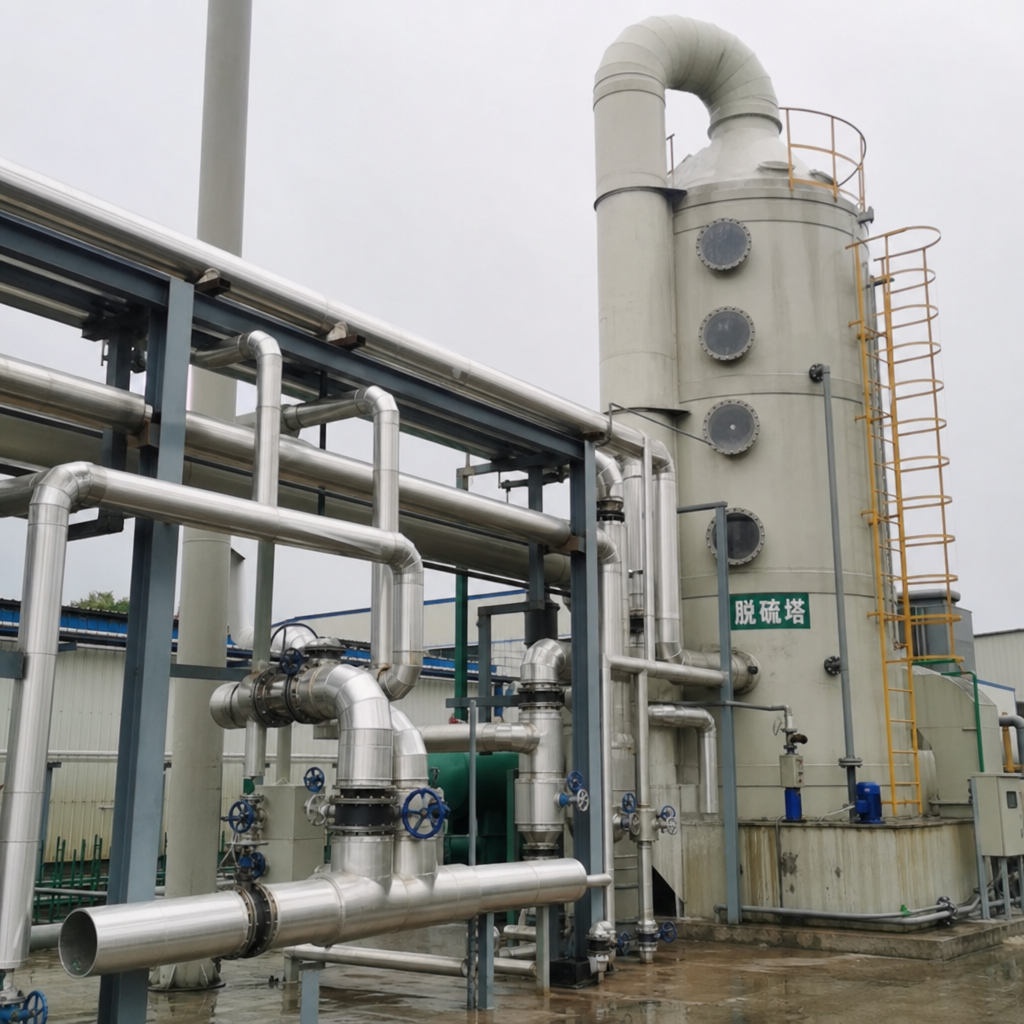
stainless steel pipe network connected to a wet desulfurization tower
The desulfurization tower environment is unusually aggressive
A desulfurization tower, especially in a wet flue gas desulfurization system, is not a simple water-handling application. The piping may carry limestone slurry, gypsum slurry, acidic condensate, process water, wash water, or chemically treated circulation liquid. These fluids can contain chlorides, sulfates, dissolved oxygen, suspended solids, and fluctuating pH levels.
The corrosion risk is intensified by how the system operates. Pipes may see continuous flow in one section and stagnant slurry in another. Shutdown periods can concentrate salts and create deposits. Localized corrosion can begin under scale, weld discoloration, crevices, gaskets, supports, or low-flow zones. A material that looks acceptable in clean water may fail much faster in tower slurry service.
The main damage mechanisms include:
- Pitting corrosion: Localized attack caused by chlorides and acidic conditions. It can create deep holes while the rest of the pipe surface appears intact.
- Crevice corrosion: Attack in shielded areas such as flange faces, gasket edges, threaded joints, pipe supports, deposits, and under slurry scale.
- Stress corrosion cracking: A risk for austenitic stainless steel when tensile stress, chlorides, and elevated temperature are present together.
- Erosion-corrosion: Accelerated wall loss caused by abrasive slurry particles, high velocity, turbulence, elbows, reducers, and pump discharge zones.
- Weld-related corrosion: Failure near heat-affected zones, poor passivation, excessive heat tint, or unsuitable filler metal.
- Under-deposit corrosion: Local chemistry under deposits becomes more aggressive than the bulk fluid, especially during shutdown or low-flow operation.
Because of these combined risks, pipe material properties must be judged as a system. Corrosion resistance matters, but so do strength, weldability, wall thickness, surface condition, velocity tolerance, maintenance access, and lifecycle cost.
Stainless steel pipe material selection starts with service conditions
Before comparing stainless steel grades, define the service. Many material failures happen because a grade was selected from a general corrosion chart instead of from the actual tower operating environment. A desulfurization tower has multiple piping zones, and each zone may need a different material.
Important design inputs include:
- Fluid type Identify whether the pipe handles limestone slurry, gypsum slurry, filtrate, absorber circulation liquid, acidic wastewater, clean process water, compressed air, or chemical dosing fluid. Slurry lines usually need stronger erosion resistance than clean water lines.
- Chloride concentration Chlorides are a major driver of pitting, crevice corrosion, and cracking. Higher chloride content generally pushes selection away from 304L and 316L toward 2205, 2507, 904L, 254SMO, lined steel, or nonmetallic materials.
- pH and acidity Acidic condensate and low-pH slurry can quickly reduce the safety margin of standard stainless steel. A pipe exposed to periodic acid washing may need a higher alloy than one used only for neutral process water.
- Temperatuur Corrosion and stress corrosion cracking risks usually increase as temperature rises. A grade that works at ambient conditions may not be adequate near hot flue gas contact zones or heated recirculation loops.
- Solids content and velocity Abrasive gypsum or limestone particles can remove protective films and increase erosion-corrosion. Elbows, tees, pump outlets, valves, and reducers need special attention.
- Oxygen and oxidizing conditions Stainless steel depends on a passive chromium oxide film. Oxidizing conditions can help maintain passivity, but they can also interact with chlorides and acidic solutions in complex ways.
- Fabrication and welding requirements Some grades are more sensitive to welding technique, heat input, filler selection, and post-weld cleaning. A theoretically superior material can fail if fabrication quality is poor.
- Inspeksie- en onderhoudstoegang If a pipe section is hard to inspect, buried, insulated, or located in a critical process area, a more conservative grade may be justified.
Key pipe material properties for desulfurization service
Die beste Toepassings van vlekvrye staal in desulfurization systems come from matching grade properties to failure modes. It is not enough to ask whether a pipe is “stainless.” Stainless steels behave very differently depending on chromium, nickel, molybdenum, nitrogen, and microstructure.
Korrosiebestandheid
Corrosion resistance is the first requirement because desulfurization liquid often contains chlorides and acidic compounds. Molybdenum improves resistance to pitting and crevice corrosion, which is why 316L generally performs better than 304L in chloride service. Duplex grades such as 2205 add higher chromium, useful molybdenum, and nitrogen, improving localized corrosion resistance compared with common 300-series stainless steels.
For severe environments, higher-alloy stainless steel grades may be required. 2507 super duplex and 254SMO provide stronger resistance to chloride pitting and crevice corrosion than 2205. 904L can be useful in certain acid-containing services, though it is not automatically better than duplex grades in every chloride slurry application.
Weerstand teen streskorrosiespleetvorming
Austenitic stainless steels such as 304L and 316L are vulnerable to chloride stress corrosion cracking under the wrong combination of temperature, tensile stress, and chloride exposure. Duplex stainless steels have a mixed austenite-ferrite microstructure, which gives them improved resistance to this type of cracking. That is one reason 2205 is frequently considered for wet FGD piping.
Stress corrosion cracking is especially concerning because it can develop with limited general wall loss. A pipe may look externally acceptable but contain cracks near welds, supports, bends, or stressed areas. In high-consequence systems, resistance to cracking can be just as important as resistance to uniform corrosion.
Mechanical strength
Duplex stainless steel generally has higher strength than common austenitic stainless steel. This can help with pressure design, vibration resistance, and mechanical durability. It may also allow optimized wall thickness in some designs, although wall thickness should never be reduced without proper engineering review.
Strength is useful in desulfurization tower piping because slurry systems experience pump vibration, pressure fluctuations, support loads, and abrasive flow. However, high strength does not eliminate corrosion risk. The pipe still needs proper alloy selection, suitable velocity, good weld quality, and reliable support design.
Erosion and abrasion tolerance
No stainless steel is immune to abrasive slurry. Limestone and gypsum particles can wear pipe walls, especially at changes in flow direction. Duplex stainless steel can offer useful mechanical durability, but elbows and pump discharge lines may still require thicker walls, long-radius fittings, replaceable spools, liners, or alternative materials.
When erosion removes the passive film faster than it can reform, corrosion accelerates. This is why velocity control matters. A material grade that performs well in stagnant laboratory conditions may behave differently in turbulent slurry.
Weldability and fabrication quality
Desulfurization tower piping often includes field welds, flanges, branches, nozzles, and complex routing. Weldability affects both construction quality and long-term reliability. 304L and 316L are generally easier to weld than duplex grades, but they may not provide enough corrosion resistance for demanding zones.
2205 duplex vlekvrye staal can be welded successfully, but it requires suitable filler, heat input control, interpass temperature control, and proper cleaning. Poor welding can disturb the phase balance or leave heat tint and surface contamination that become corrosion initiation sites. For severe service, fabrication quality should be treated as part of the material specification, not as a separate afterthought.
Grade comparison for common stainless steel options
A useful grade comparison should not simply rank materials from cheap to expensive. It should explain where each grade fits, where it becomes risky, and what practical trade-offs the buyer or engineer should expect.
304L stainless steel
304L is a common stainless steel grade with good general corrosion resistance in many clean or mildly corrosive environments. It is widely available and easy to fabricate. However, it has limited resistance to chloride pitting, crevice corrosion, and chloride stress corrosion cracking compared with molybdenum-bearing or duplex grades.
For desulfurization tower service, 304L is usually not the preferred choice for wet process piping exposed to chlorides, acidic slurry, or deposits. It may be considered for dry, clean, noncritical, or low-corrosion auxiliary systems, but it should not be selected simply because it is stainless steel. In wet FGD service, 304L often has too little corrosion margin.
316L stainless steel
316L contains molybdenum, giving it better chloride resistance than 304L. It is often used for moderately corrosive industrial piping, process water, and some chemical service. For mild desulfurization tower applications, such as lower-chloride wash water or less aggressive utility piping, 316L may be a practical choice.
Its limitation is that wet FGD conditions can be more severe than typical industrial water service. If chloride concentration is high, temperature is elevated, or deposits are expected, 316L may suffer pitting, crevice corrosion, or cracking. It is best treated as a mild-service option rather than the default grade for absorber slurry piping.
317L stainless steel
317L has higher molybdenum content than 316L, so it can provide improved pitting resistance in some chloride environments. It may be considered when 316L is not enough but the project does not require duplex or super-austenitic grades. Its low carbon content helps reduce sensitization risk during welding.
In modern pipe material selection, however, 317L often competes with 2205 duplex. 2205 may offer better strength and better chloride stress corrosion cracking resistance, while 317L may offer easier austenitic fabrication habits. The better choice depends on chemistry, temperature, availability, fabrication capability, and lifecycle cost.
2205 duplex stainless steel
2205 is often the strongest general recommendation for desulfurization tower stainless steel piping because it balances corrosion resistance, strength, and cost. It performs significantly better than 304L and 316L in many chloride-containing environments and has better resistance to chloride stress corrosion cracking. For many wet FGD systems, it provides the practical middle ground between standard austenitic stainless steel and premium high-alloy materials.
The main caution is fabrication control. Duplex stainless steel must be welded and heat-managed correctly to maintain its intended properties. It is also not a universal solution for extremely high chloride, very acidic, or highly abrasive conditions. Still, when someone asks which material grade of stainless steel pipe is most suitable for desulfurization tower service, 2205 is commonly the first grade to evaluate seriously.
2507 super duplex stainless steel
2507 super duplex provides higher corrosion resistance and strength than 2205. It is often considered for more severe chloride exposure, higher temperatures, or critical piping where failure would be costly. In aggressive absorber zones or high-chloride slurry loops, it can provide an added safety margin.
The trade-off is cost, availability, and stricter fabrication requirements. 2507 should not be specified casually for every pipe in a desulfurization system, because many areas may not need that level of alloy. It is best used selectively where the service severity justifies the upgrade.
904L and 254SMO stainless steel
904L is a high-nickel, high-molybdenum austenitic stainless steel often associated with acid resistance. It may be suitable for certain acidic, chloride-containing environments, depending on the exact chemistry. 254SMO is a super-austenitic stainless steel with very high resistance to pitting and crevice corrosion in chloride-rich service.
These grades can be strong options when standard austenitic or duplex materials are not enough. They may be considered for highly corrosive wet zones, chemical dosing areas, or process lines with difficult combinations of chloride and acidity. Their higher alloy content also means higher material cost, so they are usually selected for critical or severe-service sections rather than the entire piping network.
How should engineers choose between 316L, 2205, and 2507?
Engineers should choose between 316L, 2205, and 2507 by ranking the service from mild to severe and then adding a safety margin for deposits, shutdown concentration, welding, and inspection difficulty. In simple terms, 316L fits mild chloride service, 2205 fits many moderate to demanding desulfurization applications, and 2507 fits severe or high-consequence chloride service.
A practical selection path looks like this:
- Start with the process zone Identify whether the pipe is in clean water service, wash water service, slurry recirculation, wastewater, acid dosing, or tower drain service. Slurry and acidic condensate lines need more conservative selection than utility water lines.
- Check chloride and pH together Chloride concentration alone does not tell the full story. Chlorides become more damaging when combined with low pH, deposits, oxygen variation, and elevated temperature.
- Identify stagnant and crevice-prone areas Dead legs, flanged joints, gasketed connections, branch lines, and low points are more vulnerable than straight high-flow pipe. These areas may need a better grade than the main line.
- Review velocity and solids loading If erosion is significant, material grade alone may not solve the problem. Consider pipe routing, bend radius, replaceable wear sections, liners, or wall thickness adjustments.
- Match fabrication capability to the grade Do not choose duplex or super duplex unless the fabricator can weld, clean, inspect, and document it correctly. Poor fabrication can erase the benefit of a superior alloy.
- Consider lifecycle cost instead of purchase price only A cheaper pipe that requires shutdown, repair, or replacement may become more expensive than a higher-grade pipe installed correctly from the beginning.
This approach also helps prevent over-specification. Not every pipe needs 2507 or 254SMO. A mixed-material strategy is often more rational: use higher grades in the most aggressive sections and more economical grades in mild auxiliary systems.
Recommended material strategy by service severity
For a guide-level recommendation, the following non-table comparison can help structure early discussions. It is not a substitute for engineering verification, but it provides a clear starting point for stainless steel applications in desulfurization tower piping.
- Mild service: Consider 316L for low-chloride process water, mild wash water, noncritical drains, or areas with limited acidity and low deposit risk. Avoid using it in severe slurry service without confirmation.
- Moderate wet FGD service: Evaluate 2205 duplex vlekvrye staal as the primary option. It is often suitable for chloride-bearing wet piping where 316L lacks sufficient resistance, especially when stress corrosion cracking is a concern.
- Severe chloride or acidic service: Consider 2507 super duplex, 254SMO, 904L, or a lined/nonmetallic system. This category may include high-chloride recirculation lines, low-pH zones, stagnant slurry areas, and critical lines with difficult access.
- High-abrasion slurry service: Do not rely on stainless steel grade alone. Evaluate velocity, pipe wall thickness, elbow design, liner options, replaceable sections, and maintenance intervals.
- Chemical dosing or cleaning lines: Select based on the specific chemical, concentration, temperature, and exposure duration. Acid cleaning or oxidizing chemical service can require a different material than normal operating slurry.
Fabrication details can decide success or failure
A good grade can fail early if the pipe is fabricated poorly. This is especially important for duplex vlekvrye staal, where welding practice directly affects corrosion resistance and toughness. The material purchase specification should therefore include fabrication and inspection requirements, not just the grade name.
Key fabrication controls include:
- Use qualified welding procedures appropriate for the selected grade.
- Select filler metals compatible with the base material and service environment.
- Control heat input and interpass temperature, especially for duplex and super duplex grades.
- Remove heat tint, weld scale, iron contamination, and surface defects.
- Avoid crevices created by poor fit-up, rough internal surfaces, or unsuitable gasket design.
- Passivate or clean stainless steel surfaces when required by the project specification.
- Inspect welds, supports, and high-risk areas before commissioning.
Surface condition matters because stainless steel protects itself through a passive film. Iron contamination from carbon steel tools, grinding dust, or improper storage can create rust staining and corrosion initiation points. In desulfurization service, even small surface defects can become serious under deposits or acidic slurry.
Design practices that improve stainless steel pipe life
Material grade is only one part of a durable piping system. Good design reduces corrosion demand and allows the selected grade to perform as intended. In many cases, better geometry and maintenance access can extend pipe life as much as a material upgrade.
Useful design practices include:
- Minimize dead legs: Stagnant liquid concentrates salts and promotes under-deposit corrosion.
- Use smooth flow paths: Reduce turbulence at elbows, reducers, valves, and pump outlets where erosion-corrosion is likely.
- Specify proper drainage: Low points should not trap acidic slurry during shutdown.
- Avoid unnecessary crevices: Flanges, lap joints, threaded connections, and gasket overhangs can become corrosion sites.
- Protect dissimilar metal connections: Galvanic effects and contamination can occur when stainless steel contacts carbon steel or other metals in wet service.
- Allow inspection access: Critical welds, bends, and supports should be reachable for maintenance.
- Plan for replaceable wear sections: In high-erosion slurry lines, replaceable spool pieces may be more practical than expecting permanent service from any alloy.
The best corrosion-resistant pipes are chosen and installed as part of a system. If high-velocity slurry repeatedly strikes a short-radius elbow, even a premium alloy may suffer avoidable damage. If stagnant acidic liquid remains in a dead leg after shutdown, a grade that performs well in flowing service may corrode locally.
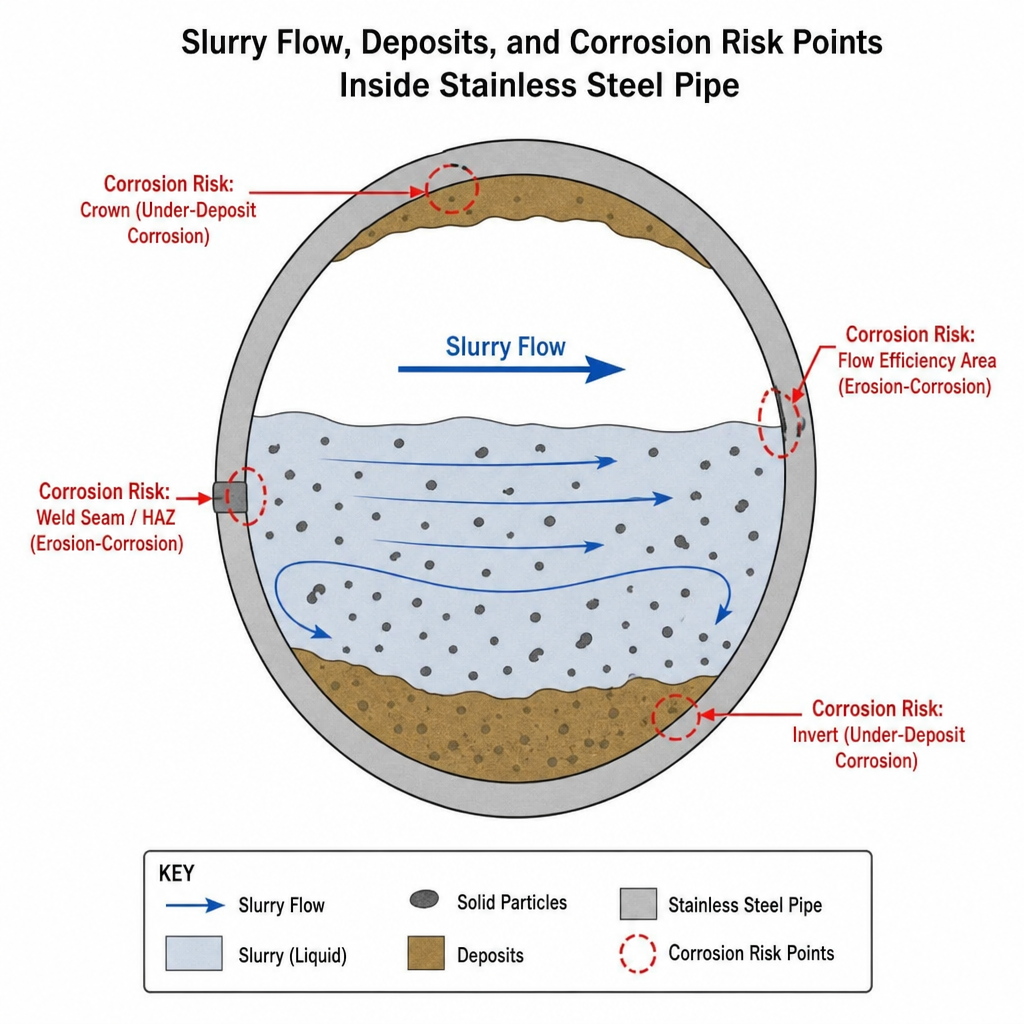
cross section diagram showing slurry flow, deposits, and corrosion risk points inside stainless steel pipe
Common mistakes in desulfurization pipe material selection
Several mistakes appear repeatedly in wet FGD and desulfurization tower projects. Avoiding them can save more money than negotiating a small reduction in pipe price.
One common mistake is selecting 304L or 316L because they are familiar stainless steel grades. Familiarity does not mean suitability. These grades can be excellent in many applications, but chloride-rich acidic slurry is not a mild environment.
Another mistake is asking for the “best” stainless steel without separating pipe zones. The absorber circulation line, wash water line, oxidation air pipe, drain pipe, wastewater pipe, and chemical dosing line may not need the same grade. A single-grade approach can either under-protect severe areas or overpay for mild areas.
A third mistake is ignoring deposits and shutdown conditions. Bulk liquid chemistry may appear acceptable, while the chemistry under scale or in low-flow areas becomes much more aggressive. Material selection should account for worst credible local conditions, not only average operating values.
Finally, some projects upgrade the alloy but neglect welding and surface cleaning. This creates a false sense of security. A high-grade stainless steel pipe with poor welds, heat tint, crevices, or iron contamination can fail earlier than expected.
Practical checklist before specifying stainless steel pipe
Use this checklist before finalizing a desulfurization tower piping specification:
- Confirm the exact fluid in each pipe section.
- Record chloride concentration, pH range, temperature range, and solids content.
- Identify normal, upset, cleaning, and shutdown conditions.
- Mark stagnant zones, dead legs, drains, and low-flow branches.
- Review slurry velocity and abrasion risk at elbows, tees, reducers, and pump outlets.
- Decide whether 316L, 2205, 2507, 904L, 254SMO, lined steel, or nonmetallic materials should be evaluated.
- Confirm welding procedures, filler metal, heat input limits, and inspection requirements.
- Specify surface cleaning, passivation, and contamination control where needed.
- Consider lifecycle cost, downtime risk, and ease of replacement.
- Require engineering review before reducing wall thickness based on higher material strength.
This checklist supports better grade comparison because it ties the material decision to real operating risks. It also helps purchasing teams avoid treating stainless steel pipe as a commodity item when the service is actually corrosion-critical.
Eindaanbeveling
For many desulfurization tower pipe systems, 2205 duplex stainless steel is the most suitable general-purpose stainless steel grade to evaluate first. It offers a strong balance of corrosion resistance, mechanical strength, chloride stress corrosion cracking resistance, and practical cost compared with standard 300-series stainless steels and premium high-alloy grades.
However, the final answer should be service-specific. Use 316L only for mild, lower-risk areas after confirming the chemistry. Use 2205 for many moderate to demanding wet FGD piping duties. Consider 2507, 254SMO, 904L, lined steel, or nonmetallic systems for severe chloride, low-pH, high-temperature, stagnant, abrasive, or high-consequence service.
The most reliable pipe material selection combines the right stainless steel grades with good design, qualified welding, clean fabrication, and realistic maintenance planning. In a desulfurization tower, corrosion resistance is not a single property on a datasheet; it is the result of matching material, process, fabrication, and operating discipline to one of the harshest environments in industrial piping.
 English
 Afrikaans
 Arabic
 Bengali
 Catalan
 Chinese
 French
 Dutch (Belgium)
 Dutch
Dutch German
 Czech
Czech Greek
Greek Hindi
Hindi Japanese
 Italian
 Portuguese
 Spanish (Chile)
 Spanish (Colombia)
 Spanish (Argentina)
 Persian
 Estonian
 Albanian
 Russian
 Spanish (Peru)
 Indonesian
 Thai
Thai Vietnamese
 Georgian
 Korean
 Nepali
 Polish
 Ukrainian
 Malayalam
 Xhosa
Xhosa